
Guide: How to Get Paid to Write for LWN.net (Step by Step)
This guide shows you, in clear steps, how to plan, research, write, and submit articles to LWN.net — even if you are new to professional writing but already interested in Linux and free/open-source software.
You will learn what LWN is, what kind of articles they want, how to use their official Author Guide, how to build a strong idea, how to research and structure a piece, and how you can later reuse that skill to earn with blogs, magazines, guest posts, or client content about Linux, DevOps, or open-source tools.
Section 1 · Understand the publication
What LWN.net actually is (and why it matters)
LWN.net (Linux Weekly News) is one of the oldest and most respected publications in the Linux and free/open-source software world. It focuses on deep, technically accurate coverage of:
- Linux kernel development and release cycles
- Distributions (Debian, Fedora, Ubuntu, etc.) and packaging
- Core tools (systemd, compilers, libraries, build systems)
- Security issues, licensing, and community governance
- New projects and trends in the broader FOSS ecosystem
Many developers, maintainers, and engineers at companies like Red Hat, Canonical, SUSE, and Google read LWN weekly. Your article is not “basic how-to Linux for total beginners”. It is more like: “careful explanation and commentary for people already working with Linux and FOSS.”
LWN content tends to fall into these broad categories:
- Kernel development reports — discussion of new features, mailing-list threads, and design debates.
- Distribution & infrastructure coverage — updates about Fedora, Debian, Ubuntu, SUSE, etc., and core system tools.
- Explainers & technical deep dives — e.g. how eBPF works, new filesystem features, memory-management concepts.
- Security and licensing pieces — vulnerabilities, project governance, licensing conflicts.
- Community & conference reports — summaries of talks and discussions at FOSDEM, Linux Plumbers, etc.
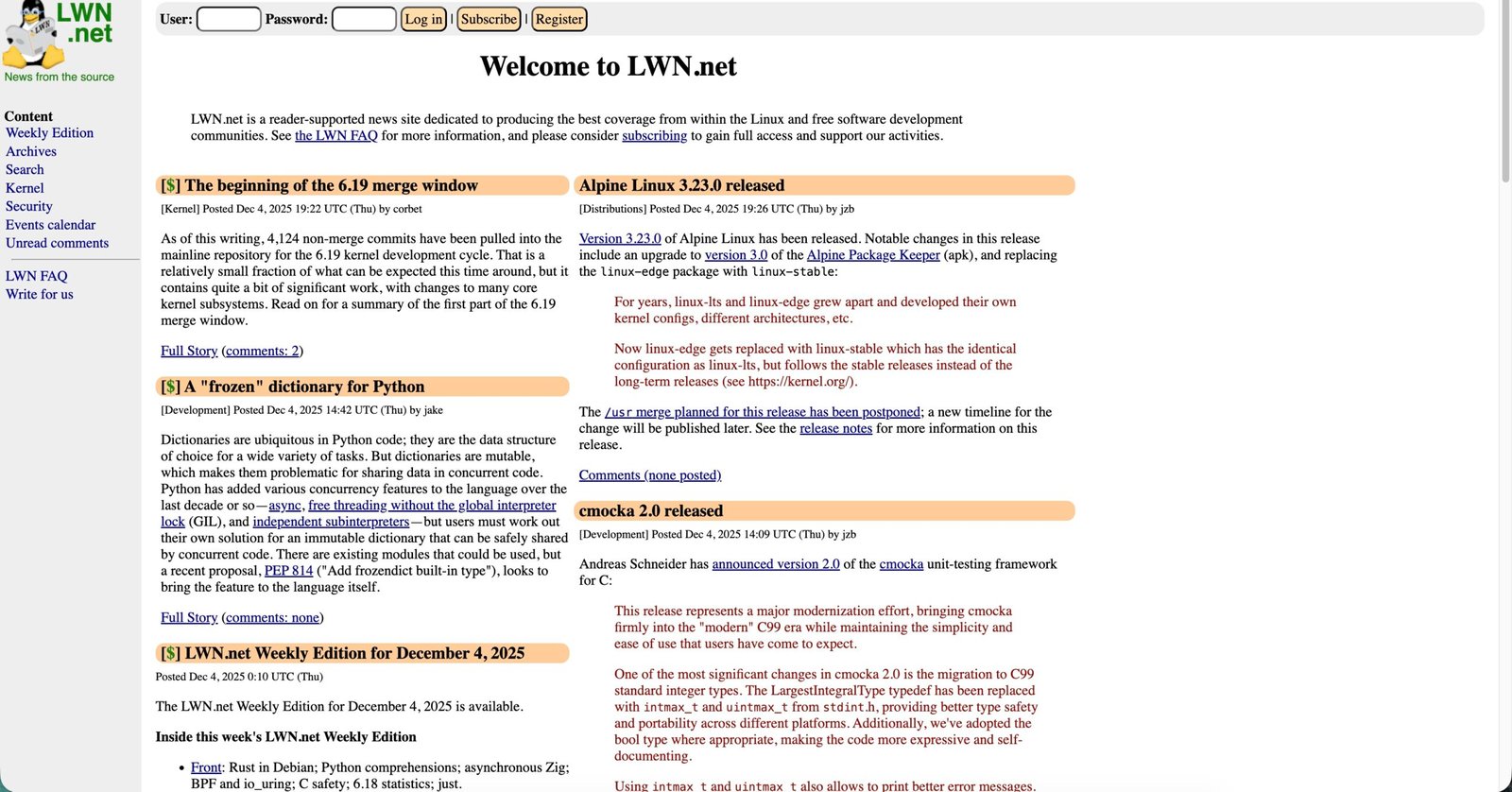
Browse a few front pages: current issue, Kernel page, Article index. Notice how each piece is carefully researched and heavily referenced.
The “typical” LWN reader is:
- A Linux user, developer, admin, or contributor with some hands-on experience.
- Comfortable reading technical discussions and kernel mailing-list excerpts.
- Interested in not just “how to”, but also “why the project works this way.”
When you write, aim slightly above basic tutorial level: assume the reader knows Linux fundamentals, but needs clarity, context, and synthesis. You are explaining, connecting, and summarizing.
| Article style | Example area | Typical depth | What LWN expects |
|---|---|---|---|
| News / report | Kernel, distributions, security | Shorter, very dense with facts & links | Accurate summary of events, with references to original sources |
| Technical explainer | eBPF, filesystems, systemd internals | Longer, conceptual + code snippets | Clear explanation of how a technology works and why it matters |
| Conference coverage | Linux Plumbers, FOSDEM, etc. | Session-by-session or topic-themed | Faithful reporting of talks, quotes, and implications |
| Opinion / commentary | Licensing debates, community issues | Carefully argued, balanced | Grounded in facts, not rants; includes multiple perspectives |
Section 2 · Know the rules
Learn LWN’s official author expectations
Before you think about pitching, read the LWN Author Guide. It explains, in LWN’s own words, how to write for them. You should follow that document first. This guide simply explains it in easier language and adds extra steps for beginners.
Your article must be original and well‑researched
The Author Guide stresses that LWN wants original work: no copy-paste from other sites, and no light rewrites. You’re expected to:
- Read mail threads, documentation, and upstream discussions.
- Link to primary sources whenever possible.
- Fact-check numbers, quotes, and historical details.
Write clearly for a technical audience
LWN asks authors to use clear, straightforward language. You do not need to “dumb things down”, but you must:
- Define unusual acronyms on first use.
- Explain kernel jargon and project-specific terms briefly.
- Avoid hype, buzzwords, and marketing language.
Credit people and projects fairly
LWN is careful about credit and community culture. From the guide:
- Use people’s correct names and project names.
- Link to mailing-list posts, commits, and documentation when you describe someone’s work.
- If you quote someone, link the original message and avoid changing meaning.
Section 3 · Pick your angle
Choose the right topic for LWN (and for you)
Even if you are a beginner writer, you can still write LWN-style content if you pick a topic you genuinely understand. Start from your real experience: what distributions you use, which kernel features interest you, or which open-source projects you follow.
- Your daily Linux use – interesting changes you notice in Fedora, Debian, Arch, etc.
- Mailing lists and release notes you already follow:
- Kernel release coverage at LWN
- Release announcements from your favorite distro
- Talks you watch from conferences like: FOSDEM, Linux Plumbers, or Linux Foundation events.
- Features you experiment with (e.g., Btrfs snapshots, systemd-boot, cgroups, containers on Linux desktop).
If you do not yet follow any of these, start now. The more you read, the easier it is to see a story worth writing.
LWN does not want “Linux is great” or “What is Btrfs?” at a basic level. Instead, pick an angle:
- “What a new memory-management change in Linux 6.x means for desktop users.”
- “How distribution X integrates systemd features for faster boot times.”
- “Lessons from a recent security incident in library Y, and how the community responded.”
You answer: “Why should serious Linux users care about this now?”
| Too vague for LWN | Closer to an LWN-style angle |
|---|---|
| “An introduction to Linux filesystems” | “Comparing ext4 and Btrfs snapshot behavior for desktop backup workflows” |
| “How to install Fedora” | “What Fedora 41’s new installer changes mean for server admins and desktops” |
| “What is systemd?” | “How systemd’s new unit feature X changes service isolation on modern distros” |
| “Using containers on Linux” | “A practical look at rootless containers with Podman and recent kernel changes” |
Section 4 · Research & structure
How to research and structure a professional LWN-style article
Think of your article as a small research project. One simple workflow you can reuse: R–O–D–P: Research → Outline → Draft → Polish. We will connect each step to the LWN Author Guide.
Collect primary sources & context
LWN expects you to be serious about sources. For most topics, you should collect:
- Mailing-list threads (e.g. LKML, distribution lists).
- Official documentation or man pages.
- Git commits, merge requests, or release notes.
- Existing LWN articles that relate to your topic.
Useful starting links: LWN kernel index, Example deep-dive article.
Create a small “research file” with each link, and 1–2 bullet points summarizing it in your own words.
Create a simple, logical outline
Your outline can follow this pattern (adapt it to your topic):
- Intro: 2–4 paragraphs giving background and why this matters.
- Section 1 – Background: what problem existed before, or what design is under discussion.
- Section 2 – The change or topic: what is being proposed, changed, or explored; who is involved.
- Section 3 – Technical details: key mechanisms or examples, with code or configuration if relevant.
- Section 4 – Reactions & implications: mailing-list debates, pros and cons, impact on users.
- Conclusion: likely next steps, open questions, or what to watch in future kernels/releases.
For guidance, look at the structure of any long article linked from the LWN Articles index.
Write a first draft in simple, precise English
While drafting, apply the Author Guide’s style ideas:
- Write shorter paragraphs than you think you need.
- Introduce technical terms before using them heavily.
- Include links directly in the text near the statement they support.
If English is not your first language, focus on being correct and clear rather than “fancy”. Editors prefer simple, accurate language over complicated phrasing.
Check facts, links, and tone
Before you send anything to LWN (or any editor), do at least one careful pass:
- Confirm every URL works and points to the correct resource.
- Re-check version numbers, dates, and people’s names.
- Look for any strong claims; add a citation or soften the wording.
- Compare again with the Author Guide to see if you’ve missed a style rule.
This is also a good time to run a spell checker and read the article out loud.
Section 5 · From draft to LWN
Writing, editing, and submitting your LWN article
LWN’s Author Guide explains the submitting process and formatting details. They prefer plain-text submissions with simple markup, and they advise talking to the editors before you invest huge time in a long piece that may not fit. Here is a safe path for beginners.
As recommended by the Author Guide, you can email LWN to discuss ideas before sending a full article. In that message:
- Introduce yourself in 2–3 lines (what you do, your Linux background).
- Describe your proposed topic and why it’s timely.
- Add a short outline (3–6 bullet points).
- Optionally link to 1–2 good technical articles or blog posts you’ve written.
This saves time: they can tell you if the topic fits or suggest changes.
LWN uses its own simple markup and prefers plain text. From the guide, note things like:
- How to mark headings and subsections.
- How to format code blocks and command lines.
- How to include links and references at the right places.
See: Author Guide – Formatting requirements. Follow that exactly; it makes editing and publishing easier.
| Stage | Your task | What helps the editor |
|---|---|---|
| Idea email | Short description + outline | Shows you understand LWN’s focus and audience |
| First draft | Full article in LWN format | Clear structure, good sources, minimal style fixes needed |
| Revisions | Implement editor feedback | Fast, polite communication and precise changes |
| Publication | Share and archive | Promote on your channels; keep link as portfolio proof |
Section 6 · Money & rights
How you get paid, and how LWN bylines help your career
LWN pays contributors for accepted articles. Exact rates can vary by article type and complexity. They may also have policies about rights (for example, whether the article must first appear on LWN, and when you can republish it elsewhere). You should confirm details with the editors by email.
- Cash payment per article (amount agreed in advance with editors).
- High-quality editing that improves your technical writing.
- Visibility in front of serious Linux professionals and maintainers.
- A strong portfolio piece you can show to clients, recruiters, or other editors.
One well-researched LWN article can open doors to job interviews, paid documentation work, or recurring writing opportunities.
Treat each LWN piece as an asset with long-term value:
- It builds your reputation in a niche (e.g., kernel, storage, containers).
- You can reference it when applying for technical writing or devrel roles.
- You can expand it into talks, webinars, or more detailed whitepapers.
Over a few years, a small set of LWN-level articles can form the core of a Linux-focused writing or consulting career.
| Result | Short-term benefit | Long-term benefit |
|---|---|---|
| One accepted LWN article | Payment + byline | Credibility as a Linux/FOSS expert |
| Several related LWN articles | Regular side income | Authority in a specific domain (e.g., containers, storage, security) |
| LWN + own blog + guest posts | Diversified income | Platform to sell courses, consulting, or premium content later |
Section 7 · Beyond LWN
Use LWN-style skills to earn with blogs, clients, and guest posts
Once you learn to write at LWN’s level — deep research, accurate sources, clear structure — you can apply that skill almost anywhere in tech. Here is how to turn it into more income from writing.
- Publish summaries of your research that are more beginner friendly than LWN pieces.
- Link out to your LWN articles as “advanced reading”.
- Use your blog to experiment with: tutorial-style posts, project writeups, and tool reviews.
Over time, this can attract consulting clients, job offers, or sponsorships.
- Many infrastructure and devtools companies run engineering blogs that want Linux-focused content.
- Your LWN credit proves you can handle technical topics accurately.
- You can pitch similar deep articles (adjusted for their audience) and charge per article or per project.
Combine LWN bylines with a GitHub portfolio or GitLab account to show you both write and code.
| Platform | What you can publish | How it connects to LWN-style work |
|---|---|---|
| Your own site (Hugo, Jekyll, WordPress) | Guides, install notes, “friendly” explainers | Reuse research and simplify for a broader audience |
| Company engineering blogs | Case studies, performance work, incident reports | Show your LWN article as proof of reliability and depth |
| Community-driven magazines | Essays on open-source culture, project histories | Adapt LWN-like research into less formal, narrative pieces |
Section 8 · Checklist & FAQ
Final checklist before you pitch LWN + beginner FAQ
Use this mini “SOP” every time you think about writing for LWN, and later for other serious technical outlets.
- Week 1: Read the Author Guide and 5–10 LWN articles in topics you like.
- Week 2: Pick one narrow Linux topic and write a deep post on your own blog (with sources).
- Week 3: Repeat with a second article, improving your structure and citation habit.
- Week 4: Choose a serious, LWN-style angle, prepare an outline, and draft a short idea email to the editors.
- LWN Author Guide – official instructions for writers
- LWN.net front page – browse current Linux & kernel coverage
- LWN Kernel page – focused kernel development news
- LWN Articles index – browse by topic and date
- FOSDEM – conference where many LWN-covered topics appear as talks
- Linux Plumbers Conference – deep technical sessions about Linux plumbing
- Dev.to – good place to practice Linux and open-source blogging before pitching LWN
- Opensource.com (archived content) – examples of approachable FOSS stories