


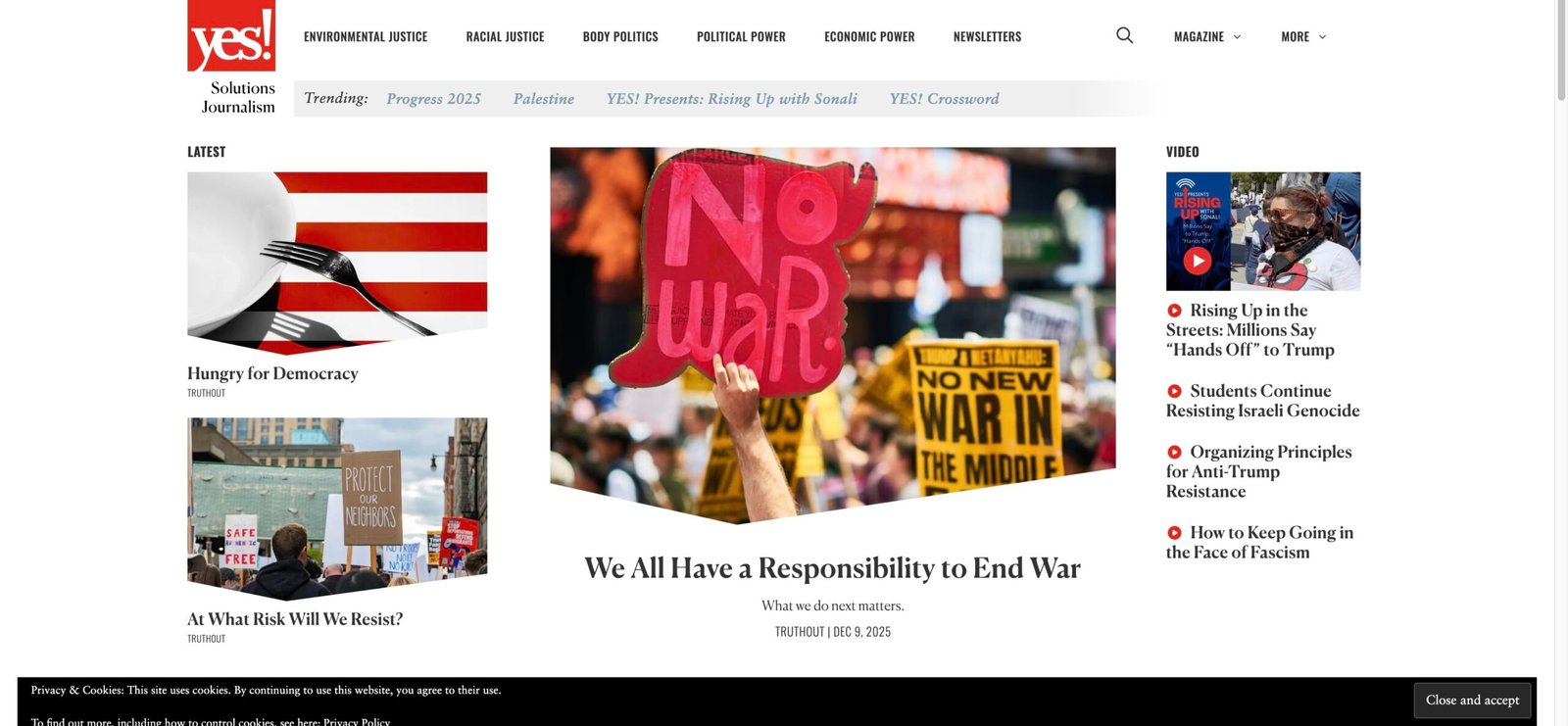
Guide: How to Write & Earn Money with Yes! Magazine
This guide breaks down exactly how to research, plan, and pitch stories to Yes! Magazine. Unlike standard blogs, Yes! focuses on Solutions Journalism—stories about how people are fixing the world’s problems.
You will learn their core beats (Environment, Economy, Social Justice), how to craft a pitch that editors love, and the mistakes beginners make that get them rejected.
Section 1 · The Core Concept
What Yes! Magazine Actually Wants
The biggest mistake beginners make is sending “opinion pieces” or “rant pieces.” Yes! Magazine is strictly dedicated to Solutions Journalism. This means your article must analyze a response to a social problem.
- Breaking News: “The President signed a bill today.” (Too slow/late).
- Pure Advocacy: “Why we should all care about trees.” (Too vague).
- Doom-scrolling: “The economy is collapsing and it’s hopeless.” (Not a solution).
- Community Solutions: “How a neighborhood in Detroit built their own internet ISP.”
- Systemic Shifts: “The city replacing police with mental health responders—and the data on if it works.”
- Evidence-based Hope: Stories backed by data or rigorous reporting.
Section 2 · The Beats
Where Does Your Story Fit?
Yes! organizes content into specific verticals. Pitching to the wrong section usually results in silence. Research these categories on their website first.
| Section | What they cover | Example Topic |
|---|---|---|
| Social Justice | Human rights, racial justice, housing, indigenous rights. | “How Tenancy Unions are stopping evictions in NYC.” |
| Environment | Climate resilience, food systems, conservation. | “Regenerative farming methods that saved a drought-struck county.” |
| Health & Happiness | Mental health, community well-being, body positivity. | “Why ‘Social Prescribing’ is replacing pills in UK clinics.” |
| Economy | Cooperatives, inequality, labor rights, new economics. | “The rise of worker-owned tech cooperatives.” |
| Democracy | Voting rights, civic engagement, government reform. | “How Rank-Choice voting changed the outcome in Alaska.” |
Section 3 · Preparation
Do This Before You Email an Editor
Read 3 Recent Articles
Go to the section you want to write for. Read the last three “Features” (long articles). Notice:
- Do they use “I” (first person) or just report facts?
- How many people did they interview? (Usually 2-3 experts).
- How does the headline look?
Check the Archives
Use the search bar on YesMagazine.org. If you want to write about “Urban Gardening,” check if they published that story last month. If they did, you need a new angle (e.g., “Urban gardening specifically for flood prevention”).
Section 4 · The Pitch
Step-by-Step Pitching Workflow
Do not send a full completed article. Professional writers send a Pitch (a query email). Here is the structure Yes! Magazine expects.
Write a compelling Subject Line
Editors get hundreds of emails. Be specific.
Bad: Submission for website.
Good: PITCH: How a Vermont town reached 100% renewable energy using old dams.
Structure the Email Body
- Paragraph 1 (The Lede): Start the story as if you were writing the article. Grab their attention immediately with a character or a stat.
- Paragraph 2 (The Nut Graph): Explain why this matters now. What is the solution being tested? What is the evidence?
- Paragraph 3 (The Plan): Who will you interview? Do you have access to the location?
Your Credibility
Keep it short. “I am a freelance journalist based in [Location]. My work has appeared in [Outlet A] and [Outlet B]. I have a background in [Topic].”
Beginner Tip: If you don’t have big bylines, highlight your expertise. “I have worked in renewable energy for 5 years.”
Send to the Right Email
According to their guidelines (always verify on the site), send pitches to submissions@yesmagazine.org.
Section 5 · The Business Side
Payment, Rights, and Expectations
Yes! Magazine is known to pay professional rates, though they change over time.
- Reported Features: Generally the highest paid. Can range from $0.30 to $0.50+ per word (estimate), or flat fees of $300–$500+ depending on complexity.
- Op-Eds/Essays: Often a lower flat fee.
- Online vs. Print: Print stories are harder to get into but often pay more than web-only exclusives.
Usually, they ask for:
- First North American Serial Rights: They get to publish it first.
- Exclusivity: You cannot publish the same story on your blog or Medium until after they publish it (and usually a waiting period after).
- Creative Commons: Yes! often allows their work to be republished under Creative Commons after a period. Check your contract.
Section 6 · Troubleshooting
Why Pitches Get Rejected
If you don’t hear back within 2-4 weeks, it might be one of these reasons:
1. “Hero Worship”
Writing a story that just says “Look how great this one person is” without analyzing how their solution works or if it can be replicated elsewhere.
2. No Tension / No Story
A good article has a narrative arc. It discusses the challenges. If everything is perfect and easy, it’s not journalism, it’s PR.
3. Too Broad
Pitching “Climate Change” is impossible. Pitching “How Oyster Reefs are saving the Manhattan Coastline” is a story.