


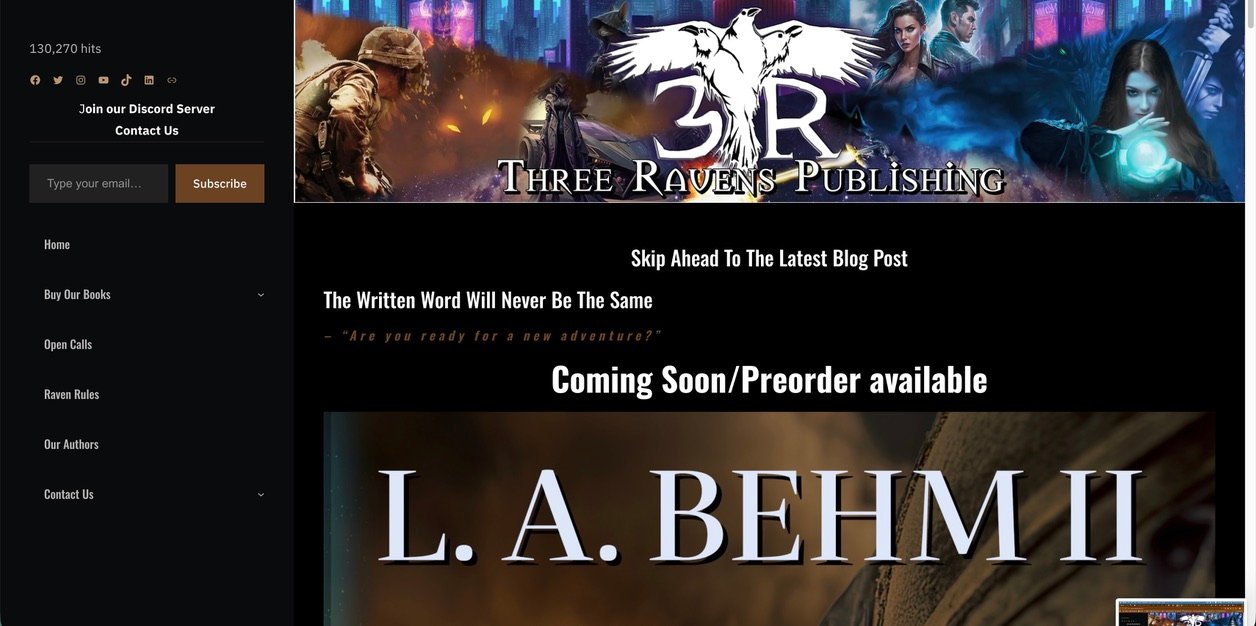
Guide: How to Submit to Three Ravens Publishing (Step by Step) — and Earn Money From Your Writing
This is a beginner-friendly guide to help you learn how Three Ravens Publishing works, how to choose a submission that actually fits, how to format your manuscript, and how to send a clean submission using their official pages. You will also learn the “money reality” of small press publishing (mostly royalties) and how to turn one accepted story into multiple income paths: more anthology credits, paid guest posts, speaking invites, freelancing, and a stronger author brand.
You can read this like a mini-course. It is written in simple English, with checklists, templates, and many links. It is designed for beginners, but it does not talk down to you. If you do the steps in order, you will end with a complete submission package you can send when the right call is open.
Important: publishing rules can change. Always trust the publisher’s latest pages: Home, Submission Guidelines, Open Calls, and Contact Us.
Section 1 · Understand the publisher
What Three Ravens Publishing is — and what “earning money” really means here
Three Ravens Publishing is a publisher, not a magazine. That changes how you earn money. In magazines, you often earn a one-time “article fee.” In a publisher relationship, you usually earn through royalties (a share of sales), and you earn over time as your book or story stays available.
That is good news if you think long-term. One strong story can become: a publication credit (social proof), a series entry, a gateway to anthologies, and a platform builder. But it also means you have to be patient and professional. Publishing has timelines, editing cycles, and contracts. If you want fast cash, you can still build it — but your fastest cash will usually come from guest posts, freelancing, and services (we cover that in Section 10).
From the site structure and categories, Three Ravens Publishing is strongly oriented toward genre fiction and especially speculative fiction and adjacent genres. You will frequently see items and categories like:
- Anthologies (the easiest entry point for beginners)
- Fantasy, Horror, and blend genres (like fantasy-horror)
- Series/Universes (shared worlds and recurring lines)
- Comedy, action-adventure, and niche sub-genres (depending on the current projects)
Your job is not to guess. Your job is to read their current calls and match your story to a specific project. Start here: Open Calls, then browse Anthology posts, and then explore their universe/series pages if you want to write inside an existing world.
Most authors earn money through a stack, not one single thing. With a small press, the most common income stack is:
- Royalties from book/anthology sales (long-term)
- New opportunities because your byline is “approved” by a publisher
- Guest posts and paid articles on other sites because you have a credible credit
- Services (editing, coaching, workshops) after you prove expertise
- Community-driven sales (events, bundles, newsletters, conventions)
Think of Three Ravens Publishing as a “credibility amplifier.” It is not only about the money from one story; it is about unlocking better opportunities.
| Goal you want | Best writing path | What to submit to Three Ravens | What you do in parallel |
|---|---|---|---|
| First publication credit | Short fiction | Anthology open calls | Write 3 “sample stories” on your own blog |
| Long-term royalties | Novella/novel | Only when submissions are open | Build mailing list and reader funnel |
| Fast cash | Paid guest posts | (Not the main purpose of a publisher) | Pitch magazines + do freelance writing |
| Author brand | Series + consistent public writing | Series universes + anthologies | Weekly blog + newsletter + social proof |
Section 2 · Fit your submission
Fit check: what you should submit, what to avoid, and how to choose your best entry path
Beginners often lose submissions for one boring reason: they submit the wrong thing. Not “bad writing.” Just the wrong format, wrong genre, wrong length, or wrong process. So we start with fit.
First, open the official pages: Manuscript Submission Guidelines and Open Calls. You will see calls for specific anthologies and announcements for what is currently open.
Publishing is not “send anything you wrote.” It is “send the thing they asked for.”
Your best beginner move is to submit to a specific open call (usually short fiction). Open calls exist because the publisher wants a particular kind of story for a specific book. That means if you meet the call perfectly, you have a clear reason to be accepted.
If you submit a random novel when they are not looking for unsolicited novels, you will likely get rejected quickly, or your submission will be ignored. So always read the top notes on the guidelines page.
The best “first win” is an anthology story (short fiction)
Anthologies help beginners because:
- Shorter length = easier to finish and polish.
- You can target a theme (very clear fit).
- You earn a publication credit and you can link to it forever.
- You can build multiple credits quickly by submitting to multiple calls (ethically).
Start browsing: Anthology category, and also scan tags like submissions, short story, and the “Open Call” pages when available: open call tag.
For novels: follow the top note (and wait if they are closed)
Sometimes publishers close unsolicited submissions because they have too many manuscripts to review. If the guidelines page says they are closed to unsolicited novels, do not fight it. Use the time to:
- Write and polish your novel anyway (be ready for when they reopen).
- Build credits through anthologies.
- Write on your blog (build your platform).
- Pitch paid articles elsewhere (build income now).
This is not “wasted time.” It is strategic preparation.
Common submission mistakes that kill your chances
- Ignoring the exact theme, word count, or format listed in the open call.
- Sending a “link to a Google Doc” instead of an attached manuscript (many publishers dislike links).
- Submitting an unfinished draft (first draft is not submission-ready).
- Writing a story that is mostly explanation and not story (too much “message” and not enough plot).
- Submitting fanfiction or IP you do not own (unless a call explicitly asks for it).
- Using AI-generated prose as your main text (risk: rights issues, style problems, and trust loss).
You can avoid 80% of rejections by being careful with these basics.
Section 3 · Research before you write
Research sprint: learn their taste fast using only the website (60 minutes)
You do not need secret information. You need pattern recognition. Publishers show you what they like by what they promote, what they talk about, and what they repeatedly publish. So do a simple research sprint. Open multiple tabs and take notes. This is the fastest way to stop guessing.
- Open the site: Home. Scroll the front page. Note recurring topics and series names.
- Open: Anthology and read 3–5 posts. Write down what themes they like.
- Open: submissions tag and scan headlines for submission deadlines, word counts, and required formats.
- Open: Award Winning Fiction. This shows what they consider their best work (taste signal).
- Open: Our Imprints and Our Authors. Make a “who writes here?” list and the vibe.
- Optional: open their archive pages and scan older open calls to learn the house style: June 2025 archive, April 2021 archive, and older categories like Series.
This research sprint should produce one output: a single sentence that describes the “Three Ravens vibe” as you see it. Example: “They like fast-moving genre stories, strong hooks, and entertaining concepts that match specific open calls.” (Your sentence may differ. Use what you actually see on the site.)
While researching, build a Fit Map with four columns:
- Project (open call or series name)
- Genre vibe (horror, fantasy, military, comedy, etc.)
- Rules (word count, theme, format, deadline)
- Your story idea (one-sentence pitch)
This Fit Map is your decision engine. It stops you from writing the wrong story. It also lets you create multiple story ideas quickly, then pick the best one.
If you see recurring anthologies (for example, long-running series), add them to your Fit Map even if they are not open now. That becomes your future submission plan.
| What you see on the site | What it signals | What you should do | Helpful link |
|---|---|---|---|
| Many anthology posts + open calls | Short fiction is a core lane | Start with a short story submission | Anthology |
| Series/universe labels | Shared worlds matter | Learn rules of the universe before writing inside it | Imprints |
| “Submission guidelines” link in nav | They care about process | Follow the guidelines like a checklist | Guidelines |
| Affiliate/sponsor section | Community + partners | Look for tools/resources they recommend | Affiliates |
Section 4 · Writing the story
Write the story: beginner-friendly craft that fits open calls and sells to readers
Most open calls want one thing: a story that entertains the reader and matches the theme. Beginners sometimes overthink it. You do not need a complicated plot. You need clarity, momentum, and payoff.
Use this simple formula: Hook → Promise → Escalation → Choice → Consequence → Ending. You can build almost any genre story from this. Below are three practical “mini frameworks” you can use for anthology submissions.
The 5-Scene Short Story (easy and strong)
- Scene 1 — Hook: show the unusual thing immediately (monster, magic, mission, discovery).
- Scene 2 — Goal: what does the character want and why now?
- Scene 3 — Complication: the plan fails or a truth changes the mission.
- Scene 4 — Choice: character makes a costly decision (this is the “heart” of the story).
- Scene 5 — Payoff: consequence + emotional ending (funny, scary, satisfying, or bittersweet).
This framework works for horror, fantasy, action, and comedy. It is also easy to outline in 10 minutes.
The “Theme Lens” (how to hit an open call perfectly)
Many open calls have a theme (for example: “trailer park horror,” “military fantasy,” “weird comedy,” “dark but hopeful”). Use a theme lens so every part of your story supports the call:
- Setting: does the setting naturally create theme moments?
- Character: does the character belong in this theme world?
- Problem: is the conflict “on brand”?
- Language: does your voice match the vibe (serious, playful, gritty, etc.)?
- Ending: does the ending deliver the “feeling” promised by the call?
When you revise, check each paragraph against the theme lens. If a paragraph does not support the theme or plot, cut it.
The “Reader Contract” (how to keep momentum)
Readers continue when they feel a contract: “I know what story I’m in, and I want to see what happens.” To build that contract:
- Give the reader a clear genre signal in the first page (fear, wonder, humor, action).
- Give the reader a clear question (Will she survive? Will the spell work? Who is the killer?).
- Raise the stakes every 600–900 words in short fiction (or every “scene”).
- End scenes with a small push-forward (a discovery, a decision, a danger).
If you do these four things, your story feels professional even if the plot is simple.
Do not submit your first draft. Use a 3-pass revision:
- Pass 1 — Structure: Does the story make sense? Does each scene change something?
- Pass 2 — Clarity: Can a reader visualize what is happening? Are pronouns clear? Are actions logical?
- Pass 3 — Line edit: Remove filler words. Tighten sentences. Fix grammar. Add a little voice.
Print your story or read it on a different device for Pass 3. Your brain catches mistakes better when the format changes.
Publishers see hundreds of “generic” stories. The easiest way to stand out is to be specific:
- Use one vivid sensory detail per paragraph (sound, smell, texture).
- Give characters one surprising habit (a ritual, a fear, a joke).
- Use concrete verbs (“slam,” “stumble,” “glide”) not weak verbs (“was,” “went”).
- Use one local detail that makes the world feel real (a sign, a tool, a slang word).
You do not need purple prose. You need clear, sharp detail.
Section 5 · Manuscript preparation
Manuscript prep: formatting, file naming, and the “clean submission” standard
Editors read faster when manuscripts are consistent. That is why publishers ask for a standard format. The easiest way to get rejected is to send a messy file: weird fonts, strange spacing, missing contact info, or confusing file names.
Always read the official page first: Manuscript Submission Guidelines. If you are submitting to an open call, read the open call post too, because open calls sometimes add extra rules.
If the open call gives no special formatting beyond “standard manuscript format,” this baseline is usually safe:
- Font: Times New Roman or another readable serif, 12 pt.
- Spacing: double-spaced body text (not single).
- Paragraphs: indent paragraphs (or use a consistent style), do not add extra blank lines every paragraph.
- Margins: use what the guidelines request; if not specified, 1 inch is standard. If specified, follow theirs.
- Header: story title + author last name (and page number if requested).
- Title page: title, pen name, legal name (if requested), email, and word count.
- File type: use the file type they request (often .doc/.docx or .rtf).
Do not assume. If the Three Ravens guidelines specify margin size or any special requirement, follow that exactly.
Editors handle many files. You can make their life easier with clean names. Use a consistent pattern like:
LastName_Title_OpenCallOrProject_YYYY-MM-DD.docxExamples:
- Patel_TrailerParkMoonshine_ItCameFromTheTrailerPark_2025-06-20.docx
- Sharma_TheRavenDeal_MisfitsOfMagic_2025-01-12.docx
Keep it boring. Boring is good. Boring is professional.
Now let’s get practical. Below is a beginner-friendly “how to format” walkthrough you can do in Microsoft Word or Google Docs. You are aiming for a file that looks like it belongs in an editor’s workflow.
Word / Google Docs: 10-minute formatting checklist
- Set font to 12 pt readable font (Times New Roman is common).
- Set line spacing to double (2.0). Also check “Before/After” spacing is 0.
- Set margins to what the guidelines request.
- Turn on page numbers if requested; otherwise keep layout clean.
- Use a single space after periods (modern standard).
- Use italics for emphasis; avoid underlines (unless a call requests it).
- Use a clear title at the start; include your author name in the header if requested.
- Run spellcheck, then do one slow manual read.
- Export/Save as .docx or the required format; do not submit a “random PDF” unless requested.
- Open the final file and scroll it: make sure it looks normal.
“No friction” rule (editors love this)
The “no friction” rule is simple: your submission should create zero extra work to understand. That means:
- Your email subject line is clear and matches the call.
- Your attachment opens correctly, with the right name.
- Your cover letter includes the basics (title, word count, theme fit, short bio).
- You follow every instruction (even if it seems small).
You cannot control editor taste. But you can control friction. Reduce friction to near zero.
Section 6 · Submission package
Submission package: cover letter, author bio, synopsis, and metadata (templates included)
Your story is the main thing, but your package is how the editor understands the story quickly. A good package is short, clear, and complete. A bad package is long, emotional, and confusing.
Use this rule: cover letter = identity + fit + proof. That’s it. Do not write your life story. Do not apologize. Do not beg. Be calm, professional, and specific.
- Greeting (generic is fine if no editor name is given).
- Submission line: title + word count + category (short story/novella/etc.).
- Fit line: one sentence about how it matches the open call theme.
- Logline: one to two sentences describing the story hook.
- Bio: 2–4 lines (relevant credits, location, expertise, or fun fact).
- Rights note (if requested): “This is unpublished and not under consideration elsewhere” or your truthful status.
- Thanks + signature: name + email + optional website.
Your cover letter should usually be 120–220 words. Shorter is fine. The editor should understand your story in 20 seconds.
Metadata is the small information that makes your submission easy to process. Keep it neat:
- Title (final)
- Word count (exact or rounded as requested)
- Genre/subgenre (as the call asks)
- Theme fit (one sentence)
- Content notes (if there are heavy triggers; be respectful, not dramatic)
- Author name (pen + legal if requested)
- Contact (email)
Some calls request a short synopsis. If they do, keep it clear and spoiler-friendly (synopsis can spoil). If they do not request it, do not attach a long synopsis “just in case.”
Below are copy-and-paste templates you can use. Customize them. Do not send them unchanged. Editors can feel “template spam.” Make it yours, but keep the structure.
Cover letter template (short fiction open call)
                Subject: [OPEN CALL NAME] Submission – “[STORY TITLE]” – [WORD COUNT] words


                Hello Three Ravens Publishing Team,


                Please consider my short story, “[STORY TITLE]” ([WORD COUNT] words), for your [OPEN CALL / ANTHOLOGY NAME].


                Fit: This story matches the theme because [ONE SENTENCE THEME FIT].

                Logline: [1–2 sentences: main character + problem + twist/stakes].


                Bio: [2–4 lines. Example: I’m a writer from [CITY/COUNTRY]. My work has appeared in [CREDIT] (if any). I love writing [GENRE]. Optional: relevant experience].


                Rights: This story is [unpublished / previously published – if allowed] and [not under consideration elsewhere / simultaneous submission – only if allowed].


                Thank you for your time and consideration.


                Sincerely,

                [Your Name / Pen Name]

                [Email]

                [Optional website or social link]
One-paragraph synopsis template (if requested)
                “[STORY TITLE]” follows [CHARACTER] who [GOAL] in a world where [SETTING RULE].

                When [INCITING INCIDENT], they must [MAIN ACTION] but [COMPLICATION].

                In the climax, [KEY CHOICE], leading to [ENDING / CONSEQUENCE].
A synopsis is not marketing copy. It is clarity. It can include spoilers if the editor needs them.
Author bio template (good for beginners)
                [PEN NAME] is a [CITY/COUNTRY]-based writer of [GENRE].

                They are drawn to stories about [THEME], especially when [TONE: funny, dark, hopeful, action-heavy].

                When not writing, they [ONE HUMAN DETAIL].

                (Optional credits: Their work has appeared in [CREDIT], or they are currently building their first publications.)
Section 7 · Submission workflow
How to submit: email/form habits that make editors trust you
When you submit, your goal is to make the editor’s job easy. Think like an editor: they are tracking many submissions, building a table of contents, matching themes, and planning production. If you are easy to work with, you rise in value.
Submission methods vary. Some calls use a form, some use email, some use a specific subject line. So you always start here: Submission Guidelines. For open calls, read the specific call post on Open Calls.
Decide which lane you are in: open call vs. general submissions
If an open call exists that fits your story, use that. Open calls are time-limited and themed, so your submission will be read in the right context. General submissions are typically slower and more competitive.
If the guidelines say unsolicited novels are closed, then “general submissions” is not your lane right now. Focus on anthologies and short fiction calls instead.
Build a “submission folder” (one place, no panic)
Create a folder on your computer called: ThreeRavens_Submissions. Inside it, create:
- 01_Manuscripts (your formatted .docx files)
- 02_CoverLetters (one cover letter per submission)
- 03_Bios (bio variations)
- 04_Proof (a checklist file and your revision notes)
Beginners feel stressed because files are scattered. A submission folder reduces stress and mistakes.
Use a professional email subject line
Your subject line should make it obvious what your submission is. A safe pattern:
OPEN CALL NAME – Submission – "Story Title" – WordCountIf the open call specifies a different pattern, use theirs. Exact compliance beats creativity.
Attach your manuscript correctly (no links unless requested)
Many publishers prefer attachments because: links can break, permissions can block access, and it slows review. Unless the call asks for a link, attach the file and keep it clean. Name it clearly (Section 5).
Before you hit send: open your attachment and scroll the first page. Make sure the title, author info, and formatting are correct.
Send, log, and move on (professional behavior)
After you submit, log it in a simple tracker (spreadsheet or notebook):
- Date submitted
- Project name
- Story title
- Word count
- Status (submitted / pending / accepted / rejected)
- Notes (special requirements)
Then move on to your next story. Professionals always have multiple submissions in the pipeline (as long as they respect exclusivity rules).
Follow-up etiquette (simple and polite)
Do not follow up too early. Publishing timelines can be long. If the guidelines or open call gives a response window, follow that. If not, wait at least 8–12 weeks for short fiction and longer for larger projects. When you do follow up, keep it short:
                Hello, I’m checking on the status of my submission “[TITLE]” (submitted on [DATE]) for [PROJECT].

                Thank you for your time.

                – [Name]
Section 8 · After you submit
After submission: timelines, edits, contracts, and what to do while waiting
Many beginners quit during the waiting stage. They think “no response means rejection.” Often, no response means “your submission is in a queue.” Publishing workflows include reading, selection meetings, editing schedules, and production calendars.
If you want to stay calm, use this mindset: submission is step one; your career is step two. While you wait, you keep writing and building assets.
Timelines vary based on the project. Anthologies often have: a submission window, a reading phase, acceptance/rejection notices, then edits and production. Larger works can take longer.
- Short fiction open call: weeks to months depending on volume.
- Anthology production: months (editing + layout + cover + release plan).
- Novel pipeline: often longer; small presses may take many months.
Your job is to be patient and to keep your tracker updated.
If your story is accepted, expect a professional process:
- Contract: defines rights, royalty/payment, deadlines, and obligations.
- Edits: you may get notes (line edits or content edits).
- Proofing: final checks before publication.
- Promotion coordination: author bio, social posts, maybe newsletter items.
The best author behavior is simple: meet deadlines, communicate clearly, and apply edits carefully.
Here is a powerful beginner strategy: use the waiting time to build your “professional author kit.” That kit makes future acceptances easier and helps you earn more money once you publish.
Build your author kit (in 2 hours)
- Short bio (50–80 words) + long bio (120–180 words).
- Author photo (clean, simple background).
- One-line tagline (example: “I write gritty fantasy with dark humor and hope.”).
- Website or profile page (even a simple one).
- Newsletter starter (optional but powerful).
- Social proof folder (screenshots of acceptances, reviews, blurbs, etc.).
If you later pitch magazines or guest posts, this kit makes you look like a real working writer.
Turn rejection into progress (no drama, just data)
Rejection is normal. Do this:
- Wait 24 hours (no emotional decisions).
- Re-read the open call. Did you match it perfectly?
- Revise using the 3-pass method (Section 4).
- Send the story to the next best market or save it for a future call.
Your goal is not “never be rejected.” Your goal is “always keep moving.”
Don’t burn bridges
Publishing communities are small. Be kind, even when disappointed. If you are accepted, be cooperative. If you are rejected, be respectful. Your professional reputation builds faster than you think.
Section 9 · Money plan
Money plan: how authors actually earn from a small press (royalties + stack)
Let’s talk about money with honesty. Most writers earn slowly at first, then faster when they build a catalog (a backlist), a reader base, and a portfolio. Three Ravens Publishing can help you build that base, but you should still plan your money like a professional.
Key idea: publishing is usually a long game. Your best money plan is a stack: royalties (long-term), plus paid articles/services (short-term), plus credibility (future opportunities).
Royalties are a share of sales. If your book sells, you earn repeatedly. If your book does not sell, you earn little. That is why marketing and community matter.
You do not need to be famous. You need to be consistent. Even 50–200 dedicated readers can create meaningful income over time if you publish regularly.
- New release spikes (launch week)
- Backlist trickle (monthly)
- Bundle boosts (promotions, events)
- Series effect (book 2 and book 3 increase book 1 sales)
Here’s a simple way to think about money without fantasy:
- Estimate how many copies you can realistically sell (start small).
- Estimate your royalty per copy (your contract defines this).
- Multiply: copies × royalty = rough earnings.
- Now add “indirect earnings” from that credit: guest posts, services, clients.
Many writers underestimate indirect earnings. A publisher credit can help you charge higher rates for paid writing and freelancing because you look more credible.
| Income type | Speed | What you do | Why Three Ravens helps |
|---|---|---|---|
| Royalties | Slow → steady | Publish strong stories/books, promote consistently | Publication + distribution + credibility |
| Paid guest posts | Fast | Pitch magazines and blogs | A publisher credit improves your pitch acceptance |
| Freelance writing | Fast | Write for clients (websites, newsletters, scripts) | Authority + portfolio strength |
| Services | Medium | Editing, coaching, workshops | Trust signal: “published author” |
| Speaking/events | Medium | Panels, podcasts, readings | Publisher network + community |
Now, the practical author money strategy: promotion habits. You do not need to be spammy. You need to be helpful and consistent. Here is a beginner-friendly promotion plan that does not feel fake.
The 5-post launch rhythm (simple and repeatable)
- Post 1: announcement (“my story is in this anthology”) + link + thanks
- Post 2: behind-the-scenes (“why I wrote this story”) + one quote
- Post 3: value post (“3 fun facts about the theme / setting / genre”) + link
- Post 4: social proof (review, quote, or “publisher spotlight”) + link
- Post 5: reminder (“last day of sale / weekend read”) + link
That is not spam. That is a clear story arc for readers. You can do it on your blog, email list, or social media.
Use community spaces (without being annoying)
Three Ravens Publishing appears to run community channels (like a Discord link on posts). Community spaces work when you give value first. For example:
- Share a writing tip from your process.
- Recommend a book you loved (not yours).
- Answer a beginner’s question.
- Then, occasionally, share your release link when appropriate.
People buy from people they like. “Be useful” is the best marketing.
Build a backlist (the hidden wealth)
The fastest way to increase your long-term income is not “one perfect book.” It is multiple good books and stories that keep selling. Each new release pulls attention to older work. Over time, your catalog becomes your passive income engine.
Section 10 · Extra earning path
Bonus: how to use your Three Ravens publication to get paid guest posts, articles, and blog income
You asked for a guide that helps you earn money through blog posts, articles, magazines, and guest posts. Here is the simple truth: a publisher relationship helps you earn more in those areas because it gives you authority. Editors and clients trust writers with real credits.
You do not need to wait until you are famous. Even one anthology credit can help you pitch paid articles. The trick is to convert your story into “expert content” that other outlets want.
Use your publication as proof. Then pitch these angles:
- Behind-the-scenes: “How I wrote a story for a themed anthology (process + lessons).”
- Craft lesson: “How to write a strong hook in horror/fantasy (with examples).”
- Research piece: “How small presses run open calls (and what writers should know).”
- Community story: “What writers learn from anthology communities and shared universes.”
- Practical guide: “Formatting and submission etiquette: the checklist that prevents rejection.”
These can be blog posts on your own site (monetize with ads/affiliate) or paid guest posts on other sites.
A funnel is just a path: reader sees your work → likes it → follows you → buys future work. Start simple:
- Make a one-page author site (bio + links).
- Add a free “reader gift” (a short story, bonus scene, or checklist).
- Collect emails with a simple newsletter.
- When you publish again, email your list (this increases sales and royalties).
You can build this slowly, even if you only get 5 subscribers per month. Small lists still matter.
Here is a practical guest post workflow you can use. It is the same method you would use for marketing blogs, writing platforms, or genre communities. The key is to offer value, not promotion.
Step-by-step: pitch a paid guest post using your Three Ravens credit
- Step 1: Find 10 sites that pay for writing in your niche (writing, publishing, genre fandom).
- Step 2: Read their contributor guidelines and find the editor email or form.
- Step 3: Pitch 2–3 specific article ideas with short outlines.
- Step 4: Include your best credit: “My work appears with Three Ravens Publishing (link).”
- Step 5: Write the piece with clean structure, examples, and actionable tips.
- Step 6: Add a short author bio with one link back to your author page.
You can start doing this even before your story is accepted. But acceptance makes it easier. Use your platform writing as a warm-up.
Build a “writing samples” page (instant credibility)
Make one page on your site that lists: your published stories, your best blog posts, and any interviews. When you pitch anything (guest posts, freelancing, podcasts), link that page. It makes you look organized and serious.
Don’t break exclusivity or rights
If your publisher contract says a story is exclusive to an anthology, do not repost the story text on your blog. Instead, post: behind-the-scenes, a short excerpt if permitted, or a “craft breakdown.” Always respect rights and agreements.
Section 11 · Ethics & AI
Ethics and AI: protect your rights, protect the publisher, protect your reputation
Publishing is built on trust. If editors feel you are careless with rights, originality, or honesty, you will lose opportunities. So let’s keep this simple and safe.
- No plagiarism: do not copy text from other stories, blogs, or fan wikis.
- No stolen IP: do not write in a universe you don’t own unless the call explicitly allows it.
- No AI ghostwriting: do not submit AI-generated prose as your main story text.
- No false claims: do not invent awards, credits, or “true story” claims.
- No rights confusion: do not submit a story that is already under contract elsewhere.
Even one mistake can damage your reputation. Be careful and professional.
- Brainstorm story ideas and outlines (then write the actual prose yourself).
- Use AI as a grammar checker or “clarity reviewer” (you still decide the final words).
- Use AI to test loglines (“is this hook clear?”) and refine subject lines.
- Never rely on AI for factual claims, quotes, or legal advice.
Final rule: you are responsible for the manuscript. If you can’t defend it, don’t submit it.
Section 12 · Final kit
Final checklist + beginner FAQ + link library (open this when you’re ready to submit)
Use this section as your “last mile.” When you finish your story, come here, check everything, and submit with confidence.
Beginner FAQ
- Three Ravens Publishing — Home
- Manuscript Submission Guidelines
- Open Calls
- Contact Us
- About Us
- Our Authors
- Our Imprints
- Our Books
- Award Winning Fiction
- Affiliates / Sponsors
- Merch
- Category: Anthology
- Tag: Submissions
- Tag: Short Story
- Tag: Open Call
- Example update post (culture + process): Anthology Update
- Standard Manuscript Format (William Shunn)
- Query Shark (query letter learning)
- Chicago Manual of Style (editing reference)
- Merriam-Webster (spelling and usage)
- Shepherd’s Men (charity referenced on site pages)
- Independent overview: Authors Publish (background and notes)
- Independent overview: Publishers Archive
- Market listing: Duotrope (status and market details)