


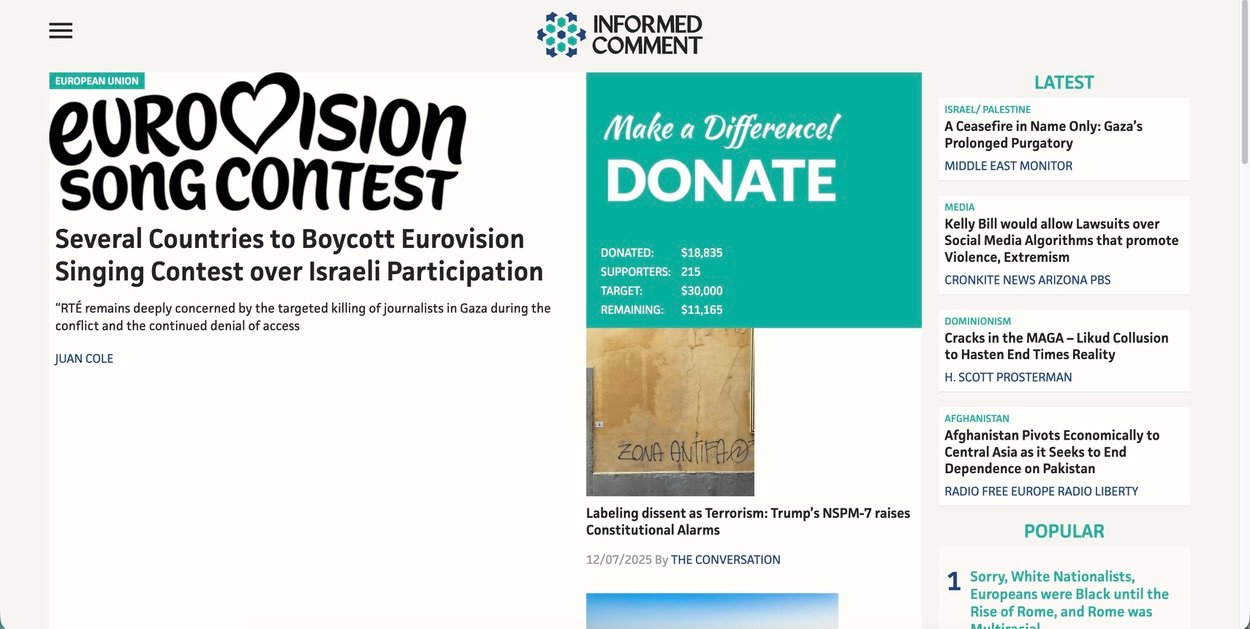
Guide: How to Write & Get Paid for Opinion Pieces on Informed Comment (juancole.com)
This step-by-step HTML guide walks a beginner through researching Informed Comment (Juan Cole’s site), preparing a pitch, writing a publishable 800–1,000 word opinion piece, submitting through the site’s freelance submissions process, and practical ways to earn and reuse the work. The guide includes templates, examples, and many links to help you learn quickly.
Key quick facts: Informed Comment accepts topical original opinion pieces (approx. 800–1,000 words) and — according to the site’s submissions page — offers an honorarium of $100 (PayPal) for accepted freelance pieces. See the site’s submission page for the definitive current terms.
Section 1 · About the site
What Informed Comment (juancole.com) is — and who reads it
Informed Comment (juancole.com) is Juan Cole’s long-running blog and commentary site that publishes analysis and opinion on international affairs, foreign policy, regional politics, and related issues. The site hosts columns, guest contributions, and topical commentary. It is read widely in policy circles and by people who follow international news and commentary.
Short, sharp, original opinion — a single argument supported by a few facts, context, and a persuasive call to attention. Editors prefer pieces that are topical (timely), evidence-based, and plainly written for a general but informed audience.
Typical readers include academics, policy makers, activists, and informed members of the public who want concise analysis.
The site’s own pages are the first source: see the official submissions page and the site’s about / contact pages. Links to those pages are collected in the resources section near the end of this guide.
Quick reading: open the site’s Freelance submissions page and skim recent posts on the homepage to understand tone and timing before you write. Read 3–5 recent pieces to get a feel for headlines and voice.
Section 2 · The submission rules (short)
What the submissions page actually asks for
The official submissions page describes what the editor is seeking. Summarized: send topical, original opinion pieces that make a single point, of roughly 800–1,000 words. The site currently reports it is able to pay an honorarium of $100 via PayPal for accepted freelance pieces. Always confirm the current terms on the live submissions page before you send work. (Links below.)
| Item | Typical requirement |
|---|---|
| Length | Approx. 800–1,000 words |
| Type | Topical, original opinion/analysis |
| Payment | Honorarium (site lists $100; PayPal) |
| How to submit | Use the form / contact on the submissions page |
Section 3 · How to shape an 800–1000 word opinion piece
Structure that fits the site: tight, evidence-backed, readable
800–1,000 words is short — you must make a single point and support it with 2–4 sharp paragraphs of evidence or analysis. Here is a proven micro-structure you can use.
Start with the news or a striking observation
Lead with what made this piece necessary. Give the reader a timestamped hook (a recent event, data point, or quote). State your single thesis sentence clearly: what you believe and why it matters.
Show the evidence and reasoning
Use 2–3 short paragraphs to present facts, a salient example, or a brief history that supports the thesis. Use links to credible sources (news, research, official statements). Keep paragraphs short (2–4 sentences).
Explain why readers should care
What does your argument imply for policy, practice, or public understanding? Provide a clear recommendation, warning, or prediction. Keep this actionable or thought-provoking.
Finish with a sharp closing line
Re-state the thesis in one crisp sentence, or finish with a memorable image or call to follow-up reading.
Practical tips: use 0–2 short embedded links (source news, official doc); never overload with citations — be selective and direct.
Section 4 · Pitching: step-by-step
How to prepare and send a pitch that editors notice
For Informed Comment you will usually pitch a short opinion piece or submit the piece directly (check the form). Below is a simple pitch SOP that takes you from idea to submission.
Read the submissions page carefully
Open Freelance submissions and the site’s homepage. Note format, preferred length, and payment terms.
Craft a one-line pitch + 1-paragraph outline
Your pitch should include:
- A one-line hook (what’s the argument?)
- A one-paragraph outline (3 bullet sections or mini-paragraphs)
- A link to your best writing sample (published work, blog, Medium, Substack)
Write a short author bio
1–2 sentences: who are you, what experience do you have relevant to this piece (job, degree, reporting, research), and a contact email. Example: “Jane Doe is a freelance Middle East analyst and former foreign service staffer. Her writing has appeared in X and Y.”
Use the site’s contact/pitch mechanism
The submission page usually points to the preferred method (form or email). Follow it exactly. If a form is provided, paste your pitch and outline there. If no form exists, use the contact email on the site’s contact page.
Attach or link to a full draft if requested
Some editors prefer a complete draft, especially for short opinion pieces. If you have a full, well-edited draft of ~900 words, include it. Otherwise, offer to send a full draft quickly upon request.
Follow up politely if needed
Wait 2–3 weeks, then send a short, polite follow-up note (1–2 lines). If the editor declines, thank them and ask for brief feedback if they offer it.
Subject: Pitch — [One-line hook] (≈900 words)

Hello [Editor name / Informed Comment editor],

I’d like to pitch a short opinion piece (≈800–1,000 words) titled “[Headline idea].”
One-line hook: [your thesis — one sentence]

Outline:
1) Intro — [attach the news/event and your thesis — 2 sentences]
2) Evidence — [2–3 short bullets of the facts/examples you'll use]
3) Implications/recommendation — [what should be done/what this shows]

I have published similar work at: [link to writing sample]
Short bio: [1–2 sentences]
Contact: [email / PayPal for payment]

Happy to provide a full draft on request.

Thanks for considering this,
[Your full name]
Section 5 · Two sample pitches + full outlines
Ready-to-use templates you can adapt
One-line hook: “A surprise diplomatic shift in X shows policymakers are ignoring local political dynamics — here’s what that will cost.”
Outline (≈900 words)
- Intro (120 w): Hook on the latest development (date + fact). Thesis: the shift is misguided and will have Y consequences.
- Evidence (350 w): Quick history, a recent data point or quote from an official, reaction from local actors, a short on-the-ground example.
- Implication (250 w): What the policy ignores, predicted outcomes, who benefits/loses.
- Recommendation/Close (150 w): What should be done differently; short final sentence that re-states urgency.
One-line hook: “Export controls on X tech risk accelerating a market split — policy-makers blind to economic costs.”
Outline (≈900 words)
- Intro (100 w): Clear thesis and immediate event (new policy announcement).
- Evidence (300 w): Short case studies, industry reaction, expert quote or public dataset.
- Analysis (300 w): Who is affected, unintended consequences, comparative example from history or another sector.
- Policy suggestion / close (200 w): Specific alternative, what to monitor, and one-line powerful close.
Use these outlines as the pitch’s “bulleted outline” and as the skeleton of a full draft. Editors appreciate a clear plan and evidence you can assemble quickly.
Section 6 · Rights, republishing, and using your piece to earn more
What to expect after acceptance — and how to multiply value
When a piece is accepted, carefully read the agreement about rights and re-posting. Short opinion items commonly allow authors to republish on their own sites after an exclusivity window, or with attribution. If the submission page does not list terms, ask the editor in the acceptance email. Keep records of the agreement.
- Use the published byline as a portfolio piece when pitching freelance clients.
- Expand the piece into a longer article or newsletter essay for paid subscribers.
- Create a short consulting brief or slide presentation based on the analysis and charge clients for briefings.
- Turn the idea into a talk or webinar and sell access or sponsorships.
- Ask: Is there an exclusivity period? If yes, for how long?
- Ask: Can you republish on your own blog after X days with a link back?
- Confirm payment method (PayPal) and invoicing details.
- Save the acceptance email as proof of terms.
If the editor doesn’t specify republishing rights, request permission to repost after a short exclusivity window (commonly 7–30 days), and always link to the original.
Section 7 · Ethics, AI use, and verification
How to use AI tools responsibly and keep your byline trustworthy
- Don’t submit text presented as your own if it was generated entirely by AI.
- Verify any factual claims AI suggests. Run the sources and confirm accuracy.
- Attribute quotes and ideas correctly; do not invent interviews or statistics.
- Disclose ethically if an AI tool materially contributed, if the editor requests transparency.
- Use AI to brainstorm angles and headlines.
- Use AI to create a clean outline, then write the article in your voice with sources you verify.
- Use AI for copy-editing after you verify all facts and quotes.
Section 8 · Final checklist, FAQ, and resources
Before you hit send — a compact checklist and lots of links
FAQ (quick)
Helpful links — start here
- Freelance submissions — official
- Informed Comment — homepage (recent posts)
- About page — site background & contact
- Contact page — mailing / donation info
- How to write short opinion pieces — short guide (external)
- List: Political blogs & guest submission info (roundup) — (useful for finding more outlets)
- WritersWeekly — marketplace and pay examples
- How to write opinion pieces — editorial tips (external)
- Concise writing tips — Purdue OWL