


How to Submit to Palette Poetry — A Beginner’s Step-by-Step Guide that Helps You Publish & Earn
This guide walks you from a raw stanza to a paid publication at Palette Poetry. It’s written so beginners can follow every step: understand what Palette wants, format and polish your submission, fill the Submittable form correctly, and maximize chances of acceptance — plus practical ideas to turn published poems into income.
This is a practical, action-first guide: checklists, sample cover letters, submission-ready formatting tips, and a Short SOP that you can copy & paste into your writing workflow. Links to Palette’s official submission pages and related resources are included so you can jump straight to the form.
Section 1 · Quick facts
Palette Poetry: at-a-glance
Palette Poetry is an online literary magazine focused on publishing contemporary poetry and creative work. Submissions for its Featured Poetry are open year-round; the editors encourage emerging poets to submit and explicitly invite under-represented voices.
Official submission pages and the Submittable manager are the single places where Palette accepts work — do not send poems by email unless the site explicitly requests them. Use the direct submission portal at palettepoetry.submittable.com/submit or Palette’s Submit page at https://www.palettepoetry.com/submit/.
- Payment: $50 per accepted poem (Palette states $50/poem; submission page also references up to $150 for certain circumstances).
- Open year-round for Featured Poetry; special contests and workshops run on dates listed on the site.
- Palette does not accept AI-generated poems — submissions using AI tools will be declined.
- Expect a response within the timeline listed on the submission page; their standard turnaround guidance is up to ~12 weeks.
Source pointers: Palette’s Submit page and Submittable listing.
Section 2 · What Palette publishes
Genres, tone, and audience — shape your work to fit
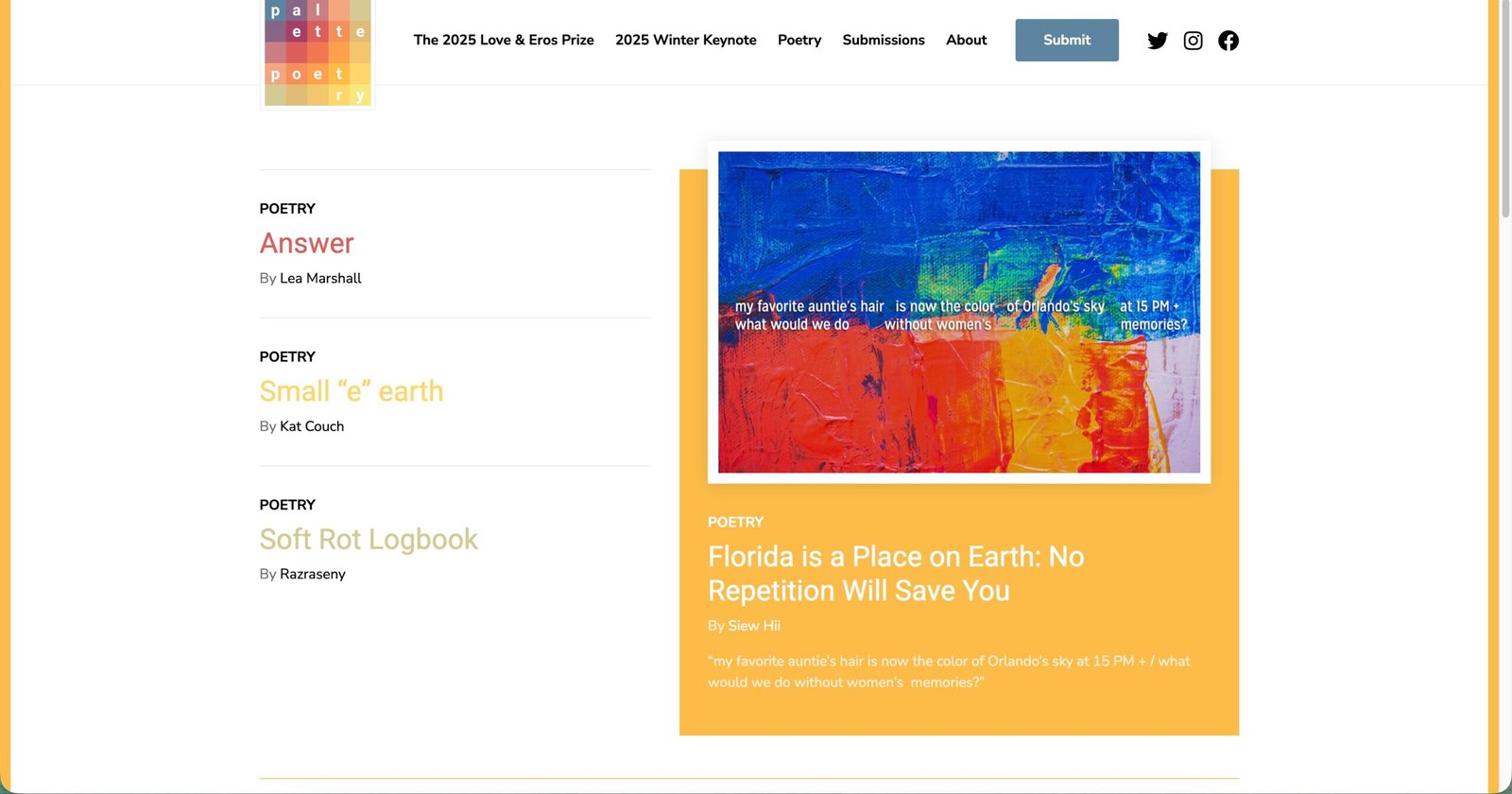
Palette publishes contemporary poetry, columns, essays, curated deadlines, and occasional contests and workshops. Their Featured Poetry category showcases new voices and emerging writers alongside more established poets. Read their archive to sense the magazine’s editorial voice: you’ll notice a wide stylistic range but a consistent emphasis on craft, clarity, and fresh perspectives.
How to decide if a poem “fits”: think about voice, originality, and craft. Palette’s editors select poems that feel both precise and alive — lyric intensity, strong images, clear line decisions, and an honest point-of-view tend to fare well. Browse recent poems on the home page to study examples.
Open 6–12 recent poems and ask: what lines stand out? How long are accepted pieces? Are there recurring themes or formal choices? Do the poems lean narrative, imagistic, or experimental? This quick research phase dramatically improves your ability to match your tone to the editors’ taste.
- Is the poem unpublished anywhere (including social media)? Palette accepts only unpublished work.
- Is the poem tightly edited (no filler lines, clear image economy)?
- Do you have a clean, single document to upload that contains up to 5 poems not exceeding 10 pages total? (Palette’s limit.)
Section 3 · Before you submit
Polish, format, and prepare your packet
Take time on the basics. Editing and presentation matter: a clean, polished PDF or DOC file with correct title lines, standard font and spacing, and a concise cover letter increases editorial confidence. Below are step-by-step actions to prepare your email (if needed) and your upload packet on Submittable.
Collect your poems into one file
Palette asks that you send up to 5 poems totaling no more than 10 pages, and that you submit them together in one document (not multiple separate files). Multiple submissions will be declined unread. Name the file clearly — for example Lastname_Firstname_Palette_Submission.pdf.
(Refer to Palette’s Submit page for the exact limits and instructions.)
Formatting: fonts, headers, and anonymity
Use a readable serif or sans serif (e.g., Georgia, Times New Roman, or Inter/Helvetica) at 11–12pt. Use single column, left-aligned text, and avoid distracting ornamentation. Importantly: do not include your name or contact information in the packet of poems themselves — include identifying details in the cover letter box, not the poem file.
Write a brief but useful cover letter
Palette wants a short cover letter in the Submittable cover letter box. Mention your name, a one-line bio (if you have publications), and any relevant context. If you select editorial feedback (a paid option), name which poem you want feedback on in the cover letter. Keep it professional and brief.
Check originality & AI policy
Palette does not consider or review AI-generated work. Any submission that used AI tools will be declined. If you revised a work that had AI assistance at any stage, do not submit it. Honesty matters.
Create a Submittable account & verify email
Most Palette submissions go through Submittable. Create and verify your account before you submit — Submittable requests that you verify your email for consistent communication. If Submittable prompts you for an upload, follow the site prompts carefully.
Section 4 · The Submittable form
Exactly what to enter (field-by-field)
Palette uses Submittable to collect submissions. Below is a practical field-by-field guide to the typical Submittable fields you’ll see for their Featured Poetry submission. Use this as a checklist while you fill the form.
| Field | What to put |
|---|---|
| Project title / Subject | Use a short title for the submission document (e.g., “Three Poems: Spring & Light“) or leave as the first poem’s title. |
| Cover letter box | Short bio (1–2 lines), publication history (if any), and a 1–2 sentence context if needed (e.g., \”Three previously-unpublished lyric poems exploring loss and repair\”). If you purchased editorial feedback, say which poem you want feedback on. |
| File upload | Upload the single PDF/DOC containing your poems. File name: Lastname_Firstname_Palette.pdf. |
| Payment options / add-ons | Palette may offer paid options like Fast Response or Editorial Feedback — decide if you want them. They do not charge for Featured Poetry submissions by default but do have paid optional services. Check descriptions before buying. |
| Eligibility & permissions | Confirm you are submitting unpublished work and agree to terms. Palette requires first publication rights for a limited period (see rights section). |
Palette’s Submittable page also explains payment and timeline — double-check there in the event of policy changes.
Section 5 · Money, rights & policies
How you get paid, and what rights you give
Payment: Palette states clearly that it is a paying market. Current official language lists $50 per accepted poem. Palette’s Submit page also references payment “up to $150” in contexts where multiple poems or special categories might affect compensation; consult the submission page or editor correspondence for exact terms for a particular acceptance.
Author’s rights: Palette holds first publication rights for a short, defined period (their Submit page states a common period is three months), after which rights revert to the author. Authors agree not to publish the poem elsewhere for that first-window period. For reprints, Palette asks for an acknowledgment. Always read the specific agreement you receive with an acceptance.
Turnaround & queries: Palette requests patience: expect a response timeline (their page states around 12 weeks) and that you should not query until approximately four months have passed if you haven’t heard back. Keep a calendar note and track your simultaneous submissions so you can update editors promptly if your poem is accepted elsewhere.
Read Palette’s Terms & Conditions before you accept an offer. If anything in the acceptance contract is unclear (e.g., reprint terms, archival rights), politely ask the editor for clarification before signing.
Palette will automatically decline any AI-generated poem; do not submit work produced by AI. They also ask that submissions be unpublished and original. If you have questions about what counts as AI assistance, err on the side of full transparency and avoid submitting work with AI-derived text.
Section 6 · Sample cover letter & templates
Copy-paste-ready templates you can adapt
Below are short, practical cover-letter templates to paste into the Submittable cover letter box. Keep them under 120–150 words. Remember to include your one-line bio (name + 1 credential if relevant) and to say which poem(s) you uploaded.
Use when you have few or no prior publications
Hi Palette editors —
Please consider these three unpublished poems (total 6 pages) for Featured Poetry: “Title One“, “Title Two“, and “Title Three“. My name is [Your Name]. I am a poet based in [City]. These poems explore family histories and migration. Thank you for your time and consideration.
Use when you have prior clips
Dear Palette editors —
Attached are two unpublished poems: “Title A” and “Title B“. My name is [Your Name]. Recent work appears in [Journal A] and [Journal B]. Thank you for reading; I appreciate any editorial feedback if available.
Use if you paid for editorial feedback
Hi —
I am submitting “Title” and would like editorial feedback on the second stanza if possible. My name is [Your Name], and these poems are unpublished. Thank you for your time and any guidance you can provide.
Section 7 · After you submit
What to expect and how to keep your momentum
After you hit Submit on Submittable, you’ll receive an automated confirmation email. Palette may take many weeks to reply; their guidance is to expect up to roughly twelve weeks for a response and not to query until four months have passed. During this time, continue writing — don’t stop because you submitted one packet.
If accepted, you’ll receive an email with payment and rights terms. Read those carefully; usually you’ll be asked to sign or confirm a short agreement granting Palette first publication rights for the specified short period (often three months).
- Minor edits (line changes, punctuation, small reorderings).
- A request for a byline and a short bio blurb or headshot.
- A schedule for publication and confirmation of payment method.
Declines are normal. Save editors’ comments (if any), consider revision, and submit elsewhere. Keep a submission tracker — spreadsheet columns for poem title, date submitted, venue, and response — to avoid confusion with simultaneous submissions.
Section 8 · Dealing with rejection & revision
How to turn “no” into practice and future acceptances
Rejection is part of the writer’s process. Use it as an opportunity to revise. If an editor provides feedback, read it slowly and consider line-level edits. If you get a form-letter decline, try to identify one thing you can improve in the poem (economy of image, clarity of metaphor, stronger first line) before submitting elsewhere.
Revise with a reader in mind
Ask: which line gives the reader trouble? Which image could be tightened? Often a single revision makes a poem land better with a second reader.
Use trusted workshops and critique partners
Before a big re-submission, test a revision in a small workshop, Slack, or writer group. External feedback quickly reveals where the poem drags or confuses.
Pick appropriate markets
Not every poem suits every journal. After a decline, consider other journals with a slightly different aesthetic. Use Submittable’s search and editors’ notes to find good matches.
Section 9 · How to earn money from poetry beyond the $50 poem
Smart strategies — build income & reach
Publishing in Palette is both a small cash payment and a career-building moment. Use your publication to amplify your profile and create income in multiple ways:
Share the poem on social media and link back to Palette. Use the byline and publication credit in pitches to other venues, grant applications, and to build a portfolio for readings or paid workshops.
- Ask your network for paid reading invites or offer a short paid workshop using your Palette publication as credibility.
- Collect clips — multiple publications can boost rates for teaching gigs, editorial work, or micro-tutoring.
- Submit to contests and chapbook prizes (Palette itself runs contests; check their Calendar and Awards pages).
In short: view each publication as both immediate cash and a long-term investment in your literary resume.
Section 10 · Checklist, FAQs & resources
Final micro-SOP and helpful links
Micro-SOP before every Palette submission
- Read the Palette Submit page and Submittable listing (open them in tabs).
- Confirm your poems are unpublished and that the packet fits 5 poems / 10 pages maximum.
- Format your file: clean font, one document, no name inside the poems (name in cover letter only).
- Write a short cover letter (bio + titles + 1-line context).
- Create or verify your Submittable account and verify your email.
- Submit, copy your cover letter text locally, then track the submission date in your spreadsheet.
- Wait (Palette notes up to ~12 weeks); follow the query guidance (do not query until ~4 months).
FAQ — quick answers
Handy resources & links (open these in new tabs)
- Palette — Submit (official).
- Palette — Submittable manager.
- Palette — homepage & archive.
- Poets.org — practical resources for poets
- Submittable — help & guidance
- Duotrope — market listings & tracking
- Poets & Writers — magazine & resources