


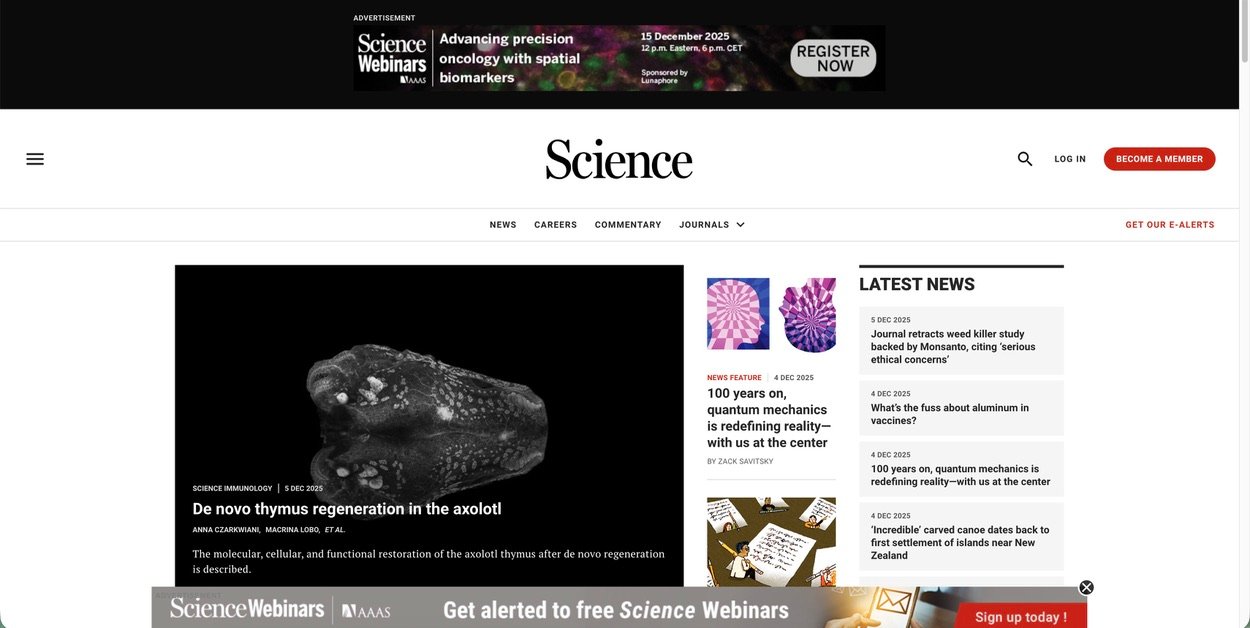
Guide: How to Write & Pitch to Science (AAAS) — a Practical SOP for Beginners
This guide walks you from idea to pitch to finished story with concrete templates, sample pitches, checklists, and a clear list of resources and links so you can learn quickly and start building paid clips.
It uses Science’s publicly-available guidance and common industry practice to explain what editors expect, where to publish practice pieces, and how to negotiate your first freelance payments.
Section 1 · Start with the official pages
Read what Science (AAAS) tells freelancers
Before you do anything else, bookmark and read these pages carefully:
- Science — Freelancer Guidelines (how to pitch News, Features, Profiles, and what kinds of tips/editing to expect). :contentReference[oaicite:0]{index=0}
- About News from Science — explains the news desk, the role of freelancers, and story types that appear under “News from Science.” :contentReference[oaicite:1]{index=1}
- Information for Authors — if you plan to submit research articles or technical content, the formal submission system and manuscript rules live here. :contentReference[oaicite:2]{index=2}
- Instructions for preparing an initial manuscript — useful if you are moving from reporting to contributing a technical write-up. :contentReference[oaicite:3]{index=3}
- Science journals — Editorial policies — background on policies, conflicts of interest, and editorial standards. :contentReference[oaicite:4]{index=4}
Tip: Read the freelancer guidelines line-by-line. These pages often contain the exact instructions editors expect in a pitch (word limits, embargo rules, whether to include press releases or journal links).
Section 2 · What they publish (and where you fit)
Match your idea to the right slot
Science and AAAS publish different kinds of content. Knowing which slot your idea fits makes the pitch clear and increases your chance of acceptance.
Short, timely stories about a new paper, discovery, or policy change. These are often written on tight deadlines and are a common starting place for freelancers with a clear scoop or a fast take.
In-depth reported features (1,200–3,500+ words) that explain the science, its context, and human stories. Features need research, interviews, and narrative structure.
Opinion pieces, Perspectives, or Policy commentaries require specialist knowledge or clear argues backed by evidence — editors expect clarity and balance.
Original research articles use the formal submission systems (CTS / Science submission portals). If you are a scientist with data, follow Information for Authors carefully. :contentReference[oaicite:5]{index=5}
If you’re new: start with newsy pieces or short features. They require reporting skills but usually not the formal manuscript preparation that research articles do.
Section 3 · Find ideas & build quick demos
How to spot good pitches for Science
Good ideas have: newness, impact, clarity. They answer: why should anyone care now? and who is affected?
- New papers: scan journals (Nature, Science, PNAS) and press release services like EurekAlert.
- Policy moves: watch government sites, funding announcements, and Parliament/Ministry briefings.
- Funding databases and preprint servers (bioRxiv, medRxiv, arXiv) for emerging results — but treat preprints carefully and verify with authors.
- Conferences & meetings: check programmes and abstracts for hot topics.
- Local labs & universities: a small institutional press release can be a great local-to-global story.
For each candidate story, produce a tiny “demo” — e.g., a 500–900-word quick draft on your blog or Dev.to, or a 600–1000-word sample emailed to an editor when asking if they’re interested. Editors love seeing that you can turn a pitch into readable copy quickly.
Section 4 · Pitch SOP + templates
Step-by-step: pitch like a pro
Use this as your personal SOP every time you pitch Science or a similar outlet.
Read the relevant guidelines and recent pieces
Open Science’s freelancer guidelines and 3–5 recent pieces in the section you target. Editors want familiar structure and tone. :contentReference[oaicite:6]{index=6}
Write a 3-line pitch + 1-paragraph outline
Keep it short: 1) headline; 2) 1-sentence nut graf (so what?); 3) 2–3 supporting points (sources, unique access, data). Attach a simple outline (3–7 sections).
Link to 2–3 relevant clips
Use your best published samples (blog, Dev.to, Medium) or a polished draft. If you have no clips, publish a sample on your own blog and link it.
Use the right channel
If the freelancer guidelines specify a form or editor email, follow that exactly. For news pitches, editors often prefer an email or a quick query. If a pitch form is indicated, use it. :contentReference[oaicite:7]{index=7}
Polite follow-up after 10–14 days
If you haven’t heard in 10–14 days for features (less for time-sensitive news), send a single polite follow-up with your original pitch pasted and a one-line nudge.
Quick pitch templates (copy & paste)
Subject: [Quick pitch] New study: “[short finding]” — timely angle
Hello [Editor name],
I’m [Name], a freelance science journalist (link to clips). A new paper in [journal] finds [one-sentence finding]. This matters because [one-sentence impact]. I can turn this into a ~600–900 word News piece by [deadline]. Proposed sources: [author, independent expert], and I can include the paper + press release. Sample clip: [link].
Thanks for considering — I’m available today/tomorrow to discuss. Best, [Name + email + phone]
Subject: Feature pitch: “[Working headline]” — [brief hook]
Hello [Editor name],
I’d like to propose a [~1500–3000 word] feature titled “[Working headline]” about [one-sentence topic]. Nut graf: [one-sentence why this matters now]. Proposed reporting: interviews with [list], analysis of [data/source], and a short demo/case study from [lab/company]. I can deliver a full draft in [X] weeks. Relevant clips: [links]. Outline (short): 1) lead, 2) background, 3) case study, 4) implications, 5) conclusion. Thanks for your time — I welcome any edits to scope. Best, [Name + clips + contact].
Section 5 · Writing the piece
Structure, clarity, and verification
Editors at Science value crisp, well-verified stories. That means: strong lede, transparent methods, named sources, and accurate representation of the research. Use short paragraphs, clear headings (for digital), and always link to original papers and data.
- Lead (30–60 words): What happened and why it matters.
- Core details (100–300 words): Methods, key numbers, what authors claim.
- Context & experts (200–400 words): Independent reaction, limitations.
- Implications & next steps (50–150 words): Why readers should care.
- Strong narrative arc and a human or practical hook.
- Multiple named sources (authors + external expert).
- Links: paper DOI, supplementary materials, datasets.
- Fact-checked numbers; methods summarised plainly.
- Clean captions for any figures or graphics you propose.
When quoting scientists, use their full name, affiliation, and a short phrase to explain why their view matters. If the story involves contested or preliminary findings, be explicit: label preprints, mention limitations, and let readers know which results are robust.
Section 6 · Money, rights, and practical expectations
How freelancers get paid and what to watch for
Payment varies by outlet, story type, and the writer’s experience. For some AAAS/Science news assignments editors offer flat fees for short pieces; features pay more and may be negotiated. Always ask about payment in the assignment stage (after a pitch is accepted) and get a simple email confirmation of the fee, deadline, and rights.
Different science outlets pay different rates. For example, freelance market guides list Science News paying freelancers roughly $300–$500 for short news pieces and higher fees for features; use such guides to benchmark rates when negotiating. :contentReference[oaicite:8]{index=8}
If an editor gives a fee and assignment, confirm:
- Exactly what you will deliver (word count, figures, sidebars).
- Payment amount and timing (on acceptance, on publication, within X days).
- Rights: usually outlets take first publication rights and request permission for republication on your portfolio after an exclusive period; ask what that period is.
Section 7 · Ethics, embargoes & peer review
Be careful with embargoes and unpublished results
Many research stories are embargoed: the journal or institution will ask journalists not to publish until a specified date/time. Breaking embargoes harms trust and future access. Always follow the embargo instructions that come with a press release and confirm embargo times in writing if the story depends on them.
Preprints are useful leads but treat them as provisional. If covering a preprint, explicitly label it and seek independent comment. For peer-reviewed papers, link to the published article and describe the review context where relevant.
Declare any relevant conflicts (e.g., collaborations). If an author is your former adviser or your institution, disclose it. Science’s editorial policies include conflict-of-interest rules you should review. :contentReference[oaicite:9]{index=9}
Section 8 · Final checklist + resources
Your final pre-pitch & pre-submission checklist
Useful links & resources (open in new tabs)
- Science — Freelancer Guidelines (official). :contentReference[oaicite:11]{index=11}
- About News from Science (how the news desk works). :contentReference[oaicite:12]{index=12}
- Information for Authors — Science (submissions & manuscripts). :contentReference[oaicite:13]{index=13}
- Preparing an initial manuscript — instructions. :contentReference[oaicite:14]{index=14}
- Science journals — Editorial policies. :contentReference[oaicite:15]{index=15}
- EurekAlert — press releases and media advisories
- Dev.to — platform for publishing practice clips
- Freelance science job listings & guides
- NASW: All About Freelancing — negotiation & contracts
- Science News freelancing pay guide (benchmarking). :contentReference[oaicite:16]{index=16}