


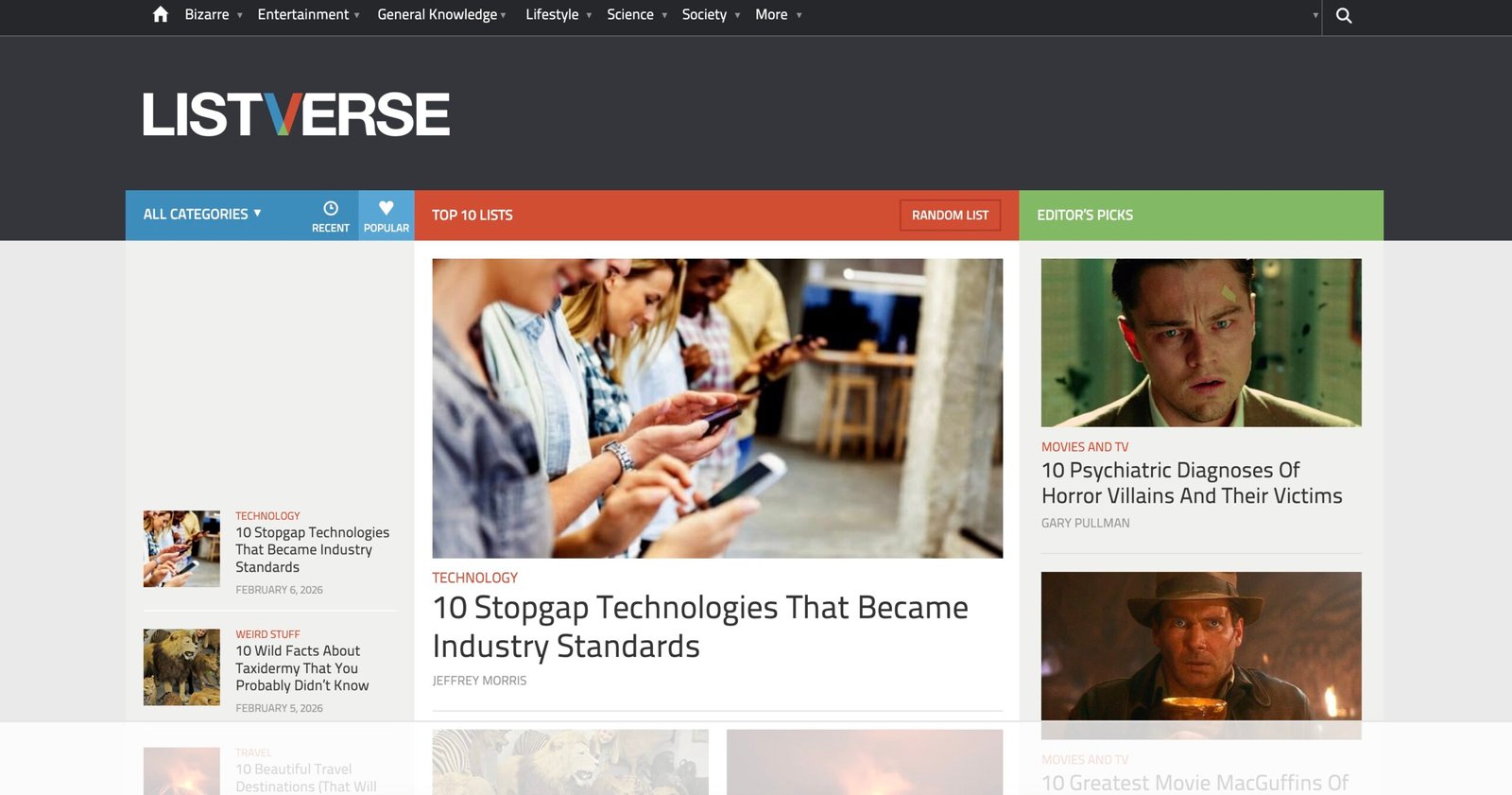
Guide: How to Get Paid to Write for Listverse (Step by Step)
This is a beginner-friendly guide that teaches you how to write a Listverse-style “Top 10” list and submit it the right way. If you follow the steps, you will also learn a skill that you can reuse for blogs, magazines, guest posts, newsletters, and paid writing work.
The core idea is simple: Listverse buys lists that feel like a fun story, but every item is backed by reputable sources. Your job is to find a topic that makes people say “Wait… seriously?” and then explain it clearly in short sections.
Quick navigation: Start with the rules → Pick a winning topic → Research & sources → Submit.
Section 1 · Understand the publication
What Listverse really is (and what it is NOT)
Listverse is famous for one thing: Top 10 lists that make you curious. The lists are usually about mysteries, weird history, surprising facts, hidden stories, crime, science, creepy topics, misconceptions, and things you did not expect.
But here is the important beginner truth: Listverse is not a “publish anything” guest post site. It is closer to a small magazine that buys one type of article: a 10-item list written in clear English with sources for factual claims.
- 10-item lists with a short intro + short entries.
- Unique angles that are not already everywhere online.
- Remarkable facts (the “wow, I didn’t know that” feeling).
- Reputable sources to prove facts and claims.
- A friendly voice: easy to read, not academic, not too long per item.
Start here: Write & Get Paid and Submit a List.
- Personal stories that cannot be verified with strong sources.
- Opinion-only lists (“best”, “worst”, “top” without evidence).
- Topics they say they almost never publish (sports, self-help/advice, etc.).
- Content that is already covered on Listverse or is copied/reworked from elsewhere.
- Lists that rely on weak sources (random blogs, forum posts, recycled news).
Keep in mind: rules can be updated, so always check the official pages again before submitting.
| Beginner question | Simple answer | What to do |
|---|---|---|
| “Can I write any topic?” | No. Listverse has a specific taste. | Read their pages and study recent lists first. |
| “Is this a guest post?” | Not really. It is closer to selling an article. | Write a full list draft before you submit. |
| “Do I need to be expert?” | You need to research well and write clearly. | Use reputable sources and keep the writing simple. |
| “What’s the main reason they reject?” | Not unique, not well written, not well sourced. | Focus on uniqueness + proofreading + sources. |
Section 2 · The format
The Listverse list formula: 10 items, short sections, real sources
If you want to get accepted, you must respect the format. Listverse lists are not essays. They are structured like this: Title → Intro paragraph → 10 numbered items → sources.
The official pages strongly encourage lists that are around 1500–2000 words total, with 10 items minimum, and usually 1–2 paragraphs per item. That means you write short, clear mini-stories, not long chapters.
| Part | What it should do | Beginner-friendly tip |
|---|---|---|
| Title | Promise something surprising (“10… you didn’t know”). | Use a clear noun + twist. Avoid vague titles. |
| Intro (1 paragraph) | Set the mood and explain what the reader will get. | Keep it 3–6 sentences. End with a curiosity hook. |
| Item headers | Make each item feel like a “headline inside the list.” | Use concrete names, places, dates, people, objects. |
| Each item (1–2 paragraphs) | Tell a short story and include a “wow fact.” | Write like you’re explaining to a smart friend. |
| Sources | Prove facts with reputable links. | Use 1+ strong source per item. Prefer primary sources. |
Remarkable means: “Most people will not already know this.” A beginner mistake is picking famous items (Bigfoot, Bermuda Triangle, etc.) with no new angle.
- Bad: “10 Facts About Titanic” (too common)
- Better: “10 Forgotten Stories From the Titanic’s Lesser-Known Passengers” (more specific)
- Even better: “10 Titanic Myths That Survived Because of Bad Journalism” (unique angle)
Do not guess. Study recent lists. Use categories and search:
- Search Listverse (check for duplicates)
- Bizarre
- Creepy
- Mysteries
- General (Fact/Fiction)
- Science & Nature
- People & Politics
Read 10 lists. For each list, notice: the title style, the intro length, item length, and how sources are used.
Section 3 · Topic mining
How to find list ideas that have a real chance to get accepted
Most beginners fail because they pick topics that are too common. Listverse wants lists that are new to their readers, and ideally new to the internet (or at least a fresh angle).
Use this beginner method: Category → Micro-niche → Twist → Proof. You start from a category Listverse already likes, narrow it down, add a twist, and then confirm you can find strong sources.
Start inside Listverse categories (follow their taste)
Open categories and write down 5 topics that feel fun to you:
- Creepy and Mysteries
- History and Misconceptions
- Space and Animals
- Crime and People & Politics
Do not start with “what I like.” Start with “what Listverse already publishes,” then add your unique twist.
Find micro-niches (specific beats broad)
Turn broad topics into micro-niches:
- Broad: “WW2” → Micro: “forgotten sabotage operations”
- Broad: “ghosts” → Micro: “documented ‘mass hallucination’ events”
- Broad: “space” → Micro: “near-miss asteroid incidents you never heard about”
Micro-niches make it easier to be unique and easier to find sources.
Add a twist that creates curiosity
A twist makes your title and list feel new. Common twist types:
- Hidden: “forgotten, banned, lost, secret, unseen”
- Misunderstood: “myths, misconceptions, false facts”
- Unexpected: “the real reason, the weird side, the accidental outcome”
- Reversed: “things you think are safe but aren’t” (with proof)
Important: avoid “clickbait with no proof.” The twist must be supported by sources.
Run the “duplicate + sources” test before you write
Two quick tests:
- Duplicate test: Search Listverse for your main keywords: Listverse Search.
- Sources test: Can you find at least 10 reputable sources (1+ per item) that are not weak sites?
If you fail either test, change the angle before you waste hours writing.
| Idea quality check | Good signs | Bad signs |
|---|---|---|
| Uniqueness | Hard to find the exact same list online; fresh angle. | Many identical “Top 10” lists already exist. |
| Remarkability | Most items make a reader say “wow” or “no way.” | Items are obvious or common knowledge. |
| Source strength | Primary sources, known news orgs, academic or official sites. | Blogs, forums, recycled list sites, Wikipedia as main proof. |
| Listverse fit | Mysteries, secrets, facts, misconceptions, creepy history, etc. | Sports, self-help, personal diaries, “best game” lists, opinion rankings. |
Try this 10-minute practice now. Fill this mini template. (You can copy it into your notes.)
Section 4 · Research & sources
The “receipts” system: how to research a Listverse list like a pro
Listverse lists are fun, but they are not “random internet facts.” They expect you to back up facts with reputable sources. Their author guide explains that sources are essential and recommends avoiding unreliable sources (including Wikipedia) and using reputable, recognized outlets.
Here is the beginner-friendly system: One folder → One document → One list of sources → One fact per source. If you build this system, you will write faster and safer.
Make a simple folder for your list topic. Add a text file or Google Doc called: Sources – [Your List Title].
- For each item, paste 1–3 strong sources.
- Under each source, paste the exact quote or fact you want to use.
- Write a short note: “What does this source prove?”
This prevents “accidental misinformation.” You are not writing from memory; you are writing from proof.
Each list item should include at least one truly interesting fact. Not a boring detail. A wow fact is a detail that changes how a reader sees the story.
- Better than: “It happened in 1972.”
- Use: “It was hidden for 27 years because…” (with proof)
- Or: “The official report found X, but the public believed Y.”
| Source type | Why it helps | Beginner note |
|---|---|---|
| Primary sources (reports, court docs, official archives, academic papers) | Strongest proof. Low risk. | Use them when possible, even if you explain simply. |
| Recognized news organizations (local or national) | They have reputations and editorial standards. | Still verify claims and avoid opinion-heavy pieces. |
| Books / Google Books | Great for history and deep context. | Use page references in your notes; link to reliable previews if possible. |
| Academic or museum sites | Often factual and well edited. | Perfect for science, history, artifacts, discoveries. |
| Weak sources (random blogs, forums, recycled “fact” sites) | High risk. Easy to be wrong or copied. | Avoid. If a site is recycling a story, find the original. |
The “triangulation” rule (how to avoid wrong facts)
Before you use a strong-sounding fact, confirm it with at least two independent sources. If only one source says it, treat it carefully, or remove it.
- Source A: first report or study
- Source B: a second outlet confirming details
- Optional Source C: a later analysis or official archive
This is how you write safe “facts + fun” lists without embarrassing mistakes.
Plan your citations early (not at the end)
In the Listverse author guide, they explain a streamlined format: use in-text markers after the fact they prove, and collect the links together at the end of the list (numbering across the whole list).
- While drafting, add “(LINK 7)” style placeholders right after the claim.
- Keep one running list of links at the bottom.
- Do not restart numbering per item—keep counting up.
Even if you draft in your own format first, the mindset is the same: every claim needs a proof link.
Official research links (keep these open):
Section 5 · Writing
Write like Listverse: simple structure, clear voice, light humor
Now we write. The easiest way to succeed is to use a repeatable mini-template for every item. If you do that, you will not get stuck.
Think of each list item like a small scene in a movie: Hook → Context → Wow fact → Meaning → Exit line. You do not need to use all parts every time, but the structure will keep you focused.
| Item part | What you write | Example starter lines (you can copy) |
|---|---|---|
| Hook | One sentence that makes the reader lean in. | “It started as a harmless mistake… until the report surfaced.” |
| Context | 2–4 sentences explaining what is going on. | “In 19XX, officials believed X. But the archive shows Y.” |
| Wow fact | The rare, surprising fact with a source behind it. | “The document states that…” |
| Meaning | Why the fact matters (human impact, scale, twist). | “That detail matters because…” |
| Exit line | A clean close or small punchline. | “And that’s how a ‘minor’ detail became a legend.” |
Listverse lists are scanned quickly. Short paragraphs make it easier to read. Try this rule:
- Most paragraphs: 2–4 lines (on desktop)
- Most items: 1–2 paragraphs total
- One “wow fact” per item is better than 10 small facts
If you find yourself writing long blocks, split them or cut them.
Listverse often uses light humor, but the facts still must be accurate. Safe humor types:
- Gentle irony (“As it turns out, the ‘expert’ wasn’t an expert.”)
- Small contrast (“The plan was genius… on paper.”)
- Human reaction (“Imagine reading that memo on a Monday morning.”)
Avoid mocking victims, tragedies, or serious crimes. Keep the humor respectful.
Write fast: first draft “ugly”, then edit twice
Beginners try to write perfectly on the first try. That slows you down. Instead:
- Draft 1: get all 10 items written (even if rough)
- Edit 1: cut fluff, tighten paragraphs, improve hooks
- Edit 2: proofread + verify every fact + clean sources
The author guide emphasizes that lists requiring heavy editing are rejected more often. Your goal is to submit something that needs minimal cleanup.
Use simple English (but not “childish”)
A good Listverse list feels like a smart person talking clearly. If you want a practical tool, you can check readability with the Hemingway-style approach: simple sentences, fewer long words, fewer complicated clauses.
- Prefer clear nouns and verbs.
- Avoid heavy academic language.
- Explain unusual words quickly in the sentence.
- Use American spelling and careful grammar.
Useful “study” links on Listverse:
- Misconceptions category (great for “myth vs truth” style)
- History category (observe how they tell short stories)
- Crime category (observe how they keep tone respectful)
Section 6 · Submission
Submit the right way (and what happens after you hit submit)
The safest beginner approach is: write the full list first, then submit it using the official page: Submit a List. Do not send half ideas. Listverse is buying finished lists, not brainstorming notes.
Confirm you meet the “basic requirements”
Before you submit, re-check:
- Your English is clean and professional (proofread carefully).
- The topic is not personal/unverifiable. You can prove your facts with reputable sources.
- The list is unique (not already covered on Listverse or elsewhere online).
- The subject matches Listverse taste (avoid categories they say they rarely publish).
This is not meant to scare you. It simply saves you time.
Prepare your submission text (clean formatting)
Write your list in a clean format:
- Title
- Intro paragraph
- 10 items with headers
- Sources (links) for each item
Note: Listverse typically adds images themselves. The author guide says not to include images, and the editorial team will pick them.
Submit using the official form
Use: Submit a List and follow the instructions on the page. If you have questions, they also provide guidance on: Write & Get Paid.
- Use your real author name (your byline).
- Include a valid email. They will contact you by email for acceptance/rejection.
- Have your PayPal info ready (they require PayPal for payment).
Be patient: response time and next steps
Listverse aims to accept or reject within about 30 days (and they recommend checking spam if you hear nothing). Sometimes you may receive feedback and can resubmit an improved list, but a rejection is usually final.
- If accepted: you may receive edits, requests for clarification, or source checks.
- If rejected: do not argue. Improve the idea and use it elsewhere (blog, newsletter, other outlets).
- Always keep your sources and notes so you can reuse research ethically.
| What happens | What you should do | Common beginner mistakes |
|---|---|---|
| They check uniqueness and fit. | Search Listverse before submitting. | Submitting a topic that already exists on the site. |
| They check writing quality. | Proofread twice and run spellcheck. | Typos in the title or first paragraph. |
| They check sources and facts. | Use reputable sources and cite clearly. | Using weak/recycled sources or missing proof links. |
| They may edit for style. | Be cooperative and fast with replies. | Taking edits personally or refusing to clarify facts. |
Section 7 · Money & rights
Payment, PayPal, and what “selling a list” really means
Listverse is well known for paying writers a flat fee for accepted lists (commonly $100 per list). The exact details can change, so always read the current version of: Write & Get Paid.
But there is a bigger thing beginners must understand: this is not “publishing on your blog.” When Listverse accepts and pays for your list, the author guide explains that the content becomes their property, with rights transferred. That means you should not republish the same list elsewhere after it is purchased.
- Typical fee: around $100 per accepted list (check the current official page).
- Payment method: PayPal is required.
- Timing: they state payment is typically sent within a set window after acceptance.
If PayPal cannot pay your country, Listverse notes you cannot submit. Confirm on the submission page.
Even if $100 feels small, one accepted Listverse byline can help you earn more elsewhere:
- Use it as a portfolio clip when pitching other outlets.
- Use the same research skill to write for magazines and blogs.
- Turn your “list skill” into paid services (research + writing packages).
In other words: a Listverse acceptance can be both “money now” and “credibility later.”
| Money topic | What it means in real life | Beginner action |
|---|---|---|
| Flat fee | You get paid once per accepted list. | Track your time; improve speed with practice. |
| Rights transfer | If purchased, you can’t republish the same list elsewhere. | Keep separate ideas for your personal blog/newsletter. |
| PayPal limitation | Payment depends on PayPal ability in your country. | Check supported countries before you invest heavy time. |
| Portfolio value | A respected byline can unlock better opportunities. | Keep a “Clips” page on your site and add Listverse there. |
Useful official links for “rules & legal” reading:
Section 8 · Ethics & AI
Plagiarism, honesty, and safe AI use (so you don’t get blacklisted)
Listverse is strict about plagiarism and unverifiable content. Their author guide makes it clear that plagiarism can lead to permanent rejection of future work. So treat ethics like a “must,” not a “nice to have.”
- Do not copy paragraphs from any site (even if you “change a few words”).
- Do not steal “the same 10 items” from an existing list and rewrite them.
- Do not invent facts, dates, quotes, or “reports.”
- Do not use weak sources to create fake certainty.
- Do not use AI to generate a full draft and submit it without heavy human editing and fact checks.
If you want to use AI, use it like a helper, not like a ghostwriter.
- Brainstorm 30 titles, then pick 1 and rewrite in your voice.
- Ask for outline suggestions, then fill with your own research.
- Use AI to simplify sentences after you write (like a language coach).
- Use AI to create a checklist: “Did I cite every fact?”
- Use AI to point out where a paragraph feels confusing—then you rewrite manually.
Final responsibility is yours: sources, facts, fairness, tone.
| Ethics checklist item | Why it matters | Simple habit |
|---|---|---|
| Original wording | Prevents plagiarism and protects your reputation. | Write from notes, not from copied paragraphs. |
| Verifiable facts | Listverse is “facts + fun,” so proof matters. | Keep a source bank with links per item. |
| Respectful tone | Some topics involve tragedy or crime. | Be human; avoid jokes at victims’ expense. |
| Clear citations | Makes editorial review faster and safer. | Add placeholders while drafting, not after. |
Section 9 · More income
How this “Listverse skill” helps you earn from blogs, magazines, and guest posts
Even if you never publish on Listverse, this training is valuable. Why? Because you are learning a paid writing “core skill”: research + structure + storytelling + citations. That skill transfers to almost every writing job.
When you research 10 items, you can reuse the material ethically in multiple ways (not by copying, but by reshaping):
- Blog post: expand 3 items into one deep article with headings and images.
- Newsletter: “Today’s 3 strangest facts…” short format.
- Guest post: pick 5 items and pitch it to another outlet in that niche.
- Social: turn each item into a short post or carousel.
Important: if Listverse purchases your exact list, don’t republish that same list elsewhere. But your research habit and your ability to find good sources still stays with you.
- Level 1: publish 3 lists on your own blog (practice + portfolio)
- Level 2: pitch smaller sites (learn editors + deadlines)
- Level 3: pitch bigger outlets (Listverse-style discipline helps)
- Level 4: offer “research + writing” services to clients
The fastest growth happens when you write weekly, not when you write once and wait for magic.
| Where you can earn | How Listverse skills help | What you create |
|---|---|---|
| Blogs (your own) | Structure + curiosity hooks + readability | Deep posts based on 3–5 items |
| Guest posts | Clear outlines + proof + credibility | Pitch: “5 surprising facts with sources” |
| Magazines / digital outlets | Research discipline + tone control | Reported explainers or mini-investigations |
| Freelance clients | Fast research + clean writing | Listicles, SEO blog posts, newsletters |
Section 10 · Checklist & FAQ
Final pre-submit checklist + beginner FAQ
Use this checklist every time. It is the fastest way to raise your acceptance chances.