


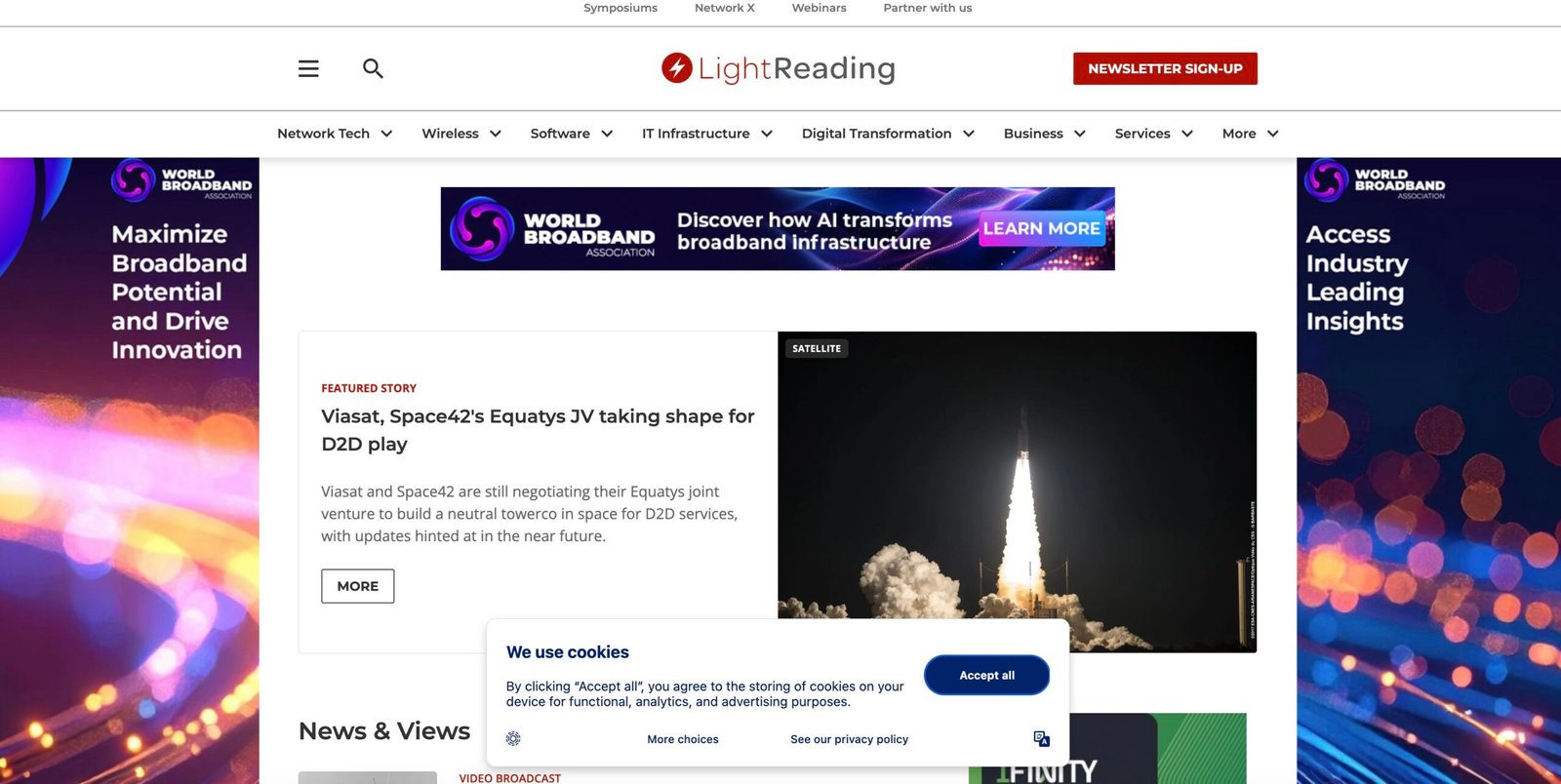
Guide: How to Research, Pitch and Write for Light Reading (Step by Step)
This guide shows you, in clear steps, how to use Light Reading as a target publication — how to spot the right topics, prepare tight newsy or analytical angles, craft a professional pitch or tip, and turn that accepted assignment into paid or career-building work.
You will find a simple workflow, practical templates, and a long resource list of Light Reading pages and sections to open while you write.
Section 1 · What Light Reading publishes
Who reads Light Reading and what they expect
Light Reading is a specialist B2B news and analysis site that focuses on the communications industry: telecom operators, cable companies, cloud hyperscalers, vendors, regulators and the consultants who advise them. The site mixes short news, analysis pieces, deep features, podcasts and sponsored white papers. Their About page explains the remit and shows how editorial staff accept industry tips. (Light Reading — About)
What this means for a writer: they value accuracy, timely facts, sourcing from operators or vendors, sharp analysis, and practical implications. Short, clear reporting and a single strong angle work better than meandering essays.
- News — fast, factual, with a source (press release, operator statement or document).
- Analysis — explains what a piece of news means for operators, vendors, investors or policymakers.
- Features — longer explainers, case studies, buy guides or technology primers.
- Podcasts & Videos — interviews, panels and sponsored content.
- Network operators and engineers looking for actionable updates and technical angles.
- Product and platform teams at vendors watching market moves and case studies.
- Business readers interested in the market and regulatory impact.
| Piece | When to pitch it | Why editors like it |
|---|---|---|
| Short news item | When a vendor or operator releases results, a trial result, a partnership or an SEC/filing | Timely, linkable to source, easy to verify |
| Analysis/Op-Ed | When a trend emerges that needs explanation (eg. 5G slicing uptake, AI in telco ops) | Shows deep thinking and sourcing; adds value beyond the press release |
| Feature / How-to | When you have a case study, demo, or research to share | Helps readers apply a technology or choose between vendors |
Section 2 · Find Light Reading-shaped ideas
How to spot a publishable idea on Light Reading
Don’t start with a lofty topic — start with a news hook, a deployment, a vendor announcement, a public filing, or a measurable test. Light Reading’s site is built around fast industry signals; successful pitches are either (a) tied to a recent event, or (b) provide telegraphed, practical insight into an ongoing market shift.
Is there a clear news trigger?
A press release, regulatory filing, analyst report or product launch makes your pitch easy to verify. If it’s only ‘interesting’, find a way to anchor it to a public or verifiable event.
Does it affect operators or their customers?
Light Reading is read by network operators and the vendor ecosystem. Your angle should say: “This affects operations, cost, performance, policy or business models.”
Can you provide evidence or a source?
Editors like named sources, public reports, quoted documentation, or a working demo. If you rely on anonymous sourcing, explain why and offer corroborating evidence.
Section 3 · Build credible samples & research
What to prepare before you pitch
Because Light Reading prioritizes accuracy and timeliness, you should arrive with: (a) a short sample of your writing in a relevant niche, (b) clear links to sources, (c) a one-paragraph summary and a 4–7 point outline, and (d) if applicable, a demo or data attachment (hosted on GitHub or a public drive — but follow the “do not send attachments” rule in their About page unless requested).
- Publish 1–3 short industry posts on your blog, Medium or LinkedIn that show you can handle facts and sources.
- Include 1 technical or analytical sample (500–1,500 words) about a concrete deployment or vendor comparison.
- Keep code/data on GitHub and link to it; avoid sending heavy attachments directly to editors.
- Press releases and SEC filings (where relevant).
- Analyst notes (Omdia / Heavy Reading / IDC) — cite publicly available press pages if you can.
- Regulator websites and public presentations.
- Operator or vendor blog posts that document trials or deployments.
| Item | Where to host | Why |
|---|---|---|
| Writing sample | Your blog / Medium / LinkedIn | Shows your voice, ability to verify, and structural sense |
| Data & demo | GitHub / CodePen / public S3 | Allows editors to verify claims without attachments |
| Short bio & contacts | Pitch email form or LinkedIn | Makes you reachable for follow-ups |
[email protected] and asks contributors not to send attachments unless requested. See their About page for the three simple rules. (About)
Section 4 · Practical pitch & tip templates
Exactly what to send: three templates
Light Reading publishes both “tips” (quick news leads) and fuller feature pitches. Use the right format. Below are copy-paste templates you can adapt.
Quick Tip / News Lead (email subject: “Tip — [Company] / [Event]”)
Hello Light Reading editors,
I have a tip about [Company / Operator / Regulator] — short summary below. I work at [Your organisation / independent journalist] and can provide a named source or public link.
- Headline idea: [One-line headline]
- Lead fact: [What happened — e.g., trial, partnership, contract value]
- Source / link: [Press release link or public doc]
- Contact: [Name, role, phone/email — or offer to introduce the source]
Happy to expand into a short writeup if useful. Thanks for considering —
[Your name] — [LinkedIn/GitHub/blog link]
Feature pitch (email subject: “Pitch — [Title] — [Short hook]”)
Hello Light Reading editorial team,
I’d like to pitch a [news/analysis/feature] titled: “[Title]”.
- 1-paragraph summary: 3–4 lines explaining the angle and why it matters now.
- Why LR readers care: 2–3 bullets tying the story to operators, vendors, policy or customers.
- Proposed outline:
- Intro: the news hook
- Section 1: technical or business context
- Section 2: case study / data / quotes
- Conclusion: what readers should do or expect next
- Samples & links: [links to 1–3 published samples, GitHub demo, LinkedIn article]
- Estimated length & date: e.g., 1200–2000 words — I can deliver a draft in 2 weeks.
Thank you for consideration —
[Your name] — [Short bio, contact, LinkedIn]
Op-Ed / Analysis (short form)
Hello — I’d like to propose a short analysis (800–1,200 words) called “[Title]”. One-paragraph summary and three evidence points follow.
- Summary: One clear sentence.
- Evidence: bullet 1 (public doc/link), bullet 2 (data point), bullet 3 (quote you can provide or I can source).
- Why it matters: one-line call to action or prediction.
If useful I can prepare a full draft for review. Best — [Your name].
[email protected] as listed on the About page.
Section 5 · Structure, sourcing and what editors expect
Format rules that save your pitch time
Editors want crisp structure and checkable facts. Follow these simple rules when drafting your pitch or sample:
Lead with the fact
In the first paragraph, state the event or claim and the primary source. If your piece is analytical, state the finding (eg. “Operator X’s trial cut latency by Y% in this scenario”) and link to the test or quote.
Use named sources where possible
Anonymity is fine for sensitive tips but explain why and provide corroboration. Named operator or vendor spokespeople increase editorial confidence.
Link — don’t attach
Light Reading’s About page asks you not to send attachments unless requested. Host demos and data publicly and link to them.
| Common editor checks | How to prepare |
|---|---|
| Fact verification | Provide links to primary sources (press release, regulator doc, GitHub) |
| Technical plausibility | Include test conditions, versions, top-line metrics |
| Commercial sensitivity | Be transparent if you are affiliated to a vendor; disclose conflicts |
Section 6 · Money, contracts and career benefits
How contributing can earn you money or career value
Light Reading typically runs staff-written news but also features contributions and analyst commentary. Exact freelance pay rates are not published on the About page, so treat any published pay figures from third-party lists as approximate and confirm with the editor when offered an assignment. What is reliably true: a published piece builds credibility, can lead to paid research/analyst projects, conference invites, consulting and other paid work.
- Direct payment for commissioned features (negotiated case-by-case).
- Sponsored research / white papers and webinars that pay contributors.
- Consulting, product briefings, and conference speaking bookings after you build a public track record.
- Ask about rights (first publication, reprint permissions, exclusivity period).
- Clarify payment terms, invoice process, and whether you keep copyright.
- Request an editor’s feedback loop and timeline for publication slots.
| When to ask for pay | How to ask |
|---|---|
| Commissioned feature | Confirm fee when the editor asks you to write the piece (before you start work) |
| Tip turned into article | Ask whether it is staff work or a contributor piece; negotiate if they request an exclusive draft |
| Reused content | Negotiate reposting rights and attribution clearly |
Section 7 · Ethics, embargoes & AI
Honesty and verification — the non-negotiables
Light Reading aims to “inform and enlighten” and will expect you to stand by facts and sources. Do not invent quotes or statistics. If you use AI to draft, fully verify and rewrite before submission; your byline carries responsibility for accuracy.
- Submitting AI-generated content without fact-checking and attribution.
- Claiming confidential or embargoed information without permission.
- Misrepresenting data or omitting crucial caveats.
- Offer named sources and links to primary documents.
- Make clear which elements are opinion vs reporting.
- Flag embargoes and respect them if asked.
[email protected]
Section 8 · Pre-pitch checklist & templates
Final micro-SOP before you hit send
Use this checklist for every pitch and tip.