


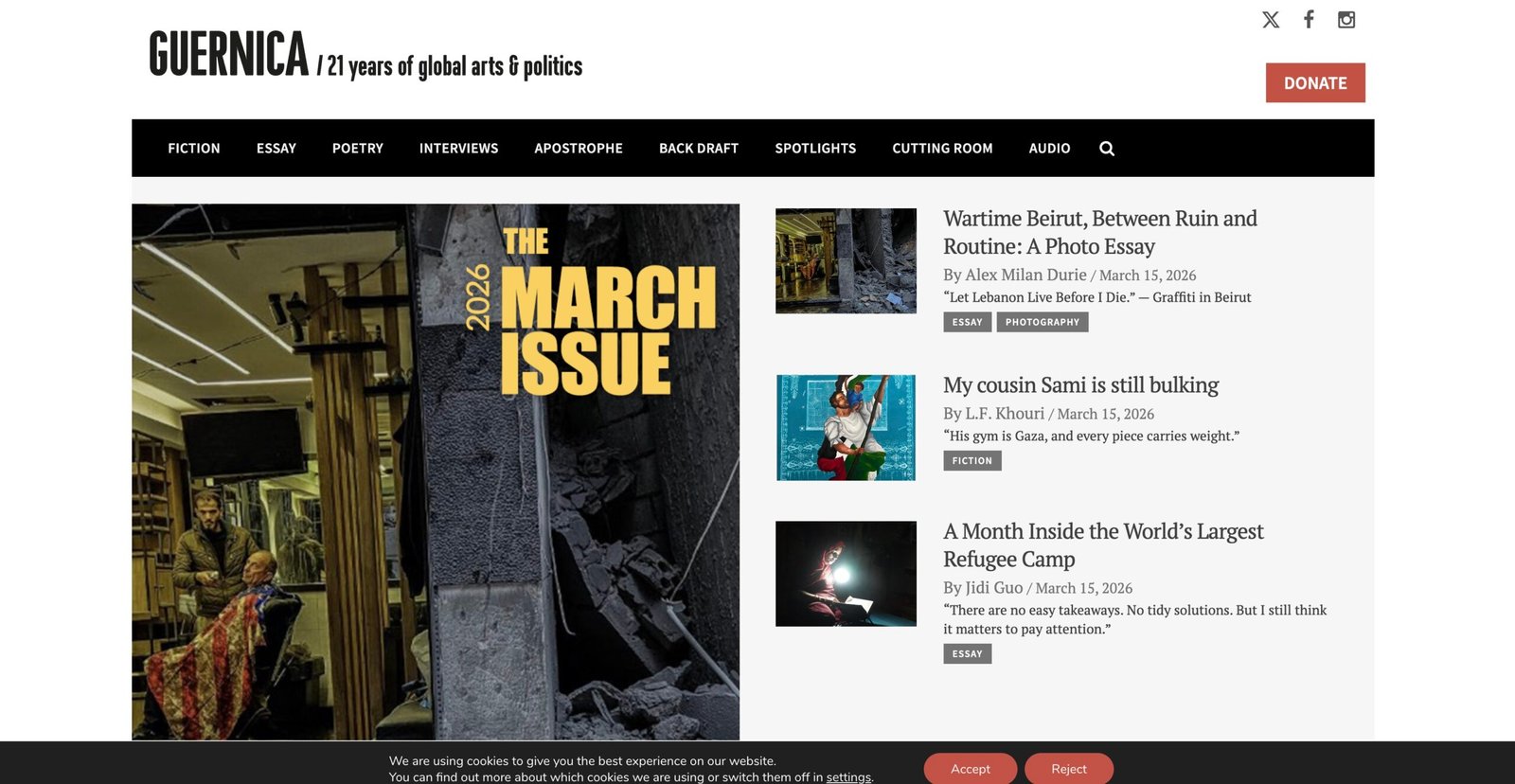
How to Write for Guernica Magazine — A Practical Beginner’s Guide
This guide will walk you, in actionable steps, through researching Guernica, preparing publishable fiction, essays, criticism, or reportage, and submitting through their official channels. Use the templates and checklist to turn ideas into finished submissions that respect editors’ expectations.
You will learn what Guernica publishes, how their submission process works (they use Submittable), how to format and polish manuscripts, sample cover letters, ethics and rights pointers, and what to do after an acceptance or rejection.
Section 1 · Quick facts
What Guernica is — short and important
Guernica is an independent, nonprofit magazine that explores the intersection of art, culture, and politics with a global perspective. Their pieces range from literary fiction and poetry to long-form essays, criticism, and reportage. Founded in the early 2000s and publishing online since 2004, Guernica has a reputation for rigorous, humane, and often experimental work that engages current events, history, and aesthetic questions.
Why this matters: Guernica values craft, original perspectives, and careful reporting. Their audience expects thoughtful analysis and well-rendered writing — not listicles or recycled hot takes. Keep that expectation central when you plan a submission.
Key official pages to bookmark before you write:
Section 2 · What they publish
Genres, length expectations, and editorial slant
Guernica accepts several categories of work, but the two most used submission forms are general fiction and general nonfiction. Their Submittable pages clearly list the expectations: fiction submissions typically range from about 2,000 to 7,000 words, while nonfiction submissions (journalism, essay, reportage) generally start around 2,500 words or more. They also publish poetry and translations in separate spaces and value work that brings literary craft to a political or cultural question.
Important editorial slant: pieces that combine careful reporting or research with literary sensibility tend to perform well. If your nonfiction is purely op-ed without reporting or careful sourcing, it may be less competitive. If your fiction is experimental, make sure it remains readable and emotionally resonant.
- Accepts short/long short fiction (check Submittable limits: ~2,000–7,000 words).
- Translations are welcome when rights are clear.
- Avoid flash fiction-only submissions unless the Submittable form specifically allows it.
- Essays, reportage, critical longform typically 2,500+ words.
- They ask for full manuscripts (not pitches) for general submissions — see Submittable forms.
- They explicitly note they do not accept certain items (interviews, book reviews) via the general forms.
Section 3 · Official submission rules (brief)
How Guernica currently accepts work — the facts you must follow
The single most important rule: follow the submission instructions on Guernica’s official Submittable forms. Guernica uses Submittable as its submission manager — fiction and nonfiction have separate forms with clear instructions. Their forms request completed manuscripts rather than short pitches; read each form carefully before uploading.
Why this matters: editors screen out submissions that ignore their process. Submitting outside the requested platform, or sending a pitch when the form asks for a full manuscript, usually results in a quick rejection or no response. Always use the right Submittable form for your genre.
- Sending an email attachment when the form requires Submittable upload.
- Submitting flash pieces where the form disallows them.
- Failure to follow word-count or rights requests on the form.
Section 4 · Prepare your manuscript
Polish, format, and verify before you submit
Guernica receives professional submissions. The quality bar is high, so treat each submission like a job application. That means: perfect grammar, readable layout, accurate facts and sourcing, and a clean manuscript file (DOCX is usually safest unless Submittable asks for plain text).
Formatting checklist (practical):
- Use a simple, readable font (12pt Times or 12pt Georgia / 11–12pt serif or sans-serif).
- Double-space prose for editorial ease, unless otherwise requested.
- Number pages and include your title in the header or first page.
- For fiction, include a short bio and contact details in the designated Submittable field, not at the top of the manuscript.
- Provide source links for facts, reporting, or quotes (either inline or in a short bibliography at the end).
- If you use images, confirm image rights and include captions + credits; Submittable often allows attachments for images but check the form.
If your nonfiction involves reporting, create a short “reporting note” that explains how you gathered facts, what interviews you conducted, and any potential conflicts of interest. Editors appreciate transparency.
Section 5 · Genre-specific guidance
Actionable tips by genre: fiction, nonfiction, poetry, and translation
Fiction for Guernica often has a literary edge and a sense of moral or emotional urgency. Even experimental pieces should feel purposeful: there must be stakes, interior motion, or an idea worth the form. Before you submit:
- Trim anything that doesn’t move character or theme forward.
- Provide a short author bio (1–2 lines) in the Submittable form; do not attach a CV unless asked.
- If submitting a translated piece, make sure you can confirm rights and, ideally, include both original-language credit and translator bio information.
For essays and reportage, Guernica expects solid sourcing and an engaging narrative. Longform essays that synthesize several texts or events are welcomed when they bring analysis and evidence together in a clear, literary voice.
- Offer clear sourcing for statistics and quotations.
- For investigative or deeply reported stories, include a brief note on your reporting process or permissions for interview material.
- Provide a strong lede — an opening paragraph that shows why the subject matters now.
Poetry submissions often appear in specific reading windows; translations that bring international voices to English readership are valued. Always include translator credits and confirm you have the right to submit translated work.
- Check whether Guernica accepts poetry year-round or in open calls.
- For translations, include original-language credits and a translator note if relevant.
Section 6 · Rights, payments, and ethics
Understand rights, payments, and what to disclose
Payment policies and rights assignments differ from piece to piece. Guernica is a nonprofit that commissions writing; payment and rights are usually specified by the editor in acceptance communications. Never assume you retain all rights without confirming them in writing.
Practical rules:
- Do not post the full text of your piece on your personal site before official publication unless the editor has given permission.
- Ask for written confirmation of payment amount and any exclusivity period before reposting or reprinting.
- If you plan to submit a simultaneous submission (send the same piece elsewhere), check the Submittable form for guidance — many literary outlets prohibit simultaneous submissions or ask to be informed.
Section 7 · Step-by-step submission SOP
Exactly what to do, in order — a micro-SOP
Open the Guernica Submittable form for your genre
Pick the right submission form (fiction / nonfiction / poetry). Read every instruction on that page — word counts, what to include in the submission fields, and whether images or attachments are allowed.
Proof, fact-check, and attach supporting material
Proofread carefully. For reportage, attach a short reporting note or list of sources if the form allows. Prepare a short bio (1–3 sentences) and any relevant links (portfolio, prior publications).
Upload to Submittable and fill the form completely
Fill every required field, paste your cover letter into the appropriate field (not as an attachment unless asked), and upload the manuscript file. Confirm contact details and click submit. You should receive a Submittable confirmation email.
Keep a simple tracker of submissions and dates
Use a spreadsheet with columns: title, form submitted to, date submitted, expected response (if stated), and current status. That spreadsheet helps you follow up professionally if needed.
Section 8 · Templates: cover letters, bios, and reporting notes
Copy, paste, adapt — real templates that have worked for writers
Use this in the Submittable ‘cover letter’ field for fiction:
Hello Guernica editors,

Title: “[Your story title]”
Word count: [X]

A short note: This story explores [one-sentence theme or stakes]. I think it might suit Guernica because [one line connecting your story to Guernica’s interests — e.g. global politics, cultural change, intimate moral questions].

Bio: [1–2 lines — relevant credits, if any; or a brief line about where you write from / what you do].

Thank you for your time and consideration.

Best,
[Your Name]
[Email] | [Website or link to prior work]
Keep it concise — editors read many letters; state the essentials, not your life story.
Use this when submitting long nonfiction:
Hello Guernica editors,

Title: “[Your essay title]”
Estimated word count: [X]

Brief pitch (2–3 sentences): This essay argues [main claim] by bringing together [reporting / texts / archival material]. I gathered reporting from [mention key interviews / travel / archives]; I can provide more sourcing notes if useful.

Reporting note (short): I interviewed [A] and [B]; I reviewed [documents / studies X]; I have permission to quote [named sources] where needed.

Bio: [1–2 lines — relevant reporting/academic background, prior publications].

Thank you for considering this submission.

Sincerely,
[Your Name]
[Email] | [Website or sample links]
Editors appreciate clarity about sources and methods; that reduces back-and-forth and increases trust.
Examples you can adapt: — “[Name] is a writer from [city/country]. Their work appears in [notable publications].” — “A [profession], [Name] writes about culture, memory, and migration. Their fiction has appeared in [journal].”
Section 9 · After you submit
What to expect: timelines, follow-ups, and edits
Typical process: Submittable will send a confirmation email. Editors may take weeks or months to respond depending on backlog and the kind of piece. If an expected response window is posted on the form, respect that window before following up. A polite follow-up after a reasonable interval (often 8–12 weeks) is acceptable; keep it short and professional.
If accepted, you’ll typically receive an offer email with payment terms, an editor contact, and next steps for edits and scheduling. Read the acceptance carefully: it will often include a contract or a request to sign a standard contributor agreement. Clarify rights and payment if not specified.
Section 10 · If you get rejected
Turn rejection into progress — an honest plan
Rejection is part of publishing. Use it constructively:
- Save the editor’s rejection text (they sometimes offer feedback).
- Revise the piece with fresh eyes: tighten, clarify, or reframe the angle.
- Consider different outlets — smaller magazines, curated newsletters, or literary journals that accept similar work.
- Reuse the piece as a portfolio example to attract freelance or commission work.
Many successful writers received rejections early in their careers. Persistence + focused improvement is the reliable strategy.
Section 11 · Long-term strategy
Build a writing ladder: samples, clips, and relationships
- Publish 3–5 strong pieces (your blog, Medium, local literary journals).
- Use those clips to approach Guernica with a polished submission.
- Work with smaller editors first to learn editorial workflow.
- Collect bylines and use them when you pitch or apply for grants/commissions.
- Follow Guernica editors on Twitter or Mastodon — read and interact with their work responsibly.
- Attend readings and panels where Guernica editors or contributors appear.
- Be professional in all contact: concise subject lines, clear attachments, good manners.
Section 12 · Final checklist & tools
Your pre-submission checklist
- Guernica Submittable portal — choose the correct form and read its guidance.
- Guernica — Submissions (official) — policy and links.
- Guernica — Contact — for press and permissions queries.
- Masthead / Staff bios — find editor names when needed for polite address (do not cold-email editors about submissions).
- Submittable Help — for technical questions about uploads and confirmations.
Section 13 · FAQ
Short answers to common beginner questions
Section 14 · Extra resources & curated links
References, official pages, and helpful articles (open these now)
- Guernica — Submissions (official)
- Guernica — Contact (official)
- Guernica — Submission portal on Submittable
- Guernica — About / History / Mission
- Guernica — Masthead / Staff bios
- Guernica (magazine) — Wikipedia overview
- Submittable — general help & tutorials
- Poets & Writers — market listings and submission advice
- Duotrope — market tracker (paid)
- Additional literary resources & writing communities
- Industry pay / submission summaries (general reference)
- Submittable Blog — best practices for submitters