


Guide: How to Research, Write, Pitch, and Earn from a New York Times Modern Love Essay — Step by Step (Beginner)
This practical guide takes you from idea → outline → draft → pitch → publication. It focuses on New York Times’ Modern Love (the column that runs the weekly personal-essay slot about relationships and intimacy). You’ll get a clear workflow, sample outlines, a pitch template, editing & ethics advice, and a long list of places you can publish—even if you don’t get into Modern Love right away.
Quick reference: official submission help from The New York Times: How to submit a Modern Love essay. Keep that tab open while you prepare your pitch.
Section 1 · What Modern Love is
Understanding the column and editorial expectations
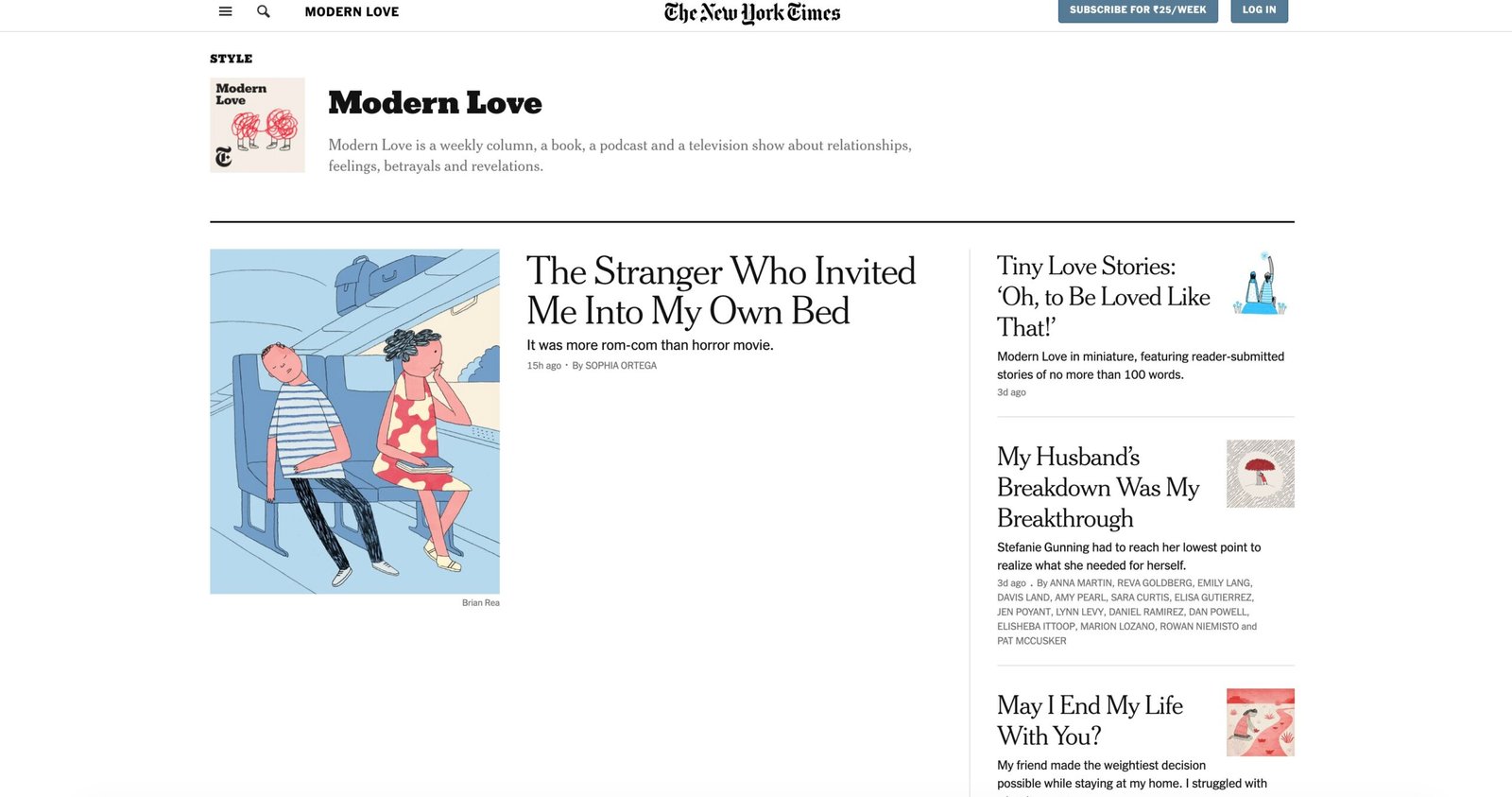
Modern Love is a New York Times column and series of personal essays that explore contemporary love and relationships — romantic and otherwise — in a deeply human, intimate voice. Essays that run in Modern Love are narrative, honest, and usually center one clear scene or turning point, then reflect on meaning. They are storytelling-first: strong openings, emotional beats, and an arc that earns the lesson.
Important fact checks and context from independent reporting: the column is highly competitive (very low acceptance rates) and writers and roundups report that published essays are often edited in consultation with the author. :contentReference[oaicite:0]{index=0}
- Originality of angle: a fresh, specific experience or brilliantly framed take on a common theme.
- Narrative arc: a clear beginning (scene), middle (complication), and a reflective ending.
- Voice & honesty: vulnerability plus craft; details that show you lived it.
- Clarity of scope: one story, one arc — not a scattershot memoir.
- Reliable facts & respectful language: names, dates, and privacy considerations handled carefully.
Modern Love essays are usually in the range of 800–1,600 words (many fall near ~1,000 words), written in first person, and focused on one narrative experience with universal resonance.
Note: exact lengths and policies can change — always check the NYT submission page before you submit.
Quick links you should keep open while preparing (official NYT link plus helpful third-party write-ups and submission guides are listed later in the resources section).
Section 2 · Is your story a Modern Love story?
Three litmus tests to decide if you should write this for Modern Love
Is this a single, specific story with stakes?
Modern Love favors a scene that can be written vividly: a moment, a revelation, an ending, a decision. If your idea is a life-long catalog of events, try to select a single episode that carries emotional weight and can be told in one essay.
Does the story give the reader new insight about relationships?
The column tends to reward pieces that turn the personal into the universal — something intimate that illuminates a broader truth about love, grief, modern dating, partnership, family, or identity.
Can you tell it with specific, verifiable details?
Sensory details, dialogue, precise moments, and verifiable context (no invented statistics or undisclosed composites) make a piece feel true. If you lack details, consider rebuilding the experience by revisiting documents, messages, photos, or timelines.
Section 3 · Research & reading list
Read examples, learn the voice, and collect model essays
Before you write, read 6–12 recent Modern Love essays. Notice the openings, how the writer lands the scene, how much reflection happens vs. showing, and where the emotional turn appears. Annotate each essay: underline the lead sentence, the scene transitions, and any lines that feel like craft moves you can borrow.
- Modern Love — The New York Times (column archive) — the primary reference for voice & structure.
- How to submit a Modern Love essay — submission guidance (official NYT page).
- Unofficial Modern Love index — archive & search by topic (useful for spotting similar published angles). :contentReference[oaicite:1]{index=1}
- Jane Friedman — How to get published in Modern Love (craft + pitching advice). :contentReference[oaicite:2]{index=2}
- Mountford Writing — practical steps to improve Modern Love submissions. :contentReference[oaicite:3]{index=3}
- WriterMag analysis — craft patterns found in Modern Love essays. :contentReference[oaicite:4]{index=4}
Two short reading exercises:
- Pick three Modern Love pieces you love. For each, write a 6–10 sentence summary of the arc (scene A → turning point → resolution + author’s reflection).
- For one of those pieces, copy the first 150 words and annotate how the author establishes voice and stakes. This trains you to open strongly.
Useful reminder: some third-party lists and pay-roundups collect markets and payment intel for personal essays. These are great for next-step markets if Modern Love is too competitive. :contentReference[oaicite:5]{index=5}
Section 4 · Practical writing recipe
From idea to finished draft — step-by-step
Lock the core sentence
Write a single sentence: “This Modern Love essay shows how [specific event] made me realize [insight].” That sentence becomes your spine. If it isn’t specific, narrow the story until it is.
Create a tight outline (4–6 beats)
Example beats:
- Lead scene — 1-2 short paragraphs that drop us right into the moment.
- Immediate consequence — what changed right after the scene?
- Backstory — why this matters (brief, essential details only).
- Complication — the challenge or dilemma.
- Turn — the realization or decision.
- Reflection & closing — the universal insight and a concrete image to end on.
Write a cinematic opening
Modern Love openings are usually scene-driven. Avoid starting with thesis statements like “I learned X.” Start with a concrete moment: dialogue, motion, weather, or an object that anchors memory.
Use sensory detail and short scenes — then reflect
Show with a few tight scenes. Then write one or two paragraphs of reflection that feel earned. Ask: did the reader have to experience the scenes to arrive at this reflection?
End with a concrete image or small action
The best endings return the reader to a small, concrete moment that resonates emotionally. Avoid abstract sermonizing — close in a tiny, memorable detail.
Sample openings (templates you can adapt)
Template A — The immediate scene
The apartment smelled like lemon oil and old coffee when I opened the door.
It was one of those nights where the city had decided to press itself quiet, and the light coming through the kitchen window looked like the last page of a photograph.
I had just returned from a flight, hands full of unspent apologies.
Template B — The striking line
"I told him I would leave the marriage if he didn't stop bringing home stray dogs," I said, and then I meant it.
Write 3–5 different openings (15–25 minutes each). Pick the one that makes the reader care fastest.
Drafting tips
- Write the first draft quickly. Get scenes down without self-editing exhaustively.
- Second pass: tighten each scene to 4–6 sentences if possible. Remove anything repetitive.
- Third pass: polish sentences for rhythm, cut clichés, verify names/dates.
- Read the piece aloud — listen for flatness and where the emotional beat drops off.
Section 5 · Pitching & submission mechanics
How to make a clean, professional Modern Love pitch
The NYT’s Modern Love accepts reader submissions through a submission mechanism described on their site. When you pitch, follow their format and fields exactly. If they ask for a short summary, give a 2–3 sentence outline (the spine). If they ask for full text, paste the polished essay. Always follow the official submission page directions.
- Your full contact info (name, email, location).
- Short bio (1–2 lines) that establishes why you’re the person to tell this story.
- One-sentence pitch (the spine sentence: this essay shows how…).
- Short outline or the full manuscript, based on the NYT form requirements.
- Links to relevant published work or a writing sample.
- Any relevant permissions (if you quote or include identifiable third parties — see ethics section).
Be concise, professional, and human. Editors receive many pitches — make it easy for them to understand your idea in the first 2–3 lines.
If you are asked for a full draft, paste the clean, formatted text with paragraph breaks. If asked for an excerpt or summary, follow their instructions exactly — do not send attachments unless requested.
Practical note: third-party reporting indicates published Modern Love essays are edited collaboratively and that the column does compensate authors. Payment reports vary year-to-year and by piece — independent sources have reported figures commonly cited in pay-roundups. :contentReference[oaicite:6]{index=6}
Section 6 · Editing, ethics & AI
How to be responsible, honest, and publication-ready
If you write about other people (partners, exes, children, colleagues), do one of the following:
- Use initials or descriptors (e.g., “my former partner”) and avoid exact identifying details if you cannot obtain permission.
- Ask permission when feasible. If someone refuses and your piece depends on their perspective, rethink the approach.
- Fact-check dates, places, and any quoted material. Editors may ask for confirmation.
- AI is fine for brainstorming headings, proofreading, and generating grammar suggestions.
- Do not submit AI-generated text as your own — the author must be the human who lived and verified the story.
- If AI helped substantially, keep careful records of changes and be ready to explain your process to an editor.
Golden rule: be prepared to defend every claim and line in a conversation with an editor. Editors appreciate honesty; they will edit for clarity and may ask for rewrites rather than outright rejection.
Section 7 · Money & rights
Payment expectations, rights, and what a Modern Love byline can do for you
Concrete pay numbers for Modern Love are reported in public roundups and writer communities — figures often cited in writer guides list pay in the low-to-mid hundreds per accepted piece in previous rounds (examples and roundups exist online). Always confirm with the NYT after acceptance for current rates and contracts. :contentReference[oaicite:7]{index=7}
- Many personal-essay markets pay anywhere from $50 to $2,000+ depending on outlet. NYT Modern Love historically sits among the more prestigious slots — pay may not be top-tier compared with trade features, but the value of the byline and exposure can be significant.
- Expect a flat fee per piece and an author agreement that covers rights and republication terms (read carefully).
A Modern Love byline can open doors: speaking offers, book interest, agent attention, or steady freelance work. Think of the piece as both immediate income and longer-term portfolio leverage.
Quick tip: negotiate nothing on first contact. If accepted, editors will send an offer with payment and rights. If you have special requests (repost rights on your blog, translations), bring them up during contract negotiation.
Section 8 · If Modern Love is too competitive — other paying markets
Places to build clips and earn while you aim for NYT
Modern Love is famously selective. If you are building a portfolio, pitch to other reputable outlets that pay for personal essays. Many curated lists collect paying markets for personal narratives — use them to plan a ladder: smaller outlets → regional magazines → national columns. :contentReference[oaicite:8]{index=8}
| Market | Why consider it | Notes |
|---|---|---|
| Dev.to | Easy place to publish tech-adjacent personal essays and tutorials quickly. | Free, great for getting publishing practice and links to sample work. |
| Medium (Partner Program) | Potential small earnings and wide audience. | Pay via member reading time; republication allowed in many cases. |
| Narratively | Focused narrative journalism and personal stories; pays for strong work. | Editors curate strong narrative work — good practice for Modern Love. |
| The Rumpus | Literary essays & longform personal work. | Often pays; good for literary voice development. |
| Freedom With Writing — Paying markets list | Curated list of outlets that have historically paid for personal essays. | Use as a research starting point. :contentReference[oaicite:9]{index=9} |
| The Freelancers Year — pay roundup | Useful list and craft tips for personal essays and who pays. | Check individual site guidelines before pitching. :contentReference[oaicite:10]{index=10} |
When you publish elsewhere first, link to those samples in your Modern Love pitch — editors want to see that you can produce finished, edited work for public audiences.
Section 9 · Templates: pitch, outline, follow-up
Copy these templates and adapt them
Modern Love pitch template (short)
Subject: Modern Love submission — "Working title" — [Your name]

Hi Modern Love editors,

I'm submitting the piece below for consideration for Modern Love.

Title: "Working title"
Pitch (1 sentence): This essay shows how [specific event] made me realize [insight].
Short bio (1 line): I'm [name], a [job/role] based in [city]. My work has appeared at [publication 1] / [link to sample].
Attachments/Links: [link to manuscript or paste below]
Full contact: [email / phone]

Thank you for your time,
[Your name]
Short outline template (paste into the form)
1) Opening scene — where/when, sensory detail (80-160 words)
2) Immediate aftermath — consequences (60-120 words)
3) Backstory (brief) — why this matters (100-180 words)
4) Complication — what makes this complicated (90-160 words)
5) Turn — realization/decision (80-140 words)
6) Closing image & reflection (60-120 words)
Polite follow-up (if allowed)
Subject: Follow-up on Modern Love submission — "Working title" — [Your name]

Hi — I hope you’re well. I sent a submission on [date]. I wanted to politely check if you had a chance to look at it. Happy to provide any additional info if that helps.

Thanks again for your time,
[Your name]
Do not follow up too soon — wait at least 2–4 weeks unless the NYT form gives a different timeline.
Section 10 · Final checklist & next steps
Use this checklist before you submit
- Finalize one polished essay; ask a trusted reader to critique it for clarity and emotional logic.
- Prepare a short 1-line bio and links to your best published work.
- Submit through the NYT Modern Love submission link (keep the official page open while you work).
- If you don’t hear back: publish the piece on another platform, gather traffic and comments, then consider resubmitting a revised version with added publishing context (if NYT allows resubmissions per their guidelines).
Additional Resources & reading
Links cited in this guide and helpful follow-ons
- Modern Love — The New York Times (column archive)
- How to submit a Modern Love essay — NYT guidance (official submission page).
- Unofficial Modern Love index (archive). :contentReference[oaicite:11]{index=11}
- Jane Friedman — How to get published in Modern Love (advice on voice & pitching). :contentReference[oaicite:12]{index=12}
- Mountford Writing — Modern Love workshop & tips. :contentReference[oaicite:13]{index=13}
- WriterMag — analysis of Modern Love craft and acceptance rates. :contentReference[oaicite:14]{index=14}
- Freedom With Writing — list of paying markets for personal essays. :contentReference[oaicite:15]{index=15}
- Freelancers Year — pay roundup for personal essays. :contentReference[oaicite:16]{index=16}
- CreativeWritingNews — submission overview & historical notes. :contentReference[oaicite:17]{index=17}
Modern Love — research. Keep them open while drafting and pitching.