


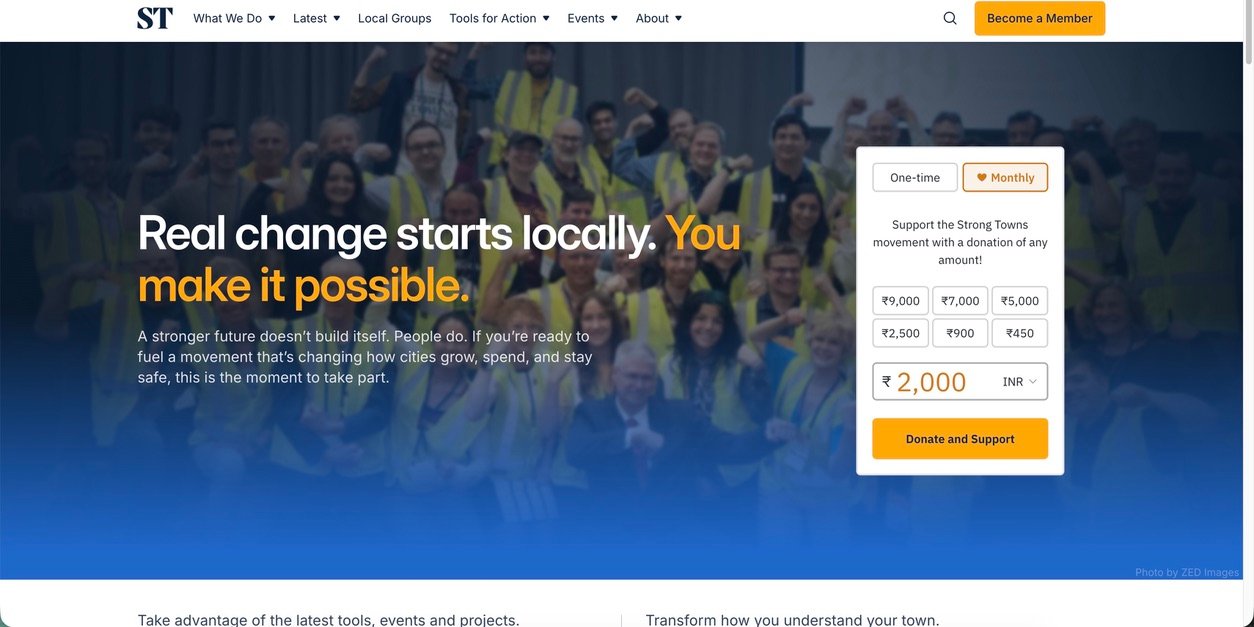
Guide: How to Research, Pitch, and Write for Strong Towns (Beginner → Paid/Published)
This long guide explains, step-by-step, how Strong Towns chooses articles, how to shape a pitch that matches their mission, what their style expects, and real templates you can copy for email pitches and outlines.
We gathered Strong Towns’ public guidance (links included) and added actionable writing templates, sample outlines, and a full pre-submission checklist so you — even as a beginner — can prepare a submission that editors will respect. Key official resources are included below. :contentReference[oaicite:0]{index=0}
Section 1 · What Strong Towns values & expects
Understand the organization’s mission and editorial focus
Strong Towns is a mission-driven nonprofit focused on **financially resilient, human-scale places** — critiquing sprawling, car-dependent development and promoting incremental, practical, fiscally sustainable solutions for cities and towns. Their content emphasizes local examples, clear economics, and actionable steps citizens and planners can take. :contentReference[oaicite:1]{index=1}
Why this matters to your pitch: Strong Towns does not publish generic urbanism commentary or partisan advocacy. Your piece must clearly connect to their mission (streets, public finance/accounting, parking policy, housing, incremental development, safe productive streets, etc.) and explain the practical consequences for local places or decision-makers.
- A clear connection to Strong Towns’ approach and mission. :contentReference[oaicite:2]{index=2}
- Readable explanations for a non-expert audience (avoid jargon).
- Concrete examples, case studies, or local reporting (not only abstract theory).
- Non-partisan language and verifiable facts.
Readers include citizens, local officials, planners, journalists, and practitioners who want practical ideas for stronger local places. Articles that teach a repeatable action or expose a financial/engineering truth tend to perform best.
Section 2 · Does your idea fit Strong Towns?
Turn a broad interest into a Strong Towns-shaped idea
Don’t pitch a generic “why planners are wrong” essay. Instead, start with a local problem and a clear lesson. The easiest way to test your idea: write one sentence that begins, “This Strong Towns article shows how (who) can (do what) to (achieve what) in (place/context).” If you can fill those blanks, you have a Strong Towns-shaped idea.
Connect to a Strong Towns theme
Map your idea to one of their core focus areas: local accounting and finances, parking policy, street safety/productivity, incremental housing, ending highway expansion, or campaign-specific topics. If you can explicitly tie it to a Strong Towns principle, the editor will immediately see the fit. :contentReference[oaicite:4]{index=4}
Is it concrete and local?
Best-performing pieces show: a place (city neighborhood, small town), a measurable financial or safety problem, and evidence-based steps someone took or can take. Vague op-eds are less likely to be accepted.
Can you back it up with reporting or an example?
Editors prefer first-hand reporting, interviews, municipal documents, or a clearly documented demonstration project. If your idea depends only on academic theory, build a small local example or collect public records to strengthen it.
Section 3 · Prep: research, evidence & demo
Do the legwork editors expect
Strong Towns editors value accuracy and evidence. Here are practical steps to prepare a publishable article that stands out.
- Collect primary sources: municipal budgets, meeting minutes, traffic crash reports, engineering memos, planning department PDFs.
- Interview two to three local stakeholders (planner, business owner, resident) and quote them with short attributions.
- Find one clear before/after measurable outcome if available (costs, crashes, vacancy rates).
- Link to public documents and data visualizations (tables, maps, simple charts).
Create a clear visual (map screenshot, chart from spreadsheet, annotated photo) that highlights the change you describe. Editors love obvious, usable visuals that make the article scannable.
If you can produce one small dataset or chart (even a 2-column table showing costs before/after), it strengthens your argument and increases the odds an editor will assign photos and promotion.
Section 4 · Strong Towns’ submission rules & style
Follow official guidance exactly — and read the style guide
Strong Towns publishes official contributor guidance on their Action Lab help center and provides a guest-writer style guide (PDF). Key public rules to note:
- Pieces must be tied to the Strong Towns mission and approach and be accessible to a general audience. :contentReference[oaicite:5]{index=5}
- Articles should be non-partisan and should not overtly promote a product or service. :contentReference[oaicite:6]{index=6}
- Suggested length: typically between 500 and 1,800 words. Longer pieces may be accepted but often as a multi-part series. :contentReference[oaicite:7]{index=7}
- Download and read the Strong Towns Guest Writer Style Guide PDF for tone, preferred spellings, terms, and house style. (Link in resources below.) :contentReference[oaicite:8]{index=8}
- Brand assets and visual guidelines exist in the Strong Towns brand guide if you are providing graphics or logos. :contentReference[oaicite:9]{index=9}
Where to send pitches and how to label them
Strong Towns publishes specific pitching instructions. For longform story ideas they have used a story-producer email (for example, seairra@strongtowns.org) and they also point to contacting the editor for article submissions. Their Action Lab pitching article explicitly states how to pitch and mentions contacting the Editor-in-Chief, Shina Shayesteh, at shina@strongtowns.org for article submissions. See resources. :contentReference[oaicite:11]{index=11}
Section 5 · Step-by-step pitch workflow + templates
A compact SOP to prepare and submit a winning pitch
Refine your idea into a one-sentence pitch
Example: “This article explains how [Town X] reduced stormwater maintenance costs by documenting right-of-way expenditure and shifting to low-cost incremental repairs.”
Write a 3–5 bullet outline
Include section headings and one sentence about what each section will cover. Keep it practical: “Intro — problem in 2 paragraphs”, “Budget analysis — cite docs”, “Intervention — what was done”, “Results — numbers or observations”, “Takeaways — 3 actionable steps for readers”.
Collect links + samples
Attach links to: your writing samples, GitHub or data files, municipal PDFs, and 1–2 photos (high-res) you can provide. If you have published reporting on the topic, include it.
Email the right contact — subject line + short pitch
Send to the address given in their contributor guidance. If pitching a longform story, use the story-producer address (example: seairra@strongtowns.org); for article submissions contact their editor (example: shina@strongtowns.org). Keep the email short: subject line, one-sentence hook, 3–5 bullet outline, links, and a 1-2 sentence bio. :contentReference[oaicite:12]{index=12}
Sample short email pitch (copy/paste)
To: seairra@strongtowns.org (or shina@strongtowns.org)
Subject: Longform pitch: How [Town X] cut street maintenance costs by fixing curb-to-curb defects
Hi [Name],
Short hook: In [Town X], a program of targeted curb repairs cut annual right-of-way maintenance by 24% and saved $X over two years — I can show the public accounting and steps other towns can replicate.
- Outline:
- Intro: the local problem in 2 paragraphs.
- Budget detective work: municipal line-items and interview w/ public works.
- Intervention: what the town did and why (process + contracts).
- Results: costs, before/after photos, interviews.
- Takeaways: 3 steps other places can start next week.
- Samples & links: [link to sample article], [link to municipal budget PDF], [link to photos or repo].
- Bio: One short sentence: who you are, your reporting/technical background, and an email/phone.
Thanks for considering — I’d be happy to adapt this to Strong Towns’ voice and length guidance.
— [Your name]
Section 6 · Ethics, tone & non-partisanship
Write with accuracy, humility, and clarity
Strong Towns explicitly requires submissions to be non-partisan and accessible to a general audience. Avoid suggesting partisan motives or using polarizing language — focus on the local facts, budgets, and direct consequences of policy choices. :contentReference[oaicite:13]{index=13}
- Overt political attacks or endorsements.
- Promotional copy for vendors, companies, or products.
- Unverified statistics or claims without citation.
- Derogatory or mocking language about locals or officials.
- Use neutral language: describe what happened, who decided, and what the measurable impact was.
- Quote sources and link to documents.
- When in doubt, offer readers practical next steps rather than broad moralizing.
- If you used AI tools to draft, disclose and heavily verify — the author is responsible for accuracy.
Section 7 · Monetization, republishing & author rights
Money and reuse — what to expect with a nonprofit outlet
Strong Towns is a nonprofit and historically pays contributors variably (some nonprofit outlets pay modest flat fees; others publish volunteer contributors). Their public materials emphasize mission and quality rather than a public pay scale. If payment is important to you, ask explicitly in the pitch whether a fee is available and what terms apply. Always get payment terms in writing before substantial extra work. :contentReference[oaicite:14]{index=14}
Republishing & rights
Nonprofits often request a first North American electronic publication right and allow authors to repost after an exclusive period; exact terms vary. At acceptance, request written confirmation of the license they ask for (one-time exclusive, non-exclusive, length of exclusivity). If you plan to repost on your own site, ask the editor what they prefer and whether to wait a specific period.
Use articles as portfolio assets
Even if pay is modest or zero, a Strong Towns byline can open doors (speaking, consulting, local credibility). Treat each published piece as a professional asset: add it to your portfolio, link it on LinkedIn, and use it when pitching local clients who need evidence-based planning support.
Section 8 · Pre-submission checklist & sample pitch
Everything you must confirm before you hit Send
Full sample long pitch (detailed) — paste & adapt
To: seairra@strongtowns.org (Lead Story Producer) and/or shina@strongtowns.org (Editor-in-Chief)
Subject: Longform pitch for Strong Towns — [Short Hook Sentence]
Hi Seairra / Shina,
Hook (1–2 sentences): In [Town X], a small program of prioritized curb and alley repairs cut annual right-of-way operating costs by 24% over two years while improving pedestrian access — I have municipal audit lines and interviews with the public works director that show the accounting mechanics behind the savings. This would be a Strong Towns story because it reveals how local accounting decisions and incremental work can change a city’s fiscal trajectory. :contentReference[oaicite:17]{index=17}
Why this fits Strong Towns: It ties to Strong Towns’ emphasis on incremental work, public accounting, and fiscally sustainable places (local example + replicable steps).
Outline (short):
- Intro — the local picture & problem (2 paragraphs)
- Budget evidence — municipal line-items showing the cost problem (link to PDF)
- What changed — the incremental program, contracts, process
- Results — quantified cost change, short interviews, before/after photos
- Takeaways — 3 replicable steps for other towns
Sources & attachments: Link to municipal budget PDF, spreadsheet with simple calculations (CSV), 3 photos (high-res), 2 interviewees (names + roles), sample public meeting citation.
Samples: [link to 1–2 published articles or long-form samples]
Bio: One sentence describing your background (reporter/planner/engineer), contact info, and availability for follow-up.
Happy to adapt length and angle. Thanks for considering — I’d love to work with Strong Towns’ editors to turn this into a 1,000–1,600 word piece or a two-part series if you prefer.
Best,
[Your Name] — [email] — [phone]
Section 9 · FAQ & Resources (official links you should open)
Quick answers and the most important official resources
shina@strongtowns.org for article submission. For longform storytelling/video projects they have used a story-producer contact (seairra@strongtowns.org). Always check the current Action Lab page before sending. :contentReference[oaicite:20]{index=20}- StrongTowns.org — homepage & mission. :contentReference[oaicite:22]{index=22}
- I’m interested in writing for Strong Towns — Action Lab pitching guidance. :contentReference[oaicite:23]{index=23}
- Strong Towns — Guest Writer Style Guide (PDF). :contentReference[oaicite:24]{index=24}
- Strong Towns — Brand quick reference (visual identity). :contentReference[oaicite:25]{index=25}
- Archived “How to pitch” / Create for Strong Towns (examples & contacts). :contentReference[oaicite:26]{index=26}
- Strong Towns Action Lab — Help center & topic guides. :contentReference[oaicite:27]{index=27}