


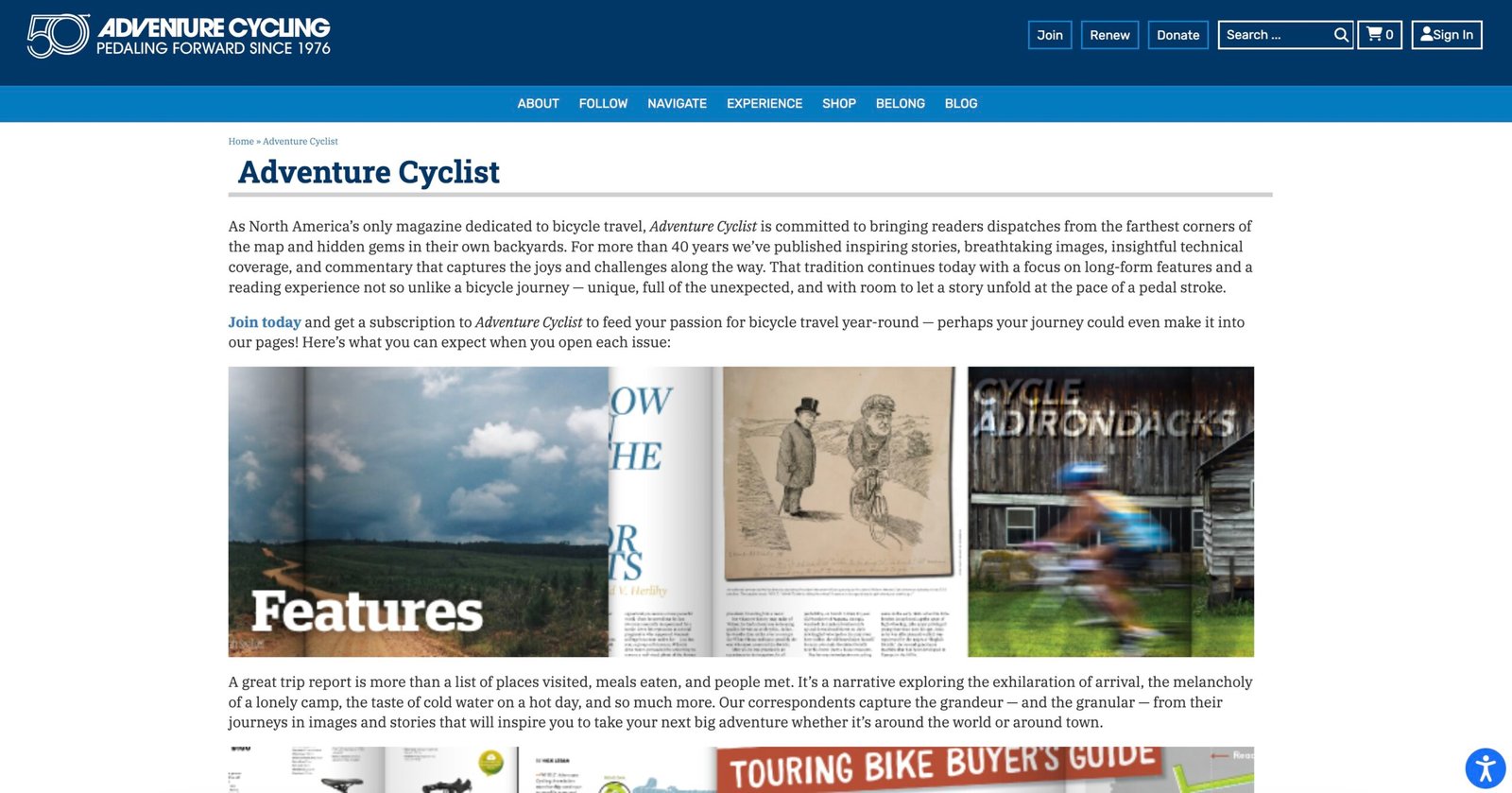
How to Write & Get Paid by Adventure Cyclist — A Beginner-Friendly, Editor-Ready Guide
This guide walks you step-by-step through researching the magazine, preparing publishable work (stories + photos), crafting a professional pitch, and submitting via the official portal so you can earn money and build a portfolio. It assumes you are a cycling traveller (or photographer) with at least one real trip or project you can document.
You’ll find: the magazine’s submission rules, timelines, photo specs, pitch templates, and a long list of resources and example links to help you make a real pitch today. Wherever possible, links point to official Adventure Cycling pages.
Section 1 · What the magazine publishes
Adventure Cyclist: the magazine’s focus (official summary)
Adventure Cyclist is the Adventure Cycling Association’s magazine dedicated to bicycle travel. It publishes first-person expedition stories, regional bike-tour features, gear and technique pieces, and photography that showcases bike travel around North America and beyond. The official magazine overview and editorial pages make their focus clear: adventure travel by bike, with strong emphasis on practical route information, vivid storytelling, and good photography. See the magazine page on the Association’s site for the official mission and recent issues: Adventure Cyclist (magazine).
Two official submission pages are the single best place to start: the magazine submissions page (magazine submissions) and the online/guest blog submissions page (Adventure Cyclist online submissions). Read both carefully before you write a pitch — the editors explicitly tell you how they prefer queries and how they accept files. :contentReference[oaicite:0]{index=0}
- They favor well-photographed bicycle travel stories — strong images help a pitch stand out.
- They accept pitches year-round but schedule 12–18 months ahead, so expect long lead times for print features. :contentReference[oaicite:1]{index=1}
- Online pieces (blog posts) are accepted via a Submittable portal and reviewed quarterly. :contentReference[oaicite:2]{index=2}
Section 2 · Submission systems & timelines
Exactly how to submit (the official flow)
Adventure Cyclist uses a Submittable portal for many of its submissions (the easiest way to send pitches, photos, and manuscripts). The official Submittable page and the Adventure Cyclist Submittable portal are the places editors expect you to use: Adventure Cyclist Submittable. :contentReference[oaicite:3]{index=3}
Important timelines and response expectations (from the magazine’s submissions page):
- Rolling acceptance: they accept pitches and manuscripts year-round.
- Quarterly review for some submissions — the editorial team reviews submissions on a roughly quarterly basis, so responses can take time. :contentReference[oaicite:4]{index=4}
- Long scheduling window for print: the print magazine often schedules stories 12–18 months out, so a yes may not mean immediate publication. :contentReference[oaicite:5]{index=5}
The site says responses can take a while (up to several months) — don’t assume a fast turnaround. If you haven’t heard in a reasonable period (see our follow-up section later), a single short polite nudge is acceptable. :contentReference[oaicite:6]{index=6}
Section 3 · What editors actually want
Story types, voice, and photography that win
Adventure Cyclist looks for three things in a strong submission: story (narrative), useful route/gear details, and photos. Below are the common kinds of pieces that editors publish.
First-person longform accounts of multi-day or multi-week tours that include:
- A clear route description (where you rode, typical distances, surfaces).
- Logistics (water, resupply, camping or lodging notes).
- Maps or links to GPX/ride files if possible.
- Vivid storytelling — what made the trip meaningful or challenging.
Practical guides on bikepacking setups, gear choices, maintenance on the road, and technique (how to pack efficiently, tire choices by surface, pannier vs. bikepacking bag pros/cons).
The site explicitly notes: they are currently (and often) looking for well-photographed touring stories in North America (road or dirt routes). If your story is a strong international trip but has excellent photos and a practical angle, it may still be considered. :contentReference[oaicite:7]{index=7}
Section 4 · Photo & file specs (the exact rules)
Images, resolution, orientation, file types, and metadata
The Submittable portal and submission pages include specifics about images. Two short, important technical rules appear repeatedly:
- High resolution is required — feature submissions should include electronic images at 300 DPI (print quality). :contentReference[oaicite:8]{index=8}
- Cover/vertical images are prized — editors often look for striking vertical photos that crop well for covers or full-page layouts.
- File formats: send high-quality JPEG or TIFF files (check portal prompts), and keep original filenames meaningful (e.g., transam_food_vendor_01.jpg).
- Provide captions and photographer credit in a separate document or in the Submittable form fields.
- Upload at least 8–12 strong images for a feature (more if you have them).
- Include a standout vertical image suitable for a cover or hero.
- Provide captions (what, where, when) and location info for each image.
- Include EXIF or note camera + lens if you have it (editors like that).
- Consider sending a low-res contact sheet plus high-res masters via cloud links if Submittable storage is limited.
If you are submitting a blog/online post rather than a print feature, you can usually get away with fewer or lower-res images, but good photos still increase your chance of acceptance. Check the online submissions page for any online-only image guidance. :contentReference[oaicite:9]{index=9}
Section 5 · Money: what you can expect
Does Adventure Cyclist pay? (short answer + guidance)
Yes — Adventure Cyclist pays contributors. The organization’s FAQ confirms that the magazine pays for content and photographs. Rates are not always publicly posted on the submissions page for every type of piece, and pay can vary by length, photo package, and assignment. :contentReference[oaicite:10]{index=10}
Publicly available reports and writer roundups offer rough historical ranges for travel and cycling magazines; some sources list Adventure Cyclist in ranges like $0.25–$0.50/word or fixed fees (reports vary by year and by type of piece). Use these figures only as a reference — confirm exact fees with the editor when an assignment is offered. :contentReference[oaicite:11]{index=11}
- Flat fee per assignment (most common for features).
- Photo buyouts for images (paid separately or as part of a package).
- Occasional per-word rates for personal essays or shorter features.
When you get an offer, ask the editor: “Is this a flat fee or per-word? Do you buy the photos outright or license them?” — get it in writing.
- Start with smaller online posts to build clips and photos.
- Use one strong magazine feature as a “hero sample” to command higher fees later.
- Sell or license your best photos to multiple outlets (if your contract allows resale).
Section 6 · Prepare an editor-ready pitch (step-by-step)
From idea to Submittable: exact steps (do these in order)
This is an actionable, copy-and-pasteable SOP you can follow the same day you read this guide. Do each step in order.
Read the official submissions pages
Open these two pages and keep them in tabs while you write: Magazine submissions and Online submissions. Editors will expect that you followed their guidelines. :contentReference[oaicite:13]{index=13}
Match your trip to the magazine type
If you have strong photos and a multi-day route, aim for a print feature. If you have a short practical tip or a day-ride narrative, aim for the online blog. Be realistic — the editors said they prefer well-photographed touring stories, especially in North America. :contentReference[oaicite:14]{index=14}
Write a tight 3–6 bullet outline
Your outline should include:
- A one-sentence hook: what makes this ride unique?
- Three sections (e.g., planning; on the road; takeaways / resources).
- What practical info you’ll include (mileage/day, surface type, water, resupply).
- Photos you can provide and a note about maps/GPX files.
Collect 2–3 published clips or a full sample
If you’re new, publish one full tutorial or trip report on your blog, Dev.to, or a local magazine first. Include links to your best pieces in the pitch. Editors want proof you can finish a polished story.
Pick 8–12 keeper images, one vertical for a cover
Caption each image clearly (what, where, date) and keep a separate file with captions and location metadata. If Submittable asks for image specs, follow them exactly (300 DPI for print features). :contentReference[oaicite:15]{index=15}
Keep it short, vivid, and practical (template below)
Your pitch should be 150–300 words with a one-line hook, 3–6 bullet outline, links to clips, and a short bio (what you ride, photography experience). Paste the sample pitch in the Submittable form field or the editor email.
Use the official portal and fill every required field
https://adventurecyclist.submittable.com/ — follow each field, attach your photo ZIP or cloud link, and upload captions. Double-check filenames and contact info before you hit send. :contentReference[oaicite:16]{index=16}
Section 7 · Sample pitch & Submittable text
Copy this template — edit for your trip and submit
Below is a ready-to-send Submittable pitch. Replace brackets with your details. Keep the tone concise, personable, and factual.
Pitch Title (one line):
[Title idea — keep it short and evocative, e.g., "Seven Days on the Eastern Plains: A Bikepacking Loop from X to Y"]

Hook (1 sentence):
[One-line hook that explains why this trip matters — e.g., "A 300-mile loop of quiet gravel roads and small-town hospitality that can be ridden in a week, with easy resupply and minimal climbing."]

Short pitch (150–300 words):
[Write 3–6 short paragraphs about the trip: the narrative arc, why it's useful to Adventure Cyclist readers, and what practical information you'll include. Mention that you have 10+ high-res images (300 DPI) and GPX files available. Example: "This piece is a first-person feature about a 7-day bikepacking loop through [region]. I'll include daily mileage, surface type, resupply spots, and campsite options, plus a 'what I packed' photo spread. I can provide 10–15 high-resolution images (including a vertical hero), GPX, and a map."]

Outline (bullet points):
- Intro: 2-3 paragraph scene-setting
- Day-by-day highlights (or key sections)
- Practical planning: route, resupply, camping/lodging, safety
- Gear and packing (what worked, what didn't)
- Takeaways + resources (GPX, maps, links)

Clips & samples:
- [Link to full sample on your blog or Dev.to]
- [Link to 1–2 published clips or other travel writing]

Photos & files:
I have 10–15 high-resolution photos (300 DPI), captions and credits, and GPX files. I can provide a vertical hero image suitable for cover use.

Short bio (1–2 lines):
[Your name], [where you live]. I ride [type of bike], guide/ride/work in [short credentials]. Photographer: [yes/no] — camera: [camera model]. Contact: [email] / [phone, optional].

Availability & rights:
Available to finish a draft by [date]. I request clarification on pay and image buyout vs. licensing if we proceed.
Section 8 · After submission: follow-up and contracts
Agency & practical next steps once you heard yes (or silence)
After you submit via Submittable, editors may:
- Accept the pitch and send assignment details, deadlines, and pay.
- Ask for a full manuscript and additional photos.
- Decline or pass without detailed feedback (common when inboxes are full).
If you have not heard back in a reasonable time (e.g., 3 months for online pitches, or 6 months for print), send one short message:
Subject: Follow-up: [Short pitch title] — submitted [date]

Hi [Editor name if known],

I submitted a pitch titled “[Title]” via Submittable on [date]. I’m still very interested and available. I wanted to check in politely to see if there’s any update or if you need additional materials (photos/GPX).

Thanks again,
[Your name]
When you receive an acceptance:
- Ask for the assignment details in writing: word count target, deadline, pay, payment method, and image rights.
- Negotiate if needed: if the editor offers a very low flat fee, you can politely explain your expected time and request a higher fee or ask for photo buyout payment.
- Get the agreement in writing (email is fine). Save invoices and keep communication organized for tax/time tracking.
Section 9 · Alternatives & other paying cycling outlets
Not accepted yet? Other places to pitch + how to monetize your writing
Use each rejected or slow response as an opportunity to place your piece elsewhere (with adjustments). Here are outlets and resource pages that often accept cycling, outdoor, or travel pieces — helpful for building clips:
- Bicycling — large audience; pitches through editorial contacts.
- Bikepacking.com — route & bikepacking stories.
- Road.cc — news & feature angles for cycling.
- National outlets — long lead times; high pay (requires unique angles).
- Local/regional outdoor magazines and state cycling associations (often pay and accept route content).
- License photos to stock libraries or specialized travel aggregators.
- Create a paid guide or e-book from your route and sell via your site or Gumroad.
- Run a multi-part series (sell as a package to several outlets if rights allow).
- Offer guided trips or workshops using your published work as marketing material.
Helpful roundup resources for pitching and pay: check lists like “150 travel publishers that pay” and writer roundups that often include Adventure Cyclist as a paying outlet (use them for research, not exact pay guarantees). :contentReference[oaicite:18]{index=18}
Section 10 · Final checklist, tools & resources
The exact checklist before you hit Submit
- Adventure Cyclist — Magazine submissions. :contentReference[oaicite:19]{index=19}
- Adventure Cyclist — Online/guest blog submissions. :contentReference[oaicite:20]{index=20}
- Adventure Cyclist Submittable portal (submit here). :contentReference[oaicite:21]{index=21}
- Adventure Cyclist — FAQ (confirms payment). :contentReference[oaicite:22]{index=22}
- Freedom With Writing: Travel publishers that pay — good research list. :contentReference[oaicite:23]{index=23}
- Dream of Travel Writing: pay rates (reference) — historical context for travel pay rates. :contentReference[oaicite:24]{index=24}
- Be a Freelance Blogger: travel blogging paid outlets — pitching & outlet ideas. :contentReference[oaicite:25]{index=25}
- WritersWeekly: paying markets (cycling & sports) — niche outlets list. :contentReference[oaicite:26]{index=26}