


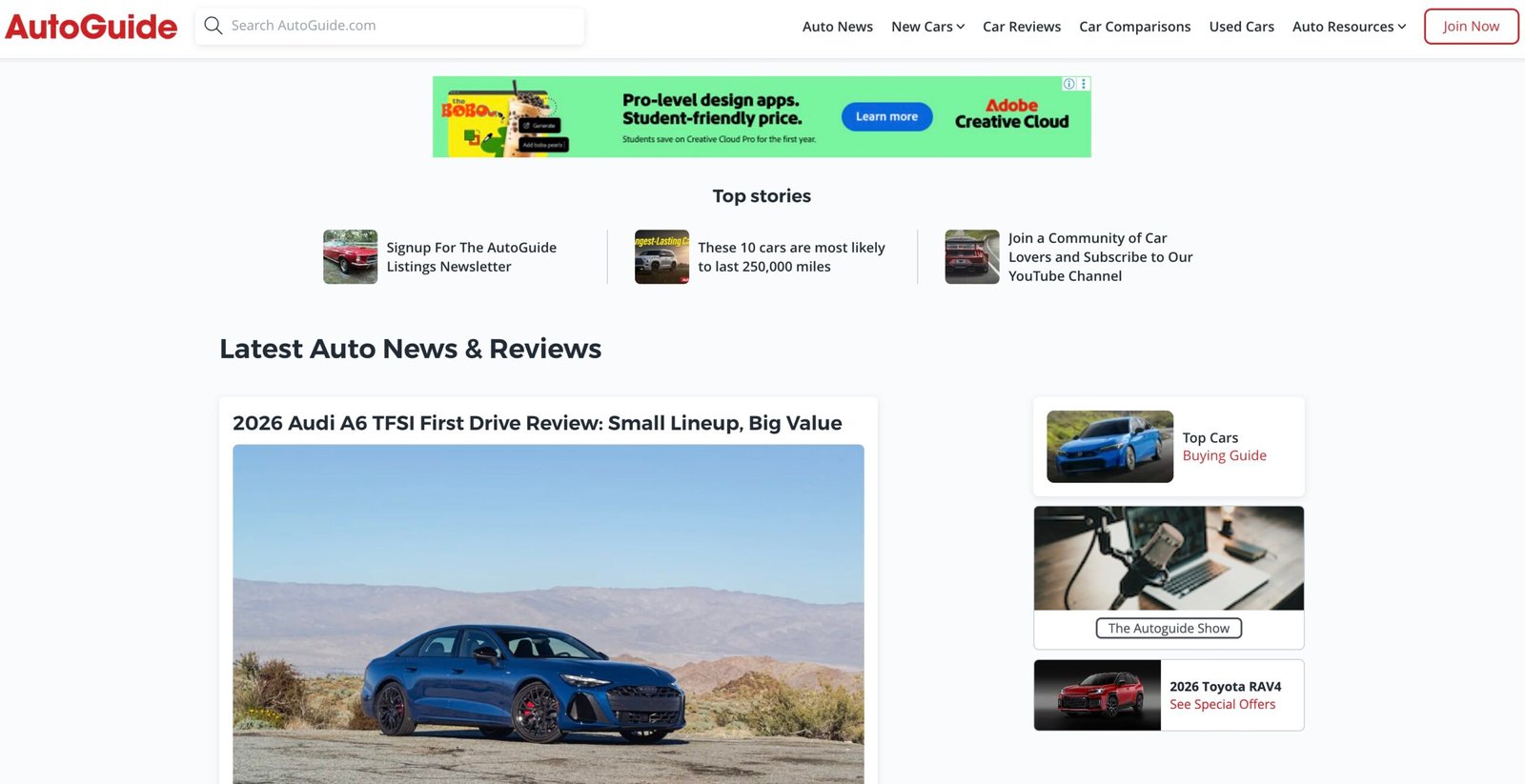
How to research AutoGuide (autoguide.com) and use it to write paid automotive content — a complete beginner’s guide
This practical HTML guide shows you how to learn from AutoGuide, find article ideas, build writing samples, pitch editors or use the site to inform your own blog and earn money from car articles, guest posts, and reviews. Packed with links and ready-to-copy templates.
1. What AutoGuide is — at a glance
AutoGuide is a high-traffic automotive news and reviews site that publishes car news, vehicle reviews, comparisons, buyer guides, and long-form automotive explainers. It is a place where test drives, spec rundowns, comparison pieces, and consumer-facing content live side-by-side with editorial lists, videos, and buying resources. When you read their articles you’ll notice practical headlines, show-and-tell photos, and clear “what this means for buyers” angles — which are useful patterns to copy when you write for automotive audiences.
- Latest Auto News — industry & breaking stories
- New Cars — first-drive reviews and impressions
- Car Reviews — long-form test drives with verdicts
- Comparisons — head-to-head model tests
- Car Buying Tools — price checks, buyer guides, loan calculators
A car shopper, enthusiast, or commuter who wants clear buying guidance, honest opinions, and hands-on test details rather than abstract commentary.
2. How to research AutoGuide (a simple step-by-step routine)
Before you write, do focused reconnaissance. The five short steps below will show you what editors publish, what readers click, and the tone that works.
- Open the AutoGuide homepage and key sections — scan top stories, recent reviews, and the “Car Comparisons” and “Car Reviews” sections to learn structure and length. Bookmark the homepage and 3–4 example posts in your topic area.
- Read 3 recent pieces in your subtopic (e.g., EV reviews, SUV haul tests, or “how-to” car maintenance). Copy their headings and outline the structure: intro, setup, step-by-step sections, results/conclusion.
- Note language and visuals — how many photos, where they place spec tables, and whether they link to official sources (manufacturer pages) or testing data.
- Track author style & recurring series — many sites have the same bylines: find 2–3 recurring AutoGuide authors and read their archives to learn voice and pacing.
- Collect links for your pitch — you will later include 2–3 sample links (your published sample + similar AutoGuide posts you are inspired by).
3. Shape AutoGuide-ready ideas (three checks)
AutoGuide publishes practical, reader-facing pieces. When you draft topics, pass them through these three simple checks:
Every great piece solves a purchase, maintenance, or decision problem. Example: “How to pick winter tires for an AWD Subaru in snowy regions.”
Avoid broad topics like “EVs.” Instead use an angle: “Top affordable EVs under $40k with >250-mile range in 2026.”
You must be able to show numbers, a demo, test drive notes, or at least credible sourcing (manufacturer spec, EPA numbers, or a small local test).
- “2026 midsize SUVs that tow 5,000+ pounds (real towing tests).”
- “How to set up a used-car inspection checklist for sellers and buyers.”
- “Real-world range: How a Tesla Model 3 performs on winter highway runs.”
4. Build publishable samples (your writing ladder)
Before you pitch any major outlet — AutoGuide included — have 2–5 samples that show you can finish an article with real value. The typical “writing ladder” looks like this:
| Where to publish | Why | What the sample should include |
|---|---|---|
| Personal blog / Dev.to / Medium | Quick to publish; shows finished work | Clear headings, code/data, at least 800–1500 words, photos or screenshots |
| Car enthusiast community (forums, YouTube short) | Shows engagement and willingness to test | Images, short video or test notes, comments/replies |
| Small automotive blogs or local outlets | Gives experience working with an editor | Measured edits, brief feedback incorporated |
A strong sample checklist
Sample article outline (copyable)
Title: How to Inspect a Used Compact SUV before you buy (step-by-step)

Intro: Who this helps (e.g., suburban buyers), quick summary of the checklist and what readers will gain.

1) Quick pre-check (photos, VIN lookup, title check tools)
2) Exterior inspection (rust, tires, lights)
3) Interior inspection (electronics, seats, signs of wear)
4) Under the hood (fluids, belts, obvious leaks)
5) Road test checklist (brakes, noise, alignment)
6) Paperwork and negotiation tips
Conclusion: Red flags and where to get a pro inspection

Include sample photos + 1 short embedded video of the road test if possible.
5. How to pitch AutoGuide editors (practical templates)
AutoGuide appears to be an editorial news & reviews site. For outlets like this you can approach via:
- Contact page or “Send us a tip” link (use for short news tips or local scoops).
- MuckRack or LinkedIn to find editors and politely ask about submission policies (many outlets list contacts on MuckRack).
- Social channels (Twitter/X or LinkedIn DMs) for a short intro if the editor is public-facing.
- Advertising / Sponsored Post pages only if you intend to pay for placement (not editorial contributions).
Subject: News idea — [short headline about the item]

Hi [Editor Name],

I'm [Your Name], I write about cars and recently tested [vehicle / scenario]. I have an idea I think would interest AutoGuide readers:

Headline: [Tentative headline]
One-sentence angle: [What a reader will learn / why it matters]
Why now: [Short reason: price change, new model, safety recall, test result]
I can provide: test notes, photos, specs, and a short video if useful.

Short bio: [1 sentence — your experience, links to 2 samples]
Links: [sample1] [sample2]

Thanks for considering — happy to expand the outline or write a full draft.
Regards,
[Your Name] — [website] — [phone]
Subject: Feature pitch: [Full headline] — 900–1600 words (outline attached)

Hi [Editor Name],

Pitch: [One-sentence summary of the article + why AutoGuide readers will care]

Outline:
Intro — define the reader and quick promise
Section 1 — [What you need / background]
Section 2 — [Step-by-step / testing approach / demo]
Section 3 — [Examples / data]
Section 4 — [How to implement / what to buy]
Conclusion — [Key takeaways + next steps]

Assets I can provide: photos (x10), spec table, short video, links to source data
Samples: [link to published tutorial], [link to blog post]
Estimated length: 1,200–1,800 words

If this sounds useful I can draft the full piece within [X days] and send a complete draft for editorial review.

Thanks,
[Your name & short bio]
Important: keep pitches concise and reader-centric. Editors want to know the angle and what assets you can provide. If AutoGuide prefers quick news, a short pitch is better; for feature-length reviews, show you can provide photos and testing data.
6. How you can earn from car articles (realistic options)
There are several practical ways writers earn money with AutoGuide-style content. Not every route requires being a staff writer — many are one-off or recurring freelance gigs.
Paid per article or per word. Rates vary widely by outlet, article length, and whether photography/video is required. If you are new, expect modest fees until you build a portfolio — then negotiate higher rates for multi-media pieces and exclusives.
Some editors will syndicate content or allow you to license content elsewhere. This can be an extra revenue path if the initial editor allows republishing after an exclusivity window.
Other revenue channels using the same articles
- Affiliate links in buyer guides (disclose clearly).
- Sponsored posts or advertorials (use editorial and legal clarity).
- Paid newsletters or a Patreon for in-depth testing and early access.
- Monetize your own blog with ads and calls-to-action for buying tools.
Tip: treat early editorial assignments as portfolio work. Use the byline and the finished piece to get higher-paying gigs: car dealerships, repair shops, aftermarket vendors, and automotive PR frequently hire experienced writers with proven clips.
7. Repurpose and promote: squeeze more value from each piece
One great article can become many revenue opportunities. Here’s a compact repurpose plan:
- Publish the original piece (AutoGuide or another outlet).
- Create a short video (60–90s) showing the main result — post on YouTube or social.
- Extract 3–5 social posts (images + 1–2 line insights) and share across LinkedIn, X, and Facebook car groups.
- Create a downloadable checklist or cheat-sheet behind a small email-gated signup to build an audience list.
- Pitch follow-up stories (data deep-dive, model updates) to the same or other outlets.
This multiplies visibility and future paid opportunities. Editors like writers who can help promote their pieces.
8. Final micro-SOP: checklist before you pitch
Quick FAQs
Yes if you can show a finished, useful piece and at least one demo or test. Start small: your own blog, local outlets, or car communities — then use those links to pitch larger sites.
Q: Do I need to be a mechanic?No. Many car writers are enthusiasts. Honesty and careful testing are more important than formal certification for consumer-facing articles. For repair-heavy pieces, partner with a mechanic for technical accuracy.
Q: Where do I send pitches?Use the site’s contact, author email (if listed), or MuckRack/LinkedIn to find an editor. Keep the pitch short and reader-focused.
9. Research & source links (open these; they help you learn AutoGuide fast)
Below are hand-picked public pages for AutoGuide and related resources. Open them in new tabs and read the latest 3–5 articles in your topic area.
- AutoGuide — homepage (news, reviews, comparisons)
- AutoGuide — about or content / about-us (official site about page)
- AutoGuide — videos (watch test drives and The AutoGuide Show)
- AutoGuide YouTube channel — video reviews & test drives
- MuckRack — AutoGuide media outlet page (editor & author info)
- AutoGuide on LinkedIn — company & staff updates
- Mike Schlee (AutoGuide) — journalist profile
- Colum Wood — author profile & sample articles
- Contact / Send a Tip (AutoGuide contact page; useful for outreach)
- AutoGuide — Auto News (great for trending story ideas)
- AutoGuide — Car Reviews (study structure & photos)
- AutoGuide — New Cars (first-drives & impressions)
- Dev.to — publish samples and tutorials
- Medium — publish guides and build an audience
- PistonHeads — enthusiast community (ideas & feedback)
Tip: save 8–12 sample AutoGuide articles (mix of news, reviews, comparisons) so you can reference them in pitches and mimic their structural choices.