


How to Submit to Chestnut Review — A Complete Beginner’s Guide
This HTML guide walks you from idea → draft → Submittable pitch → acceptance and payment for Chestnut Review. It is designed so a first-time submitter can follow each step, prepare clean files, and increase their chances of getting accepted and paid.
Important: Chestnut Review runs submissions via their Submittable manager, accepts poetry, prose, flash, art, and chapbooks, and offers editorial feedback options. Use the links in the resources section to jump directly to the forms and guidelines.
Section 1 · About Chestnut Review
What Chestnut Review publishes and who they are
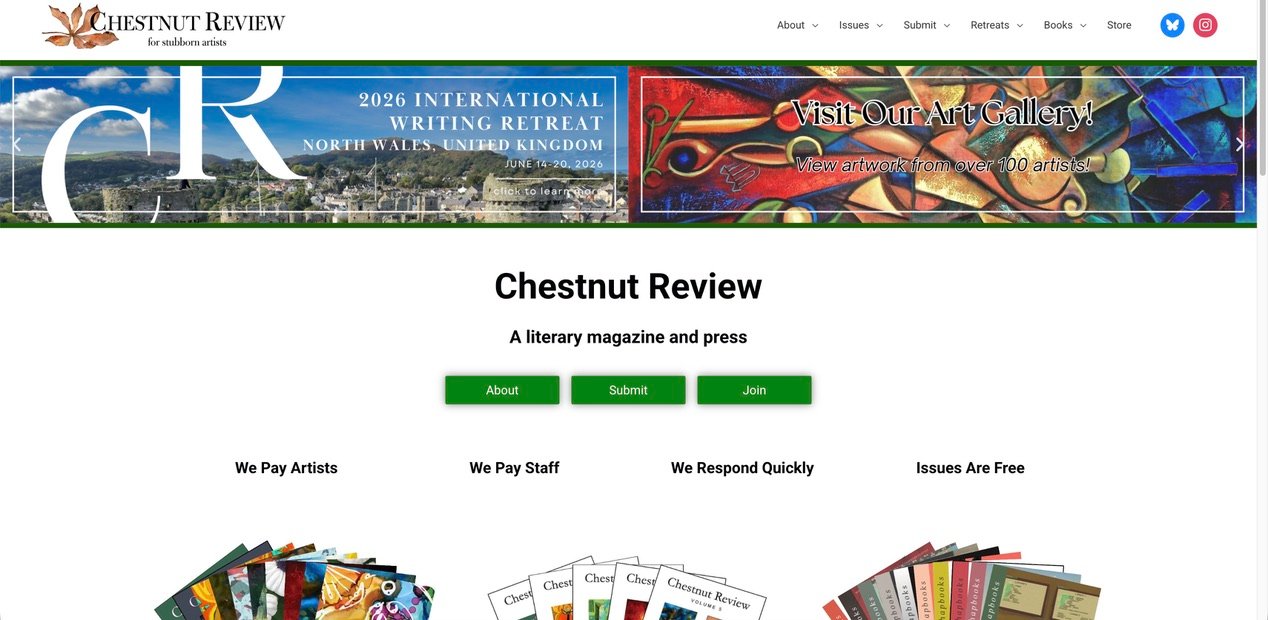
Chestnut Review is a literary magazine and press that publishes poetry, short fiction, flash, visual art and photography, essays, and occasional special projects like chapbooks and anthologies. They run online and print cycles and actively promote contributors’ work. The magazine is writer-focused and publishes both established and emerging voices.
Why this matters to you: the scope is broad — if your work fits literary poetry, short fiction (1,000–5,000 words), flash (≤1000 words), or publishable artwork, Chestnut Review has a submission category and a Submittable form for it. This makes it a good fit for many writers and artists learning to submit to reputable paying journals.
Section 2 · Submission categories & rules
Exactly what to prepare for each category
Chestnut accepts poetry packets. For typical poetry submissions you may submit several poems (their Submittable category explains free vs paid submission counts and formatting recommendations). Poems should be single-spaced; start each poem on a new page when uploading a single document.
Useful links:
Prose submissions generally accept one piece between about 1,000 and 5,000 words (check the form for current limits). Do not submit excerpts of longer works; the piece should stand on its own. Use single spacing and include a word count in the header if requested.
Link: Submittable — Prose form
Flash accepts very short work (often up to 1,000 words or less). They sometimes publish microfiction and flash creative nonfiction. If your piece is concise and strong — a flash slot is worth trying.
Link: Submittable — Flash form
Visual artists can submit portfolios (guidelines on file types and image counts are in the Submittable form). Typical limits include up to 20 images per submission; check the form for exact specs.
Section 3 · How Submittable works (a simple walk-through)
Step-by-step: submitting through their Submittable manager
Pick the exact category
Go to https://chestnutreview.submittable.com/ and select the category that matches your work (Poetry, Prose, Flash, Art, Chapbooks). Make sure your piece fits their word, line, and file-size rules.
Account and profile
If you don’t already have a Submittable account, create one (free). Fill in a simple profile — name, short bio, contact email. When you submit, Submittable will save your data for future submissions (handy).
What they usually ask for
Typical fields you’ll fill:
- Title / Word count (for prose & flash)
- Author name, email, a short bio (1–2 lines)
- File upload (DOCX, PDF, or image files for art)
- Optional cover letter or notes to editors
- Checkboxes for simultaneous submissions or exclusivity (follow instructions)
Free vs paid submissions
Some journals have a free reading window and a paid “priority” window or offer feedback for a fee. Read the form carefully before paying. Submittable shows the fee on the form and will process payment during submission. Save your receipt.
What happens after you submit
Submittable tracks your status (Received, In Review, Accepted, Rejected). Chestnut Review aims to notify contributors within a defined timeframe (see payment & timelines section). If you need to withdraw, use the Submittable interface or the magazine’s contact form.
Section 4 · Prepare strong submission materials
What to write, how to format, and what editors like
Editors read faster when your file is tidy. Basic formatting tips:
- Use a simple readable font like Georgia or Times New Roman (12pt) for prose; keep one-inch margins.
- Single-space poems (or follow the Submittable instruction); start each poem on a new page if it’s one combined file.
- Include word or line counts where requested (especially for prose and flash).
- Export as DOCX or PDF if the form allows both; for visual art, name files clearly and follow image-size guidance.
Good submissions include:
- A short author bio (1–2 lines) with relevant credits or what you write about
- A short cover note if there is context (only if it matters)
- Links (if requested) to an author page, portfolio, or previously published work
- Correct file names and a final proofread
How many pieces to send
Follow the Submittable form’s instructions. For poetry, there are often limits that differ between free and paid packets. For prose, usually one piece per submission. For art, limits on number of images will be explicit.
Section 5 · Payment, rights & timelines
How contributors are paid, typical timelines, and rights to expect
Chestnut Review pays contributors for work they publish. Public signals from the magazine and their social accounts indicate a standard payment for individual pieces — check their own pages for the current amount before submission, because rates can change.
Timeline: Chestnut Review (like many small presses) aims to notify contributors within a set window. Their Submittable manager and About pages reference response-time policies and, when present, refund rules for reading fees if response time is exceeded. Always check the Submittable form for the live turnaround and payment details.
Typical small magazine agreements:
- Non-exclusive or first North American serial rights are common, but verify the exact contract they provide if accepted.
- Many journals allow authors to repost after an exclusive period — check the acceptance email for reposting terms.
- Save a copy of your acceptance email; it usually contains the rights and payment agreement.
When accepted, Chestnut Review’s editor will generally send a contract or acceptance email that explains payment timing (e.g., within X days of publication) and how they will pay (PayPal, bank transfer, etc.). Keep copies of invoices if requested.
Section 6 · Chapbooks, contests & special calls
Chestnut Review’s chapbooks and contest cycles (how to plan)
Chestnut Review runs chapbook windows (seasonal reading periods) and special submission calls. If you plan a chapbook, check the chapbook page for open dates, requirements, and whether submissions go through the regular Submittable manager or an auxiliary account.
Link: Chestnut Review — Chapbooks and the auxiliary Submittable page for special registration or chapbook entries.
Section 7 · Copy-and-paste pitch templates & bios
Ready-to-use language you can adapt for Submittable fields
Template A (poet):
Jane Doe is a poet from Columbus, OH. Her work appears in Example Journal and Small Press Review. She runs a weekly critique group and writes about form and craft.John Smith is a fiction writer and copy editor. His short fiction has been published in Local Magazine and online at BigLit. He teaches creative writing part-time.Keep it short and factual. Example:
Hello Chestnut Review editors,

Please find attached [title] — a [poem/collection/short story] of [word-count/line count].
I appreciate your time and consideration. Thank you.

Best,
[Your Name]
[one-line bio and link to portfolio if applicable]
Optional: A slightly longer pitch note (when context matters)
If your piece benefits from context (e.g., it’s part of a linked series, or it engages with a local issue), add 2–3 sentences explaining the relevance — but keep it short. Editors rarely want long backstories; they want to know whether the piece will interest readers.
Section 8 · How publication can help you earn money
Direct payment, portfolio leverage, and downstream revenue
Chestnut Review pays contributors for accepted work. Payment is immediate income — for many writers this is the most direct benefit of publishing with reputable small presses.
A paid publication builds your portfolio:
- Use bylines to pitch paying markets and freelance clients.
- Collect clips to apply for grants, contests, residencies, or paid editing gigs.
- Leverage pieces into readings, teaching slots, or workshops.
Promotion checklist: get more bang for your published piece
- Share a short excerpt and link on Twitter/X, Instagram (if allowed), and Facebook.
- Add the piece to your author page and link to the journal’s page.
- Pitch the piece for readings or local literary events.
Section 9 · Final checklist & FAQ
Quick checklist before clicking Submit — and a short FAQ
Resources & direct links
Open these pages in new tabs — they are the forms and pages you will use
- Chestnut Review — Official Submissions & Guidelines
- Chestnut Review on Submittable (main page)
- Poetry form (Submittable)
- Prose form (Submittable)
- Flash form (Submittable)
- Art/Photography form (Submittable)
- Chapbooks & special calls
- Chestnut Review Auxiliary Submittable (retreats, chapbooks, registration)
- About Chestnut Review
- Stay in touch / contact editors
- Duotrope listing — market intel
- CLMP — publisher details
- NewPages — listing
- Chestnut Review on Instagram (payment & updates)