


Guide: How to Write for Funny Times — A Beginner’s Step-by-Step Plan
This practical guide teaches a beginner everything needed to prepare, pitch, and (eventually) earn money writing for Funny Times — the long-running cartoon-and-humor newspaper. It walks you from idea to finished pitch, provides templates, and shows how to convert a single accepted piece into an ongoing income and portfolio engine.
Wherever I state a fact about Funny Times’ submissions or pay, I’ve checked live public sources (links are supplied in the resources section). Use this guide as an SOP (standard operating procedure) you can repeat for other humor markets too.
Section 1 · About the publication
What Funny Times actually publishes
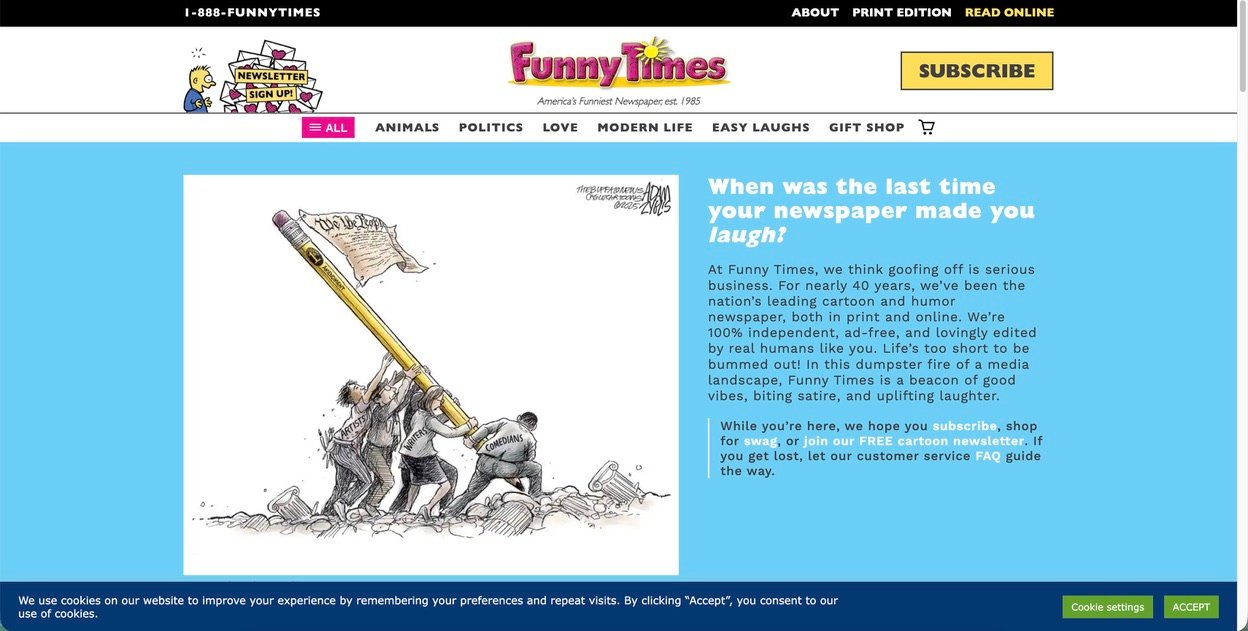
Funny Times is a monthly humor newspaper and website that curates cartoons, short humor essays, satirical lists, and comic strips that poke fun at politics, everyday life, relationships, work, and culture. The tone is often observational, satirical, and accessible to a wide, adult audience. See the homepage for samples and the magazine’s mission. (Start at their homepage for immediate examples.)
Why this matters: editors at FT look for short, punchy humor that can stand alone in print and online—pieces that make a reader laugh, nod, or think in one quick read.
Section 2 · Read the rules first
Where and how to submit — the official path
The single most important step before you write anything is to read Funny Times’ own submissions page. Their submissions page lists the method to send material,
the address or email to use, and any specific format or file preferences. In practice, their listed contact for submissions is submissions@funnytimes.com,
and they ask contributors to include identifying information in the email. Always use the address and process they list — this prevents your work from being lost.
- Exact submission email or postal address (use exactly as they give it).
- Any requested subject-line format or file-type preference (plain text, .docx, .pdf).
- Word-count or length guidelines for stories and cartoons.
- Whether they accept previously published material or simultaneous submissions.
Section 3 · Shape an idea that fits
Choose an idea that matches Funny Times’ readers
Don’t submit a long-form magazine feature. Instead, produce short, self-contained humor pieces — personal comic essays, satirical lists, ironic observations, or captioned short cartoons. Here are practical approaches to generating ideas:
Personal comic essay (500–800 words)
Tell a funny, true story (an awkward meeting, a work-from-home disaster, a misread email). Make the arc clear: setup → twist → payoff. Personal voice is valuable: editors like a human perspective that readers recognize.
Listicle / satirical how-to (8–15 items)
Examples: “10 Terrible Ways to Interview a Candidate” or “A Beginner’s Guide to Ignoring Your Smartwatch (satirical)” — keep each item short and punchy; humor builds in pattern and escalation.
Short parody / satire (one-page)
A short column-length parody of a news item, press release, or consumer product can work well if it’s tightly focused and clearly lampoons the subject.
Cartoons & single-panel submissions
If you draw, prepare single panels (JPG/PNG) optimized for print preview and with simple filenames. Many cartoonists submit multiple panels at once.
Section 4 · Make quick samples
Build 2–3 short samples you can send with your pitch
Even beginners should create publishable samples. You don’t need a book-length portfolio — you need 2–3 short, well-polished pieces that show your voice and timing.
- Personal blog (WordPress, Ghost) — permanent home for your clips.
- Medium & Substack — fast sign-up, built-in audience.
- Short-contributor platforms: Dev.to (tech), general platforms for humor: Medium.
- Social proof: post the piece on Twitter/X, Instagram, or Mastodon with a stable link back to the full sample.
- Title that sets the comedic premise.
- Clear first line that hooks the reader (3–5 strong words).
- One clean payoff or twist.
- Short paragraphs (3–4 lines max) and line breaks for rhythm.
- Proofread and read aloud — humor depends on rhythm and timing.
Once you have 2–3 samples (a mix of a short essay, a list, and maybe 2–3 cartoons or panels), you’re ready to prepare the actual submission email.
Section 5 · How to format & send
Practical formatting rules & what to attach
Follow these formatting rules to make life easy for editors and increase your chance of acceptance:
| Item | Recommended | Why |
|---|---|---|
| File type for prose | Plain text in email OR .docx attachment | Editable and easy to paste into layout |
| File type for cartoons | JPEG or PNG, 300–600 KB; separate files per cartoon | Preview friendly and print-ready |
| Subject line | “Submission: [Your Name] — [Title or Type]” | Editors sort quickly; put your name first |
| Include | Short bio (1 line), contact info, short pitch (1–2 paragraphs) | Gives context and credibility |
Section 6 · Money & rights
What to expect to be paid and rights to grant
Payment rates for small humor markets vary and are updated from time to time. Public reports and market listings commonly report that Funny Times pays contributors a modest flat fee for accepted pieces and often provides a complimentary subscription or reprint terms. Multiple market listings and contributor roundups place the per-story pay in the range of approximately $60–$75, with cartoons sometimes paid in a lower per-cartoon range (often quoted around $25–$50 per cartoon).
- Ask the editor what rights you are granting — single-use, first serial rights, or full transfer?
- Prefer single-use or first North American serial rights if you want to republish later on your site.
- If you plan to reuse the piece, record the editor’s permission in writing (email is fine).
Section 7 · Pitch templates
Copy-paste pitch email templates you can adapt
Short Pitch — send with one sample
Subject: Submission: [Your Name] — “[Title of Piece]”

Hello Funny Times editors,

I'm [Your Name], a humor writer/cartoonist from [City]. I'm sending a short piece titled “[Title of Piece]” (approx. [word count]) that I think will fit your audience — it satirizes [one-line hook].

[One-sentence bio: e.g., "My work has appeared at X, Y, Z" or "I'm a longtime reader."]

Attached: [Title].docx

Thanks for reading — I hope it gives you a laugh.

Best,
[Your Name]
[Email] | [Phone optional] | [Link to portfolio]
Multiple-idea pitch (3 short items)
Subject: Submission: [Your Name] — 3 short humor pieces

Hello editors,

I'm [Your Name]. Attached are three short pieces (one-liners / essays / list) that suit the Funny Times voice:

1) “[Title A]” — 550 words — Hook: [one-liner].
2) “[Title B]” — 430 words — Hook: [one-liner].
3) “[Title C]” — 300 words — Hook: [one-liner].

Bio: [One-liner bio and relevant clips].

Thanks for considering these. Happy to adapt for space if useful.

— [Your Name]
Section 8 · If you get accepted
What to do after acceptance
Congratulations — now turn the single win into momentum. Here are immediate next steps and mid-term strategies so one acceptance grows your income and visibility.
- Confirm payment terms and rights in writing (reply to the acceptance email with a friendly confirmation).
- Ask for an estimated publication date and any editing notes.
- Request how they prefer to credit you and whether you’ll get a byline and bio space.
- Get a short quote or promo blurb you can use on your portfolio and socials.
- Post the link on your author page and social media when live.
- Use the byline as a portfolio highlight in pitches to other editors and clients.
- Collect the acceptance email as proof of publication for freelance pitches.
Longer-term: aim to create a series of related pieces (3–5 items) that can become a repeat pitch, or form the basis for a paid talk, newsletter monetization, or a small e-book of humor pieces.
Section 9 · Checklist & Resources
Final pitch checklist and helpful links
- Funny Times — Submission Guidelines (official)
- Funny Times — Home (read recent pieces for voice & length)
- Market listing: Funny Times (pay & contact summary)
- Duotrope listing for Funny Times (submission stats & history)
- WritersWeekly & general advice on humor markets
- Freelance blog: places that pay for humor & cartoons
- Medium — to publish quick samples and develop a following
- Substack — start a newsletter to repurpose and monetize your humor clips