


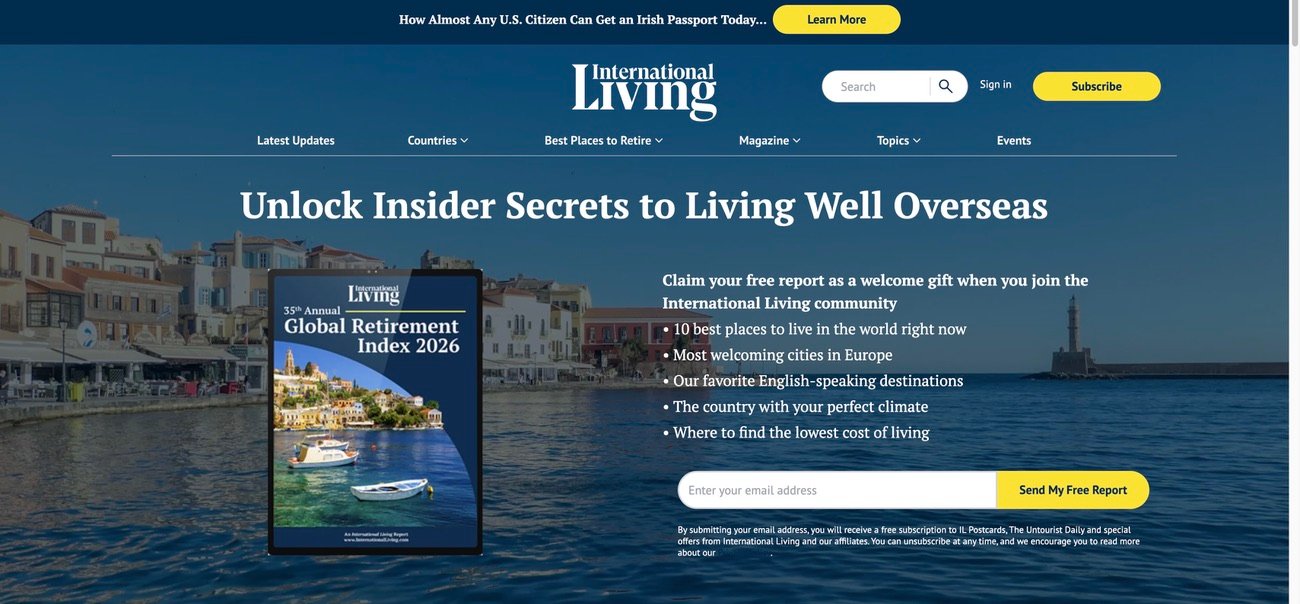
Guide: How to Write for International Living (step-by-step)
This guide shows you — in plain language and practical steps — how to research, draft, and pitch pieces to International Living, the widely-read resource for people considering living, retiring, investing, or traveling overseas.
You will get: what the editors look for, how to shape ideas they accept, where to publish samples first, exact pitch templates, money expectations, and a checklist to use before you submit.
Section 1 · What International Living publishes
Who reads InternationalLiving.com and what they need
International Living is a long-running resource for people who want to live, retire, invest, or travel overseas. Their coverage includes country-by-country guides, personal stories about moving abroad, housing & real estate, health care & visas, local costs, and lifestyle pieces that help readers decide where and how to relocate.
The site publishes multiple formats: in-depth magazine articles, shorter web features, and postcard-style short reads (often first-person snapshots from readers). They are interested in firsthand experience: clear, trustworthy descriptions of living in a place, useful local tips, verified costs, and concrete steps a reader could take to investigate or move.
Useful IL topics commonly include:
- How to retire affordably in a specific country (cost breakdowns, healthcare, visas).
- Personal relocation stories (what worked, what surprised you).
- Real estate and buying/renting abroad (neighborhoods, legal steps).
- Country-specific practical guides (how to get a driver’s license, healthcare enrolment, utilities).
- Small business, remote work, and income strategies from abroad.
Editors typically look for:
- Firsthand knowledge: you lived or spent significant time in the place you write about.
- Practical and verifiable details: actual costs, steps, contacts, and local names.
- Clear benefit to readers: your piece should help someone decide, plan, or act.
- Good storytelling: facts plus useful narrative — the “how” and the “why”.
Tip: Read International Living’s official contributor page and the “postcards” area to feel their voice. Save the official guidance: Write for IL — official page.
Section 2 · Fit your idea to IL
Is your topic something International Living will publish?
Answer these quick checks honestly. If you fail two of three, reshape the idea or research more on the ground.
Do you have firsthand experience?
International Living prefers writing informed by actual living or long visits. A story about “what it’s like” must be based on your time there, interviews with locals, or documented costs — not just internet research. If you haven’t been, consider a postcard-style short piece from someone who has, or wait until you can visit and gather firsthand info.
Is your angle practical?
IL is less interested in abstract travel poetry and more in practical, actionable guidance: “How much does health insurance cost in X city?”, “How to rent long-term in Y”, “A month-by-month budget for couples in Z”.
Can you support it with numbers, contacts, or visuals?
If you can share local prices, named service providers, official forms/screenshots, or strong photos that you own or have permission to use — your story becomes significantly stronger.
Section 3 · Build samples and credibility
Before you pitch: publish believable samples
Editors want to see you can finish a piece and follow an editor’s feedback. Speed up acceptance by having 3 strong, published samples (even if self-published).
- Your own blog with a permalink and clean layout (GitHub Pages, WordPress, Webflow).
- Medium or Dev.to for travel, lifestyle, and how-to posts.
- Local expat forums, smaller travel mags, or community newsletters (these can be clips).
Include 2–3 photos you took, a short bio, and contact details — editors will click your links to check credibility.
- Clear structure: intro, context, numbered or headed sections, and a short conclusion with key takeaways.
- Data points and named sources (e.g., “clinic X charges $Y for consult” with link/receipt where possible).
- At least one strong photo and captions; captions matter to editors.
Practical goal: within 4–8 weeks publish 3 samples that demonstrate you can research, write, and support a piece with photos or links.
Section 4 · Step-by-step pitch SOP
Exactly how to prepare and submit a pitch
Below is the compact SOP you can follow for International Living. Treat it like a checklist.
Open the official “Write for IL” page
Always start with the official guidance. Read the submission page, note the formats they accept (postcards vs magazine vs web features), and follow any explicit rules (word counts, photo requirements, and contact method). The official page is here: Write for IL.
Pick one tight idea and write the one-sentence value prop
Example: “This piece shows U.S. retirees how to get a residency visa and enroll in public healthcare in Portugal while keeping annual costs under $24,000.” Keep it short and actionable.
Draft a 3–5 paragraph summary + 6-section outline
Your pitch should include: a 1–2 sentence hook, why you are qualified to write it, a bullet outline of sections, approximate word count, and links to 2–3 writing samples. Editors want to see how the reader will move from problem to solution.
Collect supporting assets
Attach or include links to: 3+ photos (your own or licensed), receipts or screenshots proving costs or services, and a live demo if needed. Name your photo files and include captions like “Author photo — Marina in Valparaiso, Chile — 2024”.
Submit via the method on the Write for IL page
Follow the contact method described (form or email). If an email is listed, use a concise subject line like: Pitch: Residency & Healthcare in Portugal — 1600–2200 words. Include your byline, links, outline, sample photo names, and 2–3 sample links. If a form is used, paste the same content into the form fields.
Polite follow-up if needed
If you hear nothing after 2–4 weeks, send a short polite follow-up (one sentence and a link to your outline). Editors are busy — a gentle reminder is acceptable; repeated nagging is not.
Quick link to the site home and staff pages (helpful when tailoring your tone): International Living home and the editor/team pages to learn who reads and edits each section.
Section 5 · Money & rights
How contributors are commonly paid and what to expect
Payment arrangements reported publicly vary by format (postcards, website features, magazine pieces). Historically, postcard-style short submissions and website “postcard” features have had modest one-time payments, while magazine-length feature articles may command higher fees. Public reporting and writer roundups suggest typical postcard-style payments around modest flat fees (for example, some sources report $50–$100 for short postcards and larger fees for magazine work), while longer features may pay more depending on negotiation. Always confirm the exact fee with the editor before doing exclusive work.
- Ask for the fee before you do exclusive work. If they request exclusivity, get the terms in writing (email is ok).
- Check whether the payment is a one-time fee (common) and whether the magazine buys full rights (some publications do).
- Retaining the right to republish on your own blog after a set embargo is common — but always confirm in your agreement.
- Use a published IL piece as a portfolio sample to win freelance consulting, property listings, or paid talks.
- Repurpose one research project into multiple smaller posts, a short report, or a paid newsletter.
- Track your effective hourly rate (fee ÷ hours), and use it to price future pitches and client work.
Note: pay figures change, and editors may negotiate per piece. Confirm the fee, rights, and payment timeline with your editor before you invest many hours.
Section 6 · Ethics, accuracy & photos
Why honesty matters more than a pretty story
International Living’s credibility rests on accurate local details. A piece that misstates visa rules, costs, or laws can harm readers and break trust with editors. Always verify facts with official sources (embassy pages, government portals, local providers), and say plainly when something is your experience rather than a universal rule.
- Link to government or official pages for visa, residency, taxation, and health rules.
- Note the month and year of the information (e.g., “prices in March 2025”).
- Quote exchange rates and show how you calculated a monthly cost in the local currency and in USD or your readers’ currency.
- Use photos you took or photos you licensed. If using someone else’s photo, get written permission and credit it.
- Provide captions and short credits (e.g., “Photo: Author, 2024”).
- Attach high-resolution files if asked (editors usually specify size and file type).
Golden rule: if you would not be comfortable defending every factual claim in a quick call with an editor, do more verification before pitching.
Section 7 · Submit-ready checklist + templates
Before you click Send — a complete micro-SOP
Use this checklist every time — copy it into a draft email or a Google Doc and tick boxes before you submit.
Pitch subject line (examples)
- Pitch: How to get a Portugal residency visa and use public healthcare — 1,800–2,200 words
- Pitch: Cost breakdown for living in Medellín as a remote worker — 1,200–1,600 words
Short pitch template (copy-paste and adapt)
Hello [Editor Name],

I’d like to pitch a feature for International Living:

Title (working): [Short, clear headline — what the piece does for the reader]

One-sentence pitch: [This piece shows readers how to ... (what decision they can make)]

Why I’m qualified: [1–2 lines — lived in X for Y months/yrs; recent project; writing clips]

Outline (short bullets):
- Intro: [hook — personal story or surprising stat]
- Section 1: [set up the problem / local context]
- Section 2: [step-by-step how-to / costs / contacts]
- Section 3: [case study or sample budget]
- Section 4: [practical next steps and resources]
- Conclusion: [what readers can do next]

Suggested length: [e.g., 1,200–1,800 words]
Photos & assets: [I can supply 4–6 photos (filenames) and screen captures; captions included]
Samples: [link1], [link2]
Contact: [your name, location, email, phone]

Thanks for considering this idea.
Kind regards,
[Your full name]
Tip: keep your pitch brief and friendly. Editors read dozens of pitches — make it easy for them to see what the reader will gain.
Section 8 · FAQ & resources
Answers to common beginner questions + links to learn more
- Write for IL — official contributor page.
- International Living home — read recent articles to match tone.
- International Living — Contact page (editor contacts, phone).
- Example article: Singles Guide — good model for practical first-person features.
- Blog: Can you make money writing for International Living? — notes from other writers about pay and postcards.
- Overview: Get Paid to Write for International Living — roundup of reported pay ranges and tips.
- Dev.to — publish tech & practical posts quickly
- Medium — publish long-form stories and link them as samples
- FreelanceWriting.com — markets & pitching tips