


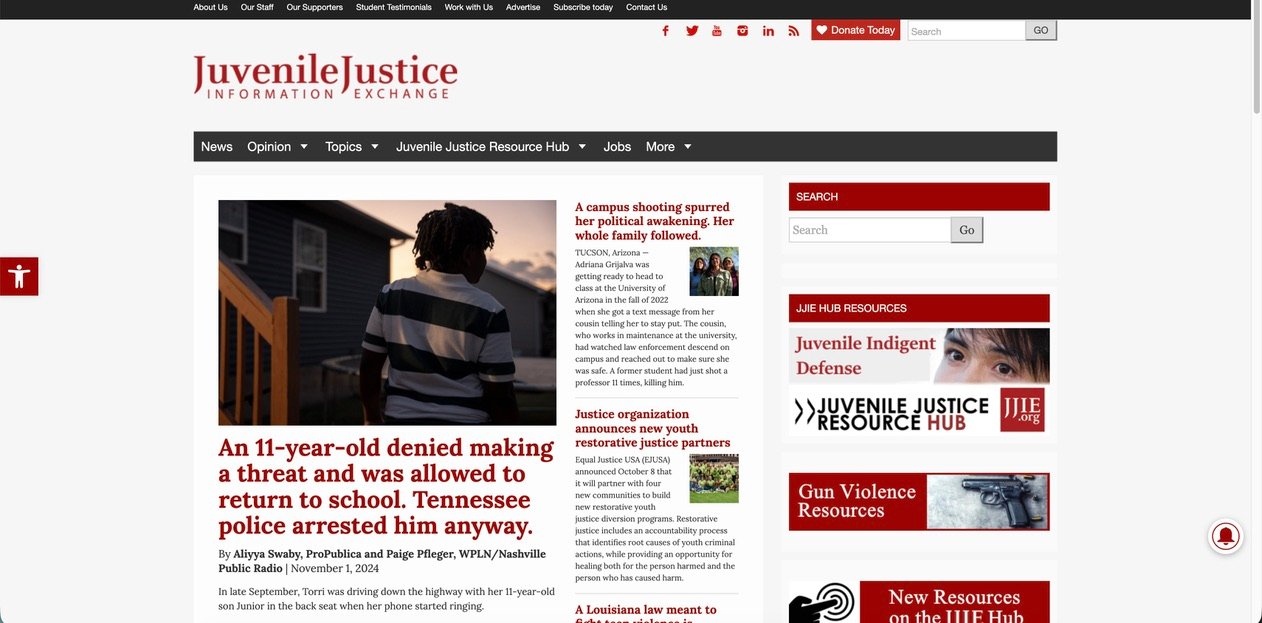
Guide: How to Research, Pitch, and Publish for JJIE — Step-by-step (Beginner → Money)
This guide helps you research JJIE — Juvenile Justice Information Exchange, shape publishable ideas for their audience, prepare strong samples, submit opinion or feature pieces, and leverage JJIE bylines to earn money from related work.
It collects JJIE links and proven pitching resources so even a beginner writer can follow each step, write a strong pitch, and increase the chance of publishing — or find paid alternatives when JJIE’s intake is closed.
Section 1 · Know the publication
What JJIE is and who reads it
The Juvenile Justice Information Exchange (JJIE) is an independent, nonpartisan journalism site focused on juvenile justice and related issues. It aims to fill gaps in coverage about youth, courts, incarceration, reentry, mental health, and community alternatives. JJIE publishes news, features, opinion essays, audio stories, and resource hub content that serve practitioners, advocates, policymakers, researchers, and engaged citizens. :contentReference[oaicite:0]{index=0}
Key things to know:
- Beat focus: juvenile justice, youth voices, courtroom and policy coverage.
- Formats: news reports, in-depth features, investigative pieces, guest opinion essays, the “Beat Within” youth-writing project, Hub resources, and multimedia (podcasts/video).
- Publisher: JJIE is published by the Center for Sustainable Journalism at Kennesaw State University — that matters for editorial independence, funding, and audience. :contentReference[oaicite:1]{index=1}
- Editorial standards: JJIE emphasizes rigor, accountability, and centering youth voices — they seek stories that hold institutions accountable or shed new light on youth issues.
Strong JJIE pieces tend to:
- Be rooted in reporting or first-person experience with verifiable sources (records, interviews, docs).
- Center youth perspectives or show how systems affect young people.
- Explain policy or practice in a way practitioners and non-expert readers can use.
- Link to resources, studies, or public records that support claims.
- Write for Us (JJIE official contributor instructions). :contentReference[oaicite:2]{index=2}
- Guest opinion / editorial guidelines — note the current intake status and return date (if any). :contentReference[oaicite:3]{index=3}
- JJIE Hub editorial policy — useful if you plan resource-style submissions. :contentReference[oaicite:4]{index=4}
Section 2 · Fit your idea
Is your idea JJIE-shaped?
Before drafting a pitch, sharpen your idea to match JJIE readers. A good JJIE idea is not just “juvenile justice” — it ties a specific policy, program, or human story to the decisions readers (advocates, agencies, legislators) might make.
Does it focus on young people or systems that touch them?
Examples: a new diversion program’s outcomes in your county; how schools and police interact in a specific district; the effects of mental-health screening in juvenile facilities; a profile of an innovative reentry program.
Is the reporting doable (sources & records)?
Editors prefer pitches grounded in sources you can reach: people (youth, families, program staff), public records, court filings, or datasets. If you cannot contact relevant sources, consider building a local sample first.
Is there a clear audience & purpose?
Who will act on this piece? Practitioners adjusting programs? Policymakers deciding budgets? Youth advocates looking for model practices? Name them in your pitch.
Section 3 · Build a small reporting base
Prepare samples and proof before you pitch
If you are a beginner, build a small set of finished pieces that show you can report responsibly and write clearly. Editors at mission-driven outlets like JJIE often look for evidence of accuracy and ethics, not just word count.
- Post a clear news-style piece or feature on your blog, Medium, Dev.to (if tech-adjacent), or local outlets.
- Include verifiable sources: quotes, links to public records, screenshots of datasets, court links, or program reports (where allowed).
- If possible, produce one short multimedia element: an audio clip, a short video, or an infographic — JJIE publishes multimedia and it strengthens your pitch.
- Save links to every published piece and build a one-page sample list (title, outlet, link, 1-line summary).
- If you’ve done youth-led reporting or written with youth voices, highlight that specially — JJIE centers youth experiences.
- If you have none, write a 1,500–2,000 word feature on a local juvenile-justice-related initiative and publish it on a personal blog or community news site.
If you plan to submit an opinion essay, check JJIE’s guest opinion page — it sometimes lists whether submissions are being reviewed and what the focus should be. When intake is paused (they may post a date), use the time to build samples or pitch other outlets. :contentReference[oaicite:5]{index=5}
Section 4 · How to write a pitch
Short, clear, reporter-style pitch + templates you can copy
Below is a compact workflow and multiple pitch templates tailored to JJIE: short news-feature pitches, investigative pitches, and guest opinion pitches. Use the one that matches your idea.
Before you write: research the exact JJIE guidance
Open the JJIE “Write for Us” page and the guest opinion editorial page. Note whether they list a submission form, required fields, or a temporary hold on submissions. Keep those pages open while you polish the pitch. :contentReference[oaicite:6]{index=6}
Structure your pitch (one paragraph opening, bullets)
Editors prefer concise pitches: 1–3 sentence lede, 3 bullet points explaining sources/approach, why now, and 1–2 links to your best writing. Add a 2-line bio with relevant credentials.
Use this exact short template — fill the blanks
Subject line: Pitch: [Short headline idea] — [City/State or beat] (e.g., Pitch: “How county X replaced detention with restorative diversion” — Cleveland, OH)
Body:
One-sentence lede: I propose a [news/feature/investigative] story that shows _____ (what) by reporting on _____ (who/where) and using _____ (records/interviews/data).
Bullets:
• Sources I can reach: [names, titles — e.g., program director, county official, youth participant; include contact status].
• Documents/data I will use: [court filings, county reports, program evaluations, FOIA request or dataset].
• Why now: [policy change, recent incident, new funding, pilot program].
Samples: Link to my best reporting: [link1], [link2].
Bio: 1–2 lines: your name, one-sentence summary of relevant work (e.g., “I’ve reported on juvenile courts for local weekly X and written features for Y.”).
Ask: Are you interested in commissioning this? I can file by [date]. Thanks — [Your name, email, phone].
Investigative / data-led pitch template
Use this for FOIA-backed stories, datasets, or multi-source investigations.
Subject: Investigation pitch: [Short title — mention FOIA/data]
Body: Short lede + three bullets: (1) dataset/public records I have or will request; (2) preliminary findings or pattern; (3) expected impact and audience.
Attach or link to a short doc or spreadsheet preview (not full files), and include at least one published sample showing you can handle complex reporting.
Guest opinion / essay template
If you are proposing an opinion essay (op-ed), follow JJIE’s guest opinion guidance and include a short, clear argument: single-paragraph thesis, 3 supporting points with examples, and why you’re the right voice. Keep op-eds tight (usually under 800–1,200 words, unless the site specifies otherwise). Link to relevant personal experience or prior opinion pieces. Check JJIE’s guest opinion page for current submission rules and any pause on intake. :contentReference[oaicite:7]{index=7}
Section 5 · Money & publishing strategy
How to turn JJIE bylines into income (and what to do when JJIE intake is paused)
JJIE is mission-driven and published by an academic center. That means the site’s main value to a freelancer is reputation and reach in the juvenile-justice policy community. JJIE sometimes commissions work; other times it may not have funds. Always ask the editor about payment when they reply — do not assume payment. If JJIE does not pay an assignment, you can still use the byline strategically to win paid work (consulting, longer features for paying outlets, speaking, grants, or local news outlets that pay). When JJIE explicitly pauses submissions, use their site as a research hub and pitch elsewhere. :contentReference[oaicite:8]{index=8}
- Repurpose a JJIE feature: Turn one research-heavy JJIE piece into a paid magazine feature, longer investigative article, or a series you pitch to larger outlets (ask the editor about reuse rights first).
- Consult or present: Use the byline to get consulting gigs, training sessions, or conference speaking on juvenile-justice topics.
- Create paid resources: Build a short briefing pack or toolkit from your reporting (for nonprofits, agencies, or foundations) and offer it for a fee or with a stipend request.
Section 6 · Ethics, youth voice, and legal safety
Journalistic ethics tailored for juvenile-justice reporting
When reporting on youth, ethics and legal caution are essential. JJIE emphasizes trust and accurate reporting — editors expect you to verify identity, protect minors, and follow privacy and consent norms. If you work with youth voices, get written consent from guardians where required and anonymize details that can identify a minor unless you have explicit permission and understand legal consequences.
- Confirm age before identifying a person as a youth; follow local law on naming minors in reporting.
- When discussing juvenile court cases, verify records and court rules about juvenile records and sealing.
- Avoid glamorizing harm; do not invent statistics or fabricate case details.
- Offer right of reply to institutions named in your piece.
- Prioritize safety: meet in safe, neutral places, keep guardians informed where appropriate, and protect contact data.
- Use trauma-informed interviewing techniques; avoid leading or retraumatizing questions.
- Credit youth voices accurately and offer them the chance to review sensitive quotes when appropriate.
Section 7 · Micro-SOP (copy-and-use)
Final checklist, exact email templates, follow-ups
Use this section as a quick operational SOP every time you prepare a JJIE pitch.
Email pitch templates — copy, paste, and edit
Subject: Pitch: [Title idea] — [Topic / City]
Body:
Hello [Editor name],
I’d like to pitch a [news/feature] on [one-sentence idea]. I will report from [where] and speak to [source types — e.g., program director, youth participant, county official]. I have access to [records/dataset] and can file a 1,200–1,800 word piece with 3–4 interviews and documents in ~4–6 weeks.
Samples: [link1], [link2].
Bio: [Your name, short credentials].
Thanks for considering — [Your name, email, phone].
Subject: Investigation pitch: [Short title — mention data/FOIA]
Body:
Hello [Editor name],
I’m working on a data-backed story showing [pattern]. I have requested/obtained [records or dataset], and initial review shows [brief finding — e.g., “a 30% rise in X”]. I can produce a deeply reported piece with document links, charts, and interviews with impacted youth and program leads. Samples attached: [link].
Can JJIE commission this investigation or suggest interest? — [Your name, contact].
Subject: Op-ed pitch: [Thesis] — [Short]
Body:
Hello JJIE editors,
I’d like to submit a guest opinion (approx. 700–1,000 words) arguing that [single-sentence thesis]. I will support this with [3 points — e.g., a local program example, policy change data, personal experience]. My qualifications: [1–2 lines]. Sample op-eds: [link]. Would you be open to this? Thanks — [Name, email].
Section 8 · FAQ + Resource bank (links you can use)
Quick answers and a large list of links for learning how to pitch, get paid, and report responsibly
- Write for Us — JJIE official contributor page. :contentReference[oaicite:12]{index=12}
- Guest Opinion Editorial Guidelines (JJIE) — check for intake pauses and updated rules. :contentReference[oaicite:13]{index=13}
- About JJIE — mission and background. :contentReference[oaicite:14]{index=14}
- JJIE Hub Editorial Policy — resources & editorial standards. :contentReference[oaicite:15]{index=15}
- Contact / Center for Sustainable Journalism (publisher). :contentReference[oaicite:16]{index=16}
- Opinion Essay Submission Form — sometimes active for guest essays. :contentReference[oaicite:17]{index=17}
- Contributors guide (may require access). :contentReference[oaicite:18]{index=18}
- Poynter – Guidelines for a good story pitch (how editors evaluate ideas). :contentReference[oaicite:19]{index=19}
- ProBlogger – guest-post guidelines and pitching tips. :contentReference[oaicite:20]{index=20}
- The OpEd Project – submission info for op-eds (useful for opinion structure). :contentReference[oaicite:21]{index=21}
- Freelance pitch email templates & tips (practical examples). :contentReference[oaicite:22]{index=22}
- IJNet – pitching best practices for freelancers. :contentReference[oaicite:23]{index=23}
- Indeed – how to write a media pitch (templates). :contentReference[oaicite:24]{index=24}
- ProBlogger – find & pitch guest posting opportunities. :contentReference[oaicite:25]{index=25}
- WritersWeekly — markets & paying publications. :contentReference[oaicite:26]{index=26}
- FundsforWriters — markets & pay listings. :contentReference[oaicite:27]{index=27}
- Freelancing with Tim — freelance journalism guides (search his site). :contentReference[oaicite:28]{index=28}
- Use Google: site:jjie.org “write for us” or site:jjie.org “submit” to locate active submission forms and guidance.
- Search the JJIE sitemap: jjie.org/sitemap.xml to find hub pages and resources. :contentReference[oaicite:29]{index=29}