


How to Research, Pitch, and Get Paid for Articles at the Journal of Accountancy — A Practical Beginner’s Guide
Short: this guide helps you read the Journal of Accountancy site, use the official author guidelines, prepare a strong pitch, and submit articles that help CPAs and accounting pros — so you can earn paid bylines and build a professional portfolio.
:contentReference[oaicite:0]{index=0}
Section 1 · What this publication actually publishes
Who reads the Journal of Accountancy and what they expect
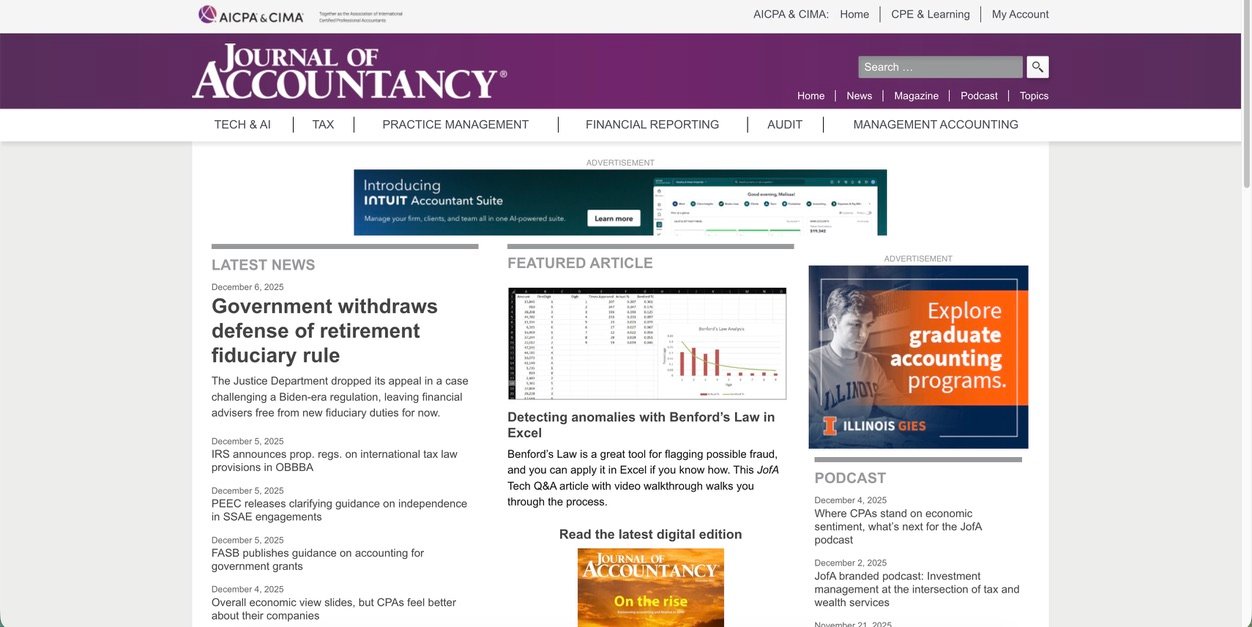
The Journal of Accountancy (JofA) is produced by the AICPA and CIMA and serves working CPAs, tax professionals, auditors, practice leaders, and accounting technology decision-makers. Its content ranges from breaking tax and accounting news to deep, practical features that help practitioners perform their jobs better. Readers expect accuracy, evidence, references to official guidance, and actionable steps they can use in practice. :contentReference[oaicite:1]{index=1}
What that means for you as an author: write with the practitioner in mind. Focus on real problems (tax reporting, audit procedures, accounting standards, Excel workflows, technology adoption, ethics, practice management) and show specific steps, examples, citations to authoritative sources, and, where possible, measurable outcomes. Editors value content that helps a CPA make a decision or complete a task more confidently. :contentReference[oaicite:2]{index=2}
Explore these Journal of Accountancy sections when choosing a topic:
- Tax & tax accounting. :contentReference[oaicite:3]{index=3}
- Audit & assurance. :contentReference[oaicite:4]{index=4}
- News & updates (policy updates, IRS guidance, standard-setting). :contentReference[oaicite:5]{index=5}
- Tech & AI in accounting (Excel, data analytics, security, AI tools).
- Practice management, ethics, and career development for CPAs.
- Practical: Will a CPA use this tomorrow?
- Accurate: cite primary sources (IRS regs, ASC, AICPA guidance).
- Readable: clear headline, short paragraphs, visuals/tables where helpful.
- Evidence: examples, sample calculations, or a demo file (Excel/GitHub).
Section 2 · Read the Author Guidelines & contact editors
Start here: official author guidance and the right contacts
Before you draft anything, read the Journal of Accountancy’s official author guidelines (this is the single most important page to understand submission preferences, synopsis length, and editorial expectations). The page explains how editors prefer a one-page synopsis, that you should discuss ideas with a senior editor first, and that reading recent JofA issues helps you match tone and depth. :contentReference[oaicite:6]{index=6}
Official author guidelines: journalofaccountancy.com/info/author-guidelines. :contentReference[oaicite:7]{index=7}
If you have a news tip or idea, contact the appropriate editor. The site lists an editorial contact and staff; for author guidelines or article submissions, Jeff Drew is listed as a contact (email is provided on the site’s contact page). Use the contact page to find the correct editor for news vs. features. :contentReference[oaicite:8]{index=8}
Contact & staff page: journalofaccountancy.com/info/contact/. :contentReference[oaicite:9]{index=9}
Bookmark these three pages now
- Journal of Accountancy homepage. :contentReference[oaicite:10]{index=10}
- Author guidance & submission notes. :contentReference[oaicite:11]{index=11}
- Contact and editorial staff. :contentReference[oaicite:12]{index=12}
Section 3 · Choose a publishable, practice-focused idea
How to shape an idea that a JofA editor will notice
A useful JofA idea is not “I want to write about tax.” It’s a clearly framed problem + audience + outcome. Use this formula: Problem + Who + Outcome — for example, “How to implement ASC 842 lease accounting in small firm ERP systems so a controller can close monthly faster by 20%.”
Find a practitioner pain point
Scan recent JofA news and topic pages for gaps (e.g., a new IRS rule with unclear practitioner steps, or common Excel workflows used in audit sampling). Read two or three recent pieces in the relevant section and note unanswered questions or “how-to” steps you can demonstrate. :contentReference[oaicite:13]{index=13}
Be specific about audience
Specify: “state and local tax managers,” “small-firm controllers,” or “audit seniors preparing SOC reports.” The narrower the reader, the easier to write to their level and show exactly what they need to do. :contentReference[oaicite:14]{index=14}
Pick a measurable or demonstrable result
Examples: save X hours per month, reduce common errors by Y%, simplify a reconciliations step down to N steps, or produce a tested Excel file / template that readers can reuse.
Exercise: write one sentence: “This JofA article will show [who] how to [do X] so they can [measurable result].” If you can fill the blanks clearly, proceed to outline.
Section 4 · Build writing samples & demos
How to prepare public samples that prove you can deliver
Editors want to see that you can finish an article and that your examples work. If you’re a beginner writer, publish 2–4 strong samples first — long-form practical guides on your blog, on LinkedIn, or a niche platform. Each sample should include a clear setup, step-by-step guidance, and attachments when relevant (Excel workbook, code snippets, sample contract language, or screenshots).
- Headline + one-line summary of the practical benefit.
- Context/setup: tools and versions (e.g., Excel 365; QuickBooks Online; CCH/TaxPrep).
- Step-by-step instructions with screenshots or sample files.
- References to authoritative sources (IRS regs, AICPA pronouncements, ASC sections).
- Attribution for any third-party content and permission for reproduced figures.
Use trustworthy hosting and link to it in the pitch:
- Dropbox or Google Drive (set share links)
- GitHub for scripts or code-based demos
- Attach a small Excel workbook demonstrating calculations (never include client-sensitive real data)
Tip: publish draft samples with “Draft” labels and a short explanation that these are writing samples or preprints. Editors appreciate seeing the work even if it’s not final.
Section 5 · Step-by-step submission / pitch template
A simple pitch workflow and a copyable pitch template
Follow this compact workflow: (1) read author guidelines, (2) prepare one-page synopsis + one sample, (3) email or use the submission route listed on the contact page, (4) follow up politely after two weeks if you haven’t heard. The author-guidelines page suggests discussing ideas with a senior editor or submitting a one-page synopsis prior to a full manuscript. :contentReference[oaicite:15]{index=15}
One-page synopsis structure
- Title (working): short and precise
- Who: the practitioner who benefits
- Problem: specific task or decision
- Solution outline: 4–6 bullets of sections
- Examples / support: attachments or sample links
- Why JofA: explain how this suits Journal of Accountancy readers
Copy-paste pitch email (editable)
Subject: Pitch — [Working Title] — one-line benefit

Hello [Editor Name],

I’m [Your name], [short bio: CPA / accounting manager / tax specialist / consultant], and I’d like to pitch an article for Journal of Accountancy.

Working title: [Short, clear title]

One-line summary: [Who this helps and what they’ll be able to do after reading — e.g., "Shows small-firm controllers how to reconcile multi-entity consolidations to reduce closing time by 25%"]

Synopsis (3–5 bullets):
• Problem: [describe]
• Setup / tools: [Excel workbook, example GL, XYZ software]
• Sections: [1) Setup, 2) Step-by-step, 3) Tests / examples, 4) Common gotchas, 5) Conclusion]
• Support files: [link to Excel / Dropbox / GitHub / sample]
Why this fits JofA: [one sentence]

Links:
• Writing sample: [link to published sample]
• Portfolio / GitHub: [link]

I’d welcome a short conversation if this is of interest. Thank you for taking a look.

Best,
[Your name] — [email] — [phone optional]
Note: keep the tone professional and concise. If the author-guidelines page asks for a form submission instead of email, follow the site process. :contentReference[oaicite:16]{index=16}
Section 6 · Money: how contributors are typically paid & how to leverage a byline
What to expect and how to convert bylines into ongoing income
Public pay rates for trade publications vary and are often negotiated per article. The Journal of Accountancy is an established professional outlet; some contributors are staff writers or AICPA subject-matter experts. If payment is not explicit on the author guidelines, use the contact page to ask about contributor fees and editorial expectations before submitting a full manuscript. (Tip: ask in the initial discussion whether the assignment is paid and the payment process.) :contentReference[oaicite:17]{index=17}
- Use the byline to attract freelance consulting clients or CPE speaking engagements.
- Turn a flagship article into a short paid course or webinar.
- License practical tools/templates (Excel checklists) to readers or firms.
- Republish excerpts on LinkedIn / newsletter to build authority.
In your initial outreach (or after the editor requests a draft), politely ask: “Is this assignment paid, and if so, can you share the typical range or the payment process?” Editors will often answer; if they don’t, you can proceed but keep expectations modest until confirmed.
Section 7 · Ethics, accuracy & evidence (non-negotiable)
How to keep your practitioner credibility intact
Trust is the Journal of Accountancy’s core currency. Never publish theoretical or untested “solutions” as facts. Test any Excel formulas, sample journal entries, or scripts. When citing law, standards, or rules, link to the primary source (IRS, ASC, AICPA statements, PCAOB, FASB) and include clear references in the document. If you used AI or automated assistance to draft text, clearly edit and verify everything — you remain responsible for accuracy and clarity.
- Do not include confidential client data or identifiable information in examples.
- Do not invent case studies — use anonymized, real examples or hypotheticals that are clearly labeled.
- Do not rely on non-authoritative sources for legal or tax guidance.
Golden rule: if you could not comfortably defend each figure, code line, or tax position on a call with an editor, revise it before submission.
Section 8 · Final checklist, templates, and quick resources
Printable micro-SOP you can reuse for every pitch
- Author Guidelines — Journal of Accountancy. :contentReference[oaicite:18]{index=18}
- Contact & staff — editors and submission contacts. :contentReference[oaicite:19]{index=19}
- Tax topics — practical tax coverage. :contentReference[oaicite:20]{index=20}
- Auditing & assurance topics. :contentReference[oaicite:21]{index=21}
- News — stay current. :contentReference[oaicite:22]{index=22}
- Magazine editions (archive issues). :contentReference[oaicite:23]{index=23}