


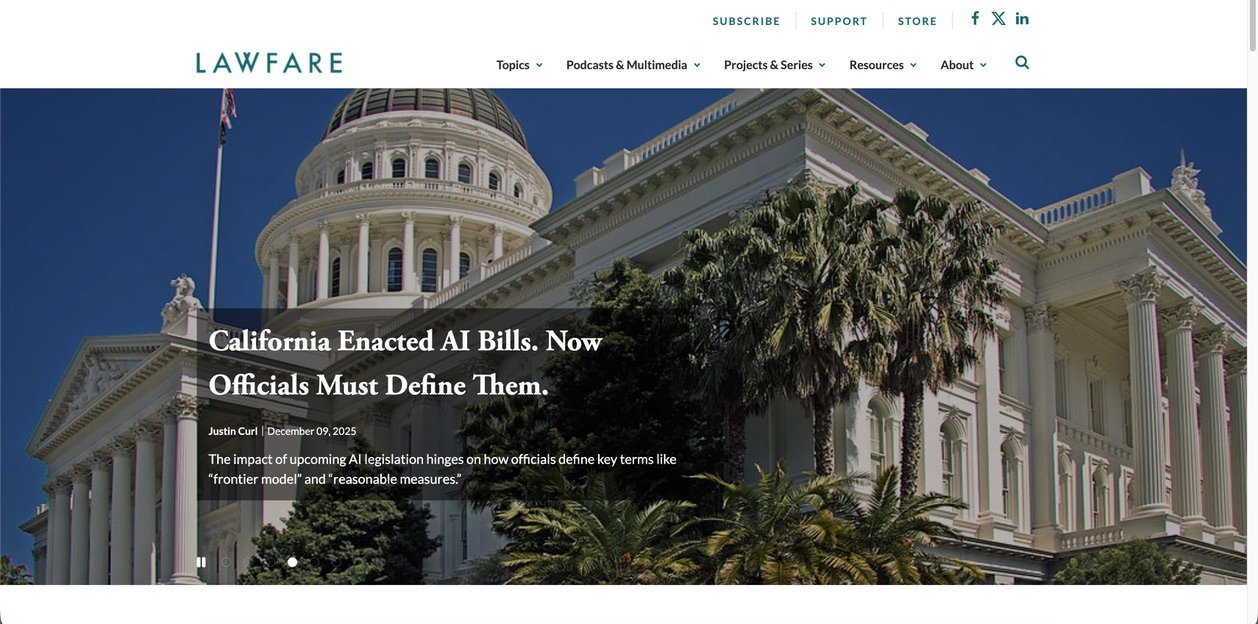
Guide: How to Write for Lawfare — From Student Contributor to Credible Byline
This practical guide explains how Lawfare works, how its Student Contributor Program operates, what kinds of pieces the editors look for, how to prepare and pitch publishable work, and how to use a Lawfare byline to grow a career in national-security law and policy.
Read actionable templates, sample outlines, a full student-application checklist, pitching text you can copy, and a resource list with direct links so you can apply today.
Section 1 · What Lawfare is
Who publishes Lawfare and who reads it?
Lawfare is a nonprofit multimedia publication focused on the intersection of national security, law, and policy. It publishes analysis, essays, podcasts, and research aimed at practitioners, legal scholars, policy-makers, and informed members of the public.
Contributors include academics, former and current government officials, policy experts, and student contributors. The site is editorially run by an in-house staff with a public masthead that lists editors, fellows, and student contributors.
Common items you’ll see on Lawfare:
- Short analytical posts responding to breaking national-security news and legal developments.
- Long-form legal analysis (detailed explanations of statutes, cases, policy options).
- Op-eds and essays by practitioners and scholars.
- Podcasts and interviews exploring policy choices and legal frameworks.
The audience expects:
- Analytic clarity — precise legal language where needed, plain language where possible.
- Evidence and sourcing — citations to cases, statutes, official reports, and primary documents.
- Seriousness — Lawfare is not a promotional site; it values critical and independent analysis.
Tip: Before you write, read several recent Lawfare posts in your chosen topic — note how authors cite primary sources (cases, statutes, official reports) and how they make recommendations or explain legal constraints.
Section 2 · Student Contributor Program
How the Student Contributor Program works (eligibility & application)
Lawfare runs a Student Contributor Program that accepts applications from current law students (generally 2L/3L, LLM, SJD) and other graduate students in relevant fields. The program gives students the opportunity to submit articles, help with research, and gain editorial experience. The program recurs seasonally (Lawfare posts application announcements when accepting new cohorts).
Important: application windows are specific. Recent announcements (for example, the 2025–2026 program) were posted on Lawfare with a Google Forms application link; always use the official application link on Lawfare’s site when applying.
Eligibility
Law students in their second or third years, LLM and SJD candidates, and graduate students in related fields are eligible. First-year (1L) students are typically not eligible. Check the specific announcement for exact dates and eligibility notes.
Typical application items
- Short bio and contact details.
- Writing samples (ideally 1–3 pieces showing legal or policy analysis).
- A short statement of interest and topic ideas you could write about.
- Academic or resume information (school, expected graduation year).
Some applications are via a Google Form (linked in the announcement). Keep answers concise and show you can handle primary-source legal analysis.
What to expect
If accepted you may be invited to submit pieces, participate in research tasks, or be paired with editors. Lawfare staff edit submissions; student contributors have previously been listed on the public masthead. Acceptance is competitive.
Quick action: when Lawfare posts applications, the post usually contains a direct application link. Save that link and prepare samples in a single PDF or cloud links you can paste into forms.
Section 3 · Fit your idea for Lawfare
How to craft a Lawfare-shaped article idea
Instead of “I want to write about X,” start with a narrow policy/legal problem that readers need solved. Good Lawfare ideas are anchored to cases, statutes, government guidance, policy debates, or technology-law intersections (privacy, cybersecurity, AI governance, intel law).
Is the question timely and narrow?
Examples: “How will [new statute] change surveillance warrants?” or “What legal options exist for X state actor after Y event?”
Can you point to primary sources?
Lawfare articles cite cases, statutes, court filings, government memos, and reports. If you cannot point to source documents, build that research first.
Do you offer analysis, not just summary?
Lawfare readers want clear analysis: explain stakes, constraints, and plausible policy options or legal interpretations.
Exercise: draft one-sentence “This piece explains…” — if that sentence ends in a clear, defensible recommendation or a narrow explanation of legal mechanics, your idea is likely a fit.
Section 4 · Build sample work
Create publishable samples that editors will accept
You will need 1–3 strong writing samples when applying to the Student Contributor Program or when pitching editors. These need not be already published on Lawfare — they can be on your school blog, a legal clinic page, Medium, or an institutional blog — but they must show your ability to analyze primary sources and explain consequences clearly.
- Clear lead paragraph that states the legal question and why it matters to policy or practitioners.
- Brief background with citations to the statute, case, or memo at issue.
- Analytic sections with subheads (e.g., “Legal standard,” “Application to facts,” “Policy implications”).
- Concise conclusion with recommended next steps or unanswered questions.
- Length: typically 800–2,500 words depending on depth.
- Your law-school blog or centers (constitutional law, national-security law centers).
- Medium, Substack, or LinkedIn (use tags to reach policy readers).
- Student journals (short policy notes) or relevant professional student publications.
- Smaller policy outlets that accept submissions (see resource list below).
Warning: avoid thin summaries or pure opinion pieces without factual/legal support. Editors prefer analysis grounded in primary materials.
Section 5 · Pitching & application templates
Exact language you can use in forms or emails
Lawfare’s student applications frequently use a Google Form; general contributor submissions (when solicited) may request a short pitch, outline, and samples. Below are copy/paste templates you can adapt.
Short application pitch (Google Form entry)
Paste this into the “Brief description of proposed article” field:
This piece explains how [specific legal instrument/case/policy] affects [specific actors or process]. I will:
• Summarize the core legal text (cite primary sources).
• Explain practical consequences for practitioners and policymakers.
• Offer 2–3 realistic policy/legal options and trade-offs.
Draft length: ~1,200–1,800 words. Sample of my work: [link].
Email pitch to an editor (use only if an email is requested)
Subject: Student contributor application — [Your Name] — “[Short idea title]”
Dear [Editor name],

I am a [2L / 3L / LLM / grad student] at [School]. I am applying to the Lawfare Student Contributor Program and would like to submit the following idea:

Title: [Short, specific title]
One-sentence hook: [What the piece explains and who benefits]
Outline:
1) Quick background (why this matters)
2) Legal/technical framework (primary sources)
3) Case studies or examples
4) Policy implications and options

My attached sample: [link to PDF or published sample]. Short bio: [50–75 words].

Thank you for your consideration — I would be grateful for any guidance on fit or scope.

Best,
[Your name] • [email] • [LinkedIn/GitHub/SSRN if applicable]
Two-line bio (for forms)
[Your name] is a [2L / LLM / graduate student] at [School], where they study [topic]. Their recent research/experience includes [clinic, internship, or research assistant role].
Quick tip: keep subject lines and headings specific. Replace vague phrases like “national security” with precise briefs: “EO on surveillance authorities” or “litigation over Section 702.”
Section 6 · Editing, ethics & AI
Rules to live (and publish) by
Lawfare’s reputation relies on accuracy. Whether you are a student contributor or an outside author, follow basic rules:
- Verify primary sources: link to full statutes, opinions, or government documents.
- Avoid speculation: label uncertain interpretations clearly.
- Credit material you quote or adapt — footnote or inline citation.
- Do not submit AI-generated text as-is. If you use AI, fully edit and verify every claim.
- Concise, careful legal analysis that adds value to the public debate.
- An evidence-based conclusion or clear mapping of options.
- Willingness to revise — Lawfare editors will edit; be prepared to respond constructively.
Golden rule: if you wouldn’t defend a paragraph in a call with an editor or in front of a subject-matter expert, rewrite it.
Section 7 · Money & career value
How a Lawfare byline helps (and what to expect about payment)
Lawfare is a nonprofit editorial outlet. While staff roles and internships are paid positions (see job postings and internship announcements on Lawfare), public contributor payment rates are not broadly published in the site’s contributor announcements. For students and early-career writers, the primary immediate value of a Lawfare byline is reputation and visibility in legal and policy circles.
- Credibility for job and clerkship applications.
- Networking — editors and contributors are well-connected in policy circles.
- Visibility — Lawfare pieces are read by policy-makers, academics, and practitioners.
- Use Lawfare pieces to win consulting, speaking, or freelance research work.
- Promote pieces on LinkedIn/SSRN to attract clients or job offers.
- Collect a portfolio of strong analytical pieces to pitch other paying outlets or to develop a short course.
If payment is crucial to you, ask the program/editor directly during the process — staff job posts and internships list compensation when applicable, but contributor pay is not always public.
Section 8 · Final pre-application checklist
Micro-SOP: things to do before you submit
Pro-tip: when uploading files to a form, use descriptive filenames like “LastName_Lawfare_Sample1.pdf” — editors appreciate organized submissions.
Section 9 · FAQ & quick answers
Beginner questions — short answers
Resources · Direct links and reading
Official Lawfare links, application posts, and helpful external guides
- Lawfare — Home
- Interested in Becoming a Student Contributor? (information & form link)
- Student Contributor Program — Applications Are Now Open (example announcement)
- Lawfare Masthead (editors & student contributors)
- Lawfare Contributors — directory of regular contributors
- UNC Medialaw summary of Lawfare Student Contributor Program (helpful third-party overview)
- Guide: Publishing in policy outlets — practical tips for op-eds and analysis
- Jobs & internships postings (to see how Lawfare staff roles are listed)
- Call for Papers (useful for longer academic submissions)
- Lawfare Student Contributor announcement (social post example)
Want more links? Open the Lawfare masthead and contributors pages and click the names of people working on topics you care about — many authors link to their institutional pages, which are great models for tone and structure.