


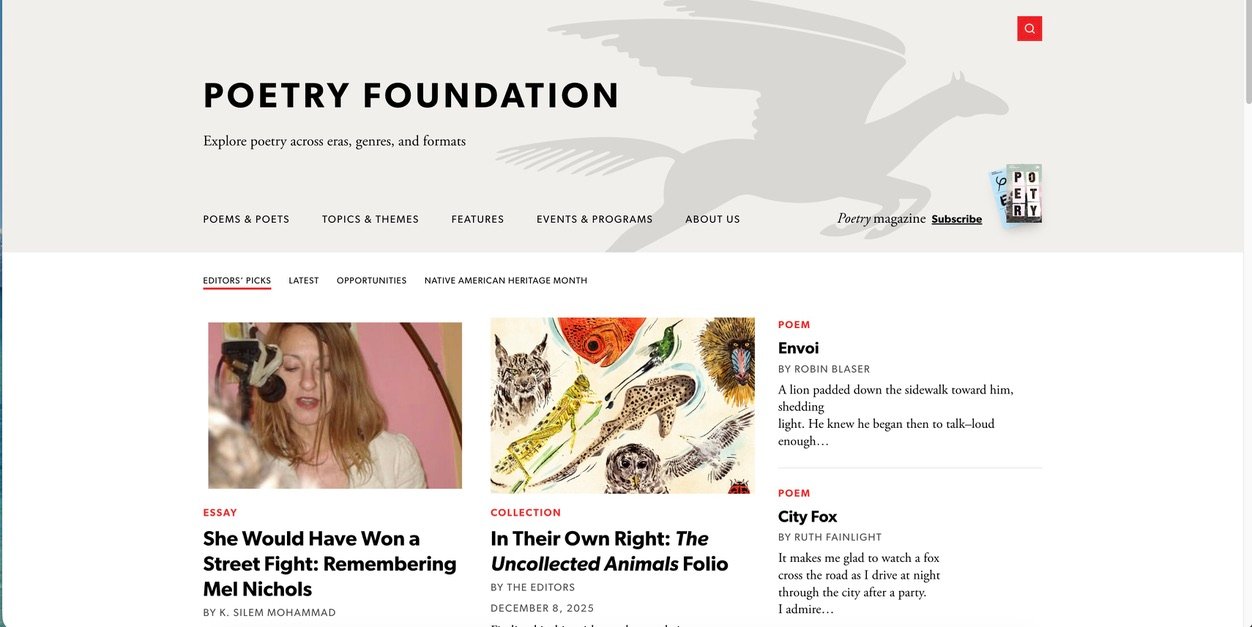
Guide: How to Use Poetry Foundation (and nearby markets) to Get Published & Earn as a Poet
This guide helps beginners: how to read Poetry Foundation / Poetry magazine guidelines, prepare polished submissions, find paying markets, enter contests, and create income from poems, readings, chapbooks, and teaching.
It includes step-by-step submission SOPs, sample emails, a checklist, an extensive resource list with direct links (including the Submittable page and Duotrope listing you shared), and quick strategies to turn a poem into paying opportunities.
Section 1 · What the Poetry Foundation / Poetry Magazine are
What you need to know (short version)
The Poetry Foundation runs PoetryFoundation.org and publishes the long-standing print and digital journal Poetry (often written in uppercase, POETRY). The site contains thousands of poems, essays, interviews, and the magazine’s submission and subscription information. :contentReference[oaicite:0]{index=0}
Why it matters: getting a poem into Poetry is a major credential — it can raise your profile, lead to readings, and open doors to grants and book offers. The magazine also runs open calls (through Submittable) for many categories (text poems, visual poems, translations, video) during specific reading windows. :contentReference[oaicite:1]{index=1}
- Poetry Foundation = home of POETRY magazine + large poem archive.
- Submissions are handled online (Submittable) during open windows; they close mid-June through mid-September annually for some categories. :contentReference[oaicite:2]{index=2}
- Poetry publishes work from a global range of poets and translations; they prioritize previously unpublished work.
Reading recent issues and the submissions FAQ helps you match tone, length, and the kinds of conceptual risks editors choose. It’s worth 2–4 hours of research before you pitch or submit. :contentReference[oaicite:3]{index=3}
Section 2 · How submissions actually work (Submittable & policies)
Open windows, simultaneous subs, response times, and pay
The magazine uses Submittable for submissions. During open reading periods (commonly September 15–June 15 for some categories) you can upload your poem(s) directly to a listed call. The Submittable listings include precise instructions (how many poems, page limits, file types). Always use the Submittable link on the Poetry Foundation site so you are in the correct category. :contentReference[oaicite:4]{index=4}
Important submission rules often include:
- Submit only previously unpublished work (work on social media counts as published for many editors).
- Submit one submission per category at a time; if you submit twice in the same category before hearing back, later submissions may be archived unread. :contentReference[oaicite:5]{index=5}
- Poetry’s staff reads tens of thousands of submissions; response times can be long (their Submittable pages mention up to ~eight months in some listings). :contentReference[oaicite:6]{index=6}
Payment: Poetry states that poets compensated for published poems are paid per published line with a minimum honorarium (the Submittable listing for visual poems and the general Poetry Submittable manager show a $10/line rate and a minimum per-poem honorarium). Always confirm the exact rate on the Submittable call you use. :contentReference[oaicite:7]{index=7}
Section 3 · How to prepare your poems (formatting & selection)
Concrete steps so your submission isn’t knocked out for avoidable reasons
Editors reject many submissions by form (not quality) — wrong file type, missing translation, formatting hidden in an image, or sending previously published work. Here’s a checklist that removes those basic barriers.
Choose your 3–6 strongest poems
For general poetry submission windows, editors often ask for up to 3–5 poems. Choose poems that work together: voice, range, or a clear thematic arc. If the listing allows one poem, pick the absolute strongest one.
File type and layout
Save poems as a single .docx or .pdf (follow the Submittable instructions). Use a readable serif or sans-serif font (11–12pt), single spacing, and do not embed unique fonts. Put the poem title and your name (or not — check guidelines) consistently. If submitting translations, include the original and the translation in the same document and label clearly. :contentReference[oaicite:8]{index=8}
Proofread and test
Copy-paste your poem into a fresh document to check smart quotes, hyphenation, and line breaks. If your poem uses unusual spacing, preserve it but confirm it converts properly to PDF. Check that links to audio or video (if asked) work.
Short bio & contact details
Prepare a 20–50 word bio and one-line contact info (email). If you collaborate, include your co-author’s name and a 20-word bio as requested on some Poetry Submittable calls. :contentReference[oaicite:9]{index=9}
- Single .docx or .pdf, up to the page limit stated.
- Title, line breaks preserved, no weird fonts.
- Include translations where required.
- Attach a short bio (20–50 words).
- Mark simultaneous submissions when accepted elsewhere.
Section 4 · Submission SOP: step-by-step for beginners
From final poem to “Send” — a simple reproducible routine
Follow this small SOP every time you prepare to submit — it reduces errors and helps you keep an accurate record of where your poems are.
Finalize & time-stamp your master file
Save a master folder: poem-name_final_DATE.docx and a PDF export. Keep a simple changelog (what you edited and why). This becomes your archive for rights questions later.
Find the exact call & read it three times
Open the Poetry Submittable page (or the magazine’s site) and read instructions exactly: how many poems, whether translations allowed, simultaneous policy, and the pay/honorarium terms. Use the link on Poetry Foundation pages when applying to Poetry. :contentReference[oaicite:10]{index=10}
Complete submission form carefully
Copy-paste your 20–50 word bio into the bio field. Attach the PDF file. In the cover letter field (if present), write a one-line descriptor: “Enclosed: 3 previously unpublished poems exploring [theme]; PDF attached. Thank you for considering.” Keep it short.
Record & follow-up
Log the submission in a tracker (spreadsheet or Duotrope / Submittable history): date, publication, category, file name, and expected wait (e.g., 6–8 months). Only follow up after the listed wait period. If accepted elsewhere, notify promptly. :contentReference[oaicite:11]{index=11}
Section 5 · How poets actually earn money (real routes)
Magazine pay, contests, readings, books, teaching, and more
There’s no single path — professional poets typically combine several income streams. Below are the main, practical ways poets earn money and how to approach each one.
Many literary magazines pay small fees per poem or per page; major journals like Poetry publicly state honoraria for published poems on specific Submittable calls (see Submittable listing). Smaller journals might pay copies or small honoraria; others pay nothing. Use market databases (Duotrope, Poets & Writers, NewPages) to find paying publications and their rates. :contentReference[oaicite:12]{index=12}
Contests (single-poem, chapbook, full manuscript) can pay cash, publication, or both. Use Poets & Writers or NewPages to find legitimate contests; beware of scams and always check prize details and judge bios. :contentReference[oaicite:13]{index=13}
Local readings, university readings, and festivals often pay an honorarium or travel reimbursement. Offer a short craft talk or a workshop to increase your fee. Build a one-page speaker one-sheet with a short bio, sample poems, and fees/rider.
Winning a chapbook contest or publishing with a small press can lead to modest advances and future opportunities. Self-publishing (print-on-demand) gives more control and higher per-copy earnings, but marketing is on you. Many poets combine press publication with merch, readings, and teaching.
Section 6 · Market list & tracking tools (links you’ll use a lot)
Databases, submission trackers, and trusted lists
Below are the highest-value sites for finding paying markets, tracking submissions, and checking contest legitimacy. Bookmark them and build a small routine for weekly checks.
| Resource | What it does | Why to use it |
|---|---|---|
| Duotrope | Market listings + submission tracker (paid with trial) | Detailed publisher stats (response times, fees, payment info). Use it to research a magazine before you submit. :contentReference[oaicite:14]{index=14} |
| Poets & Writers | Grants, contests, magazine database | Best place for vetted contests, grants, and a literary-mag database for magazines and reading windows. :contentReference[oaicite:15]{index=15} |
| NewPages | Calls for submissions, contests, magazines | Great for PR-style calls and smaller press contests; often lists themed calls. :contentReference[oaicite:16]{index=16} |
| Submittable | Submission portal used by many journals | Keep a Submittable account; you’ll use it to submit to Poetry and many other journals. Use the “Submissions” dashboard to see statuses. :contentReference[oaicite:17]{index=17} |
| Poetry (Visual Poetry) — Submittable | Official submission call for visual poems at POETRY magazine | One of the exact places you’ll send work for Poetry magazine; includes length, translation, and pay details. :contentReference[oaicite:18]{index=18} |
Section 7 · How to turn publication into income (practical tactics)
Concrete, repeatable actions you can take after an acceptance
An acceptance is not the end — it’s the start of a small promotional and business process. Below are high-ROI steps to convert a poem acceptance into money and opportunities.
Collect your assets
Ask the editor for: a high-resolution image of the magazine cover (if provided), the exact publication date, and any promo copy. Save your byline, headshot, and the poem file that will appear in print/digital form.
Ask about rights & reprint policy
Most magazines request first serial rights. Ask when you can repost the poem on your site or in a collection. Keep the rights timeline in writing (email) for your records.
Promote strategically
Share the poem link, but also craft a short behind-the-poem thread (on X/Twitter or a blog) showing process, images, or audio. Tag the magazine and editors — this increases the chance of resharing and brings readers to your other work.
Pitch readings & workshops
Use the publication as credibility: email local bookstores, libraries, or festival bookers with a 2-line pitch: “I have a recent poem in Poetry (Dec 2025 issue) and a 45-minute reading + 60-minute workshop on writing ekphrastic poems.” Include fees and tech needs.
Convert into teaching & editing gigs
Offer a short online workshop (45–90 mins) that uses your poem as a case study; charge a modest fee. Create a “teach your poem” micro-course (video + worksheet) and host it on Gumroad or Teachable.
Section 8 · Pitch & cover letter templates (copy, paste, adapt)
Short, honest templates for submissions and event pitches
Use this in the “cover letter/notes” field on Submittable
 Hello —
Please find attached three previously unpublished poems for consideration:
“Title A” (1 page), 2) “Title B” (1 page), 3) “Title C” (2 pages).


Bio: [20–30 words — your current project, one credit]
Thank you for your time and for reading.
Best,
 [Your Name]
 Hello [Curator Name],
My name is [Your Name]. I’m an author and poet recently published in [Magazine — link]. I offer a 45–60 minute reading (20–30 minute reading + Q&A) and an optional 60–90 minute practical workshop on [topic: ekphrastic poems / lyric essay craft / writing prompt workshop].
I can travel [area] / run remotely via Zoom. Fee: [state your range] + travel.
Available dates: [list].
Thank you for considering — I can send a speaker one-sheet and sample audio.
Best,
 [Your Name]
Section 9 · Final checklist, ethics, & FAQs
Before you click SUBMIT — the final items to check
Ethics & honesty
Don’t submit AI-generated poetry as your own. Don’t claim false publication history. If a poem quotes or samples others, clear permissions if required. Editors care about provenance and author responsibility.
Legal basics
Keep records of acceptances and contracts. Know the rights you grant (first serial, non-exclusive, etc.). If uncertain, ask the editor plainly before signing anything.
Timing & tracking
Log the submission and set a calendar reminder for follow-up after the editor-specified wait. Don’t repost the poem publicly until the magazine’s reprint policy allows it.
- Can I submit the same poem to many journals at once? Many journals allow simultaneous submissions but require notification if accepted elsewhere — check each journal’s policy. :contentReference[oaicite:19]{index=19}
- How long will editors take? Varies — for Poetry, Submittable pages warn that response times can be up to months (some listings state up to ~eight months). :contentReference[oaicite:20]{index=20}
- Will they pay? Many journals pay; Poetry’s Submittable call lists per-line rates and minimum honoraria for accepted poems — check the specific notice. :contentReference[oaicite:21]{index=21}
Section 10 · Long resource list (links you’ll need)
Open these in separate tabs — your core market & pay-finding toolkit
- Poetry Foundation — Submit to Poetry (official submission hub). :contentReference[oaicite:22]{index=22}
- POETRY magazine — Visual Poetry Submittable page (example call and pay info). :contentReference[oaicite:23]{index=23}
- Duotrope — Poetry Magazine listing (market stats & payment notes). :contentReference[oaicite:24]{index=24}
- Duotrope home — market search & tracker (trial & subscription options).
- Poets & Writers — contests, grants & literary magazine database. :contentReference[oaicite:25]{index=25}
- NewPages — submission calls, magazine guide, contests. :contentReference[oaicite:26]{index=26}
- Academy of American Poets (Poets.org) — prizes, resources, Poem-a-Day. :contentReference[oaicite:27]{index=27}
- Submittable — account dashboard used by journals. :contentReference[oaicite:28]{index=28}
- Make a Living Writing — overview of sites that pay for poetry (practical list for paid markets).
- Poetry Foundation — Learn (teaching resources, education).
- Subscribe to Poetry magazine (info on issues & access). :contentReference[oaicite:29]{index=29}
- NewPages — Calls for submissions (current opportunities). :contentReference[oaicite:30]{index=30}
- Poetry Submissions (aggregator) — a long list of open magazines (use carefully; verify each journal).
- Poets & Writers — Grants & Awards database. :contentReference[oaicite:31]{index=31}
- NewPages — Guide to Literary Magazines. :contentReference[oaicite:32]{index=32}