


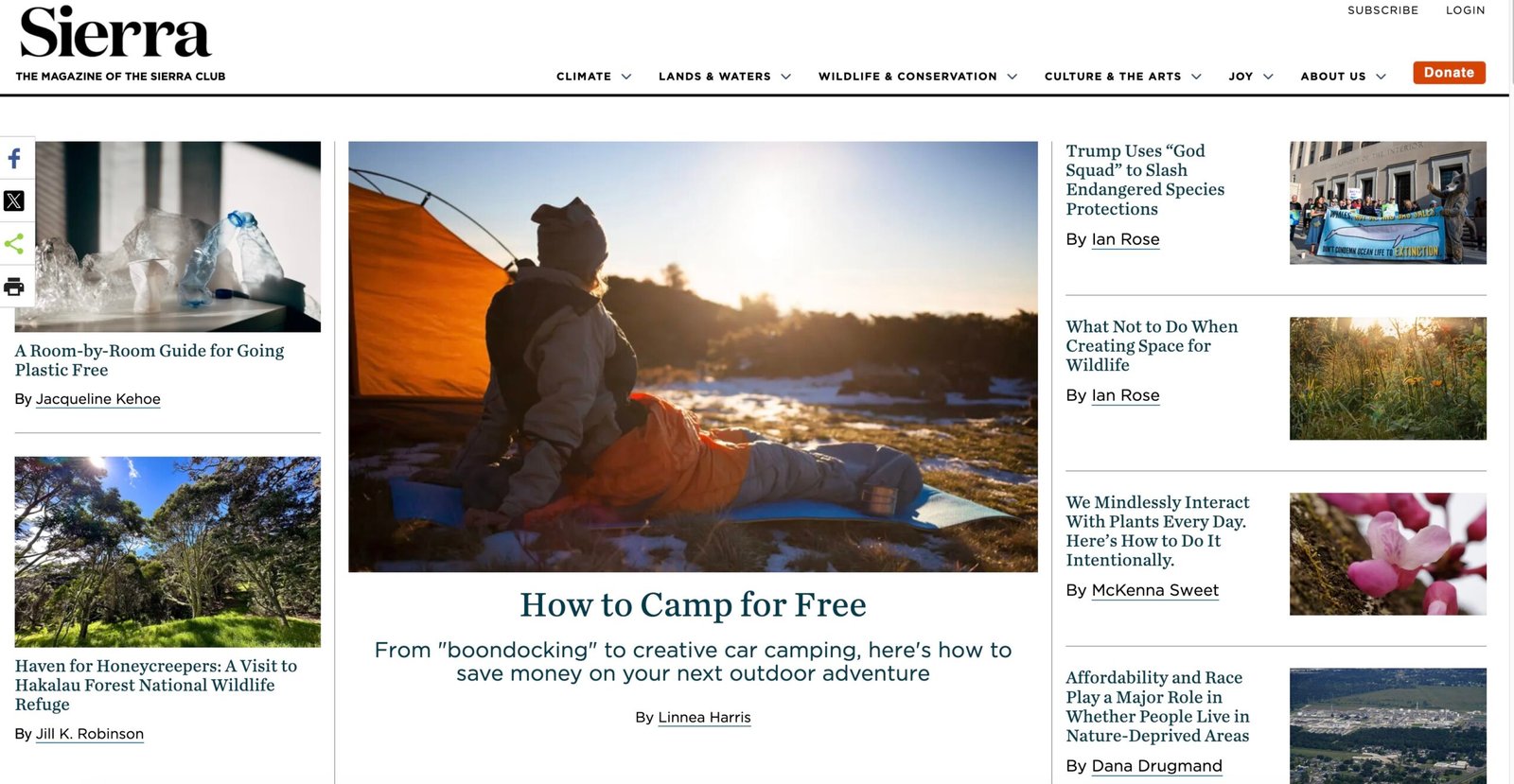
Guide: How to Pitch, Write & Get Paid (or Published) in Sierra
This practical guide walks you — step by step — from idea to pitch to published piece in Sierra, with templates, research tips, and links to the official Sierra Club pages you should use. It’s written for a beginner who can build or report on real environmental stories, reporting, or outdoor features.
Open the official Sierra pages while you read: Sierra magazine home, Contact & Pitch, and the About / Submissions section are essential.
Section 1 · The publication
What Sierra (the magazine) actually is
Sierra is the national magazine of the Sierra Club. It mixes investigative reporting, environmental features, outdoor writing, science explainers, and practical guides for people who care about the natural world and conservation. The site publishes both web-first journalism and magazine features that appear in its bimonthly print issues.
Key facts you should know:
- Sierra balances reporting (policy, climate, energy, conservation) with nature writing, photography, and how-to pieces for conservation-minded readers.
- The magazine often features long-form reporting and deeply reported features, as well as shorter departments, reviews, and field dispatches.
- Editors value accuracy, strong reporting or first-hand experience, and storytelling that connects policy/science with real people and places.
Section 2 · Fit your idea
What kinds of pieces fit Sierra’s audience?
Before you pitch, refine an idea so it’s clearly useful or newsworthy for an environmental, conservation, or outdoor audience. Sierra runs several kinds of work:
In-depth reporting on environmental threats, campaigns, science, or policy. Usually requires interviews, data or documents, and strong sourcing.
Personal or literary essays that illuminate nature, outdoor experience, or conservation values with lyrical craft and insight.
Is it timely or timeless?
Timely pieces tie to developing policy, court rulings, or major campaigns. Timeless pieces give strong, evergreen guidance (e.g., how to protect a backyard habitat) that remains useful for readers.
Can you document or report it?
Editors prefer work based on reporting, primary sources, interviews, or direct field experience. If you have only a theory, plan a small reporting trip or experiments to gather evidence.
Who will read & why it matters
Target an audience: Sierra readers might be conservationists, policy-interested citizens, outdoor enthusiasts, or climate-curious generalists. Make the benefit clear: what will they know or do after reading?
Section 3 · Prepare yourself
Build a small reporting & writing base before you pitch
Editors at major outlets prefer to see evidence you can finish a piece. You don’t need a decade of experience — you need demonstrable work. Follow this mini ladder:
- Write for your blog, local alt-weekly, conservation blogs, or platforms like Dev.to (for process) or Medium or Substack (for essays & reporting).
- Sample types: short reported piece, a how-to / guide, and one essay or field dispatch.
- Attach sourcing: interviews, documents, data links — show how you verify facts.
- Read recent Sierra features and note: lead types (anecdotal/scene-setting), supporting evidence, and how they end with implications or action.
- Look for clear ledes, named sources, and accountable claims (which are what editors check).
| Step | Where to publish | Goal |
|---|---|---|
| Start | Personal blog / community outlet | Practice reporting, links, and structure |
| Middle | Local papers, conservation blogs | Get editor feedback, earn clips |
| Higher | National outlets like Sierra | Submit stronger, better-documented features |
Section 4 · Pitch workflow
Step-by-step: how to craft a Sierra-shaped pitch
Below is a practical flow. Copy the template, then personalize each field. Sierra’s official pages list contact and pitch pathways — use the official contact form or editor email as indicated in their contact and about pages.
Research the recent coverage
Read 3 recent Sierra pieces in the topic area. Note the angle, sourcing level, and the typical length and voice. This prevents duplicate pitches and helps you craft a unique hook.
Write a one-paragraph hook
One crisp paragraph: what the story is, who you will interview or what data you will use, why it matters now, and the approximate word count. Editors are busy — give the core in the first sentence.
Include a short outline
Give a 4–7 bullet outline of sections: Lede, Scene, Evidence/Interviews, Counterpoint, Wider implications, Next steps/Action. Include a short list of potential interviewees or data sources.
Attach or link to relevant samples
Include 1–3 links to published work that show your skills: reporting, features, or essays. If you have local reporting clips or a mini-project page with documents/images, include that too.
Write a short bio
1–2 sentences: who you are, reporting experience, beat familiarity, or relevant training. If you have affiliations (local conservation groups, university, etc.) include them briefly.
Send via the official channel
Follow the instructions on Sierra’s site. If they provide a pitch form or an editor email, use that; if they ask for proposals via a form, don’t send long attachments — paste your pitch and link to samples.
Section 5 · Money & rights
How writers commonly earn (what to expect)
Public pay rates can vary and sometimes change. Long-form environmental feature fees for established magazines often range from flat-fee offers to per-word rates for print features. Independent reporting and writer resources commonly list Sierra as a paying market with historically mid-range fees for features and lower fees for departments. Always confirm exact payment with the editor in writing before beginning major reporting.
Industry listings and writer-market summaries report a range: departments and short pieces often pay lower flat fees, long features have historically been reported at rates that can approach common magazine per-word benchmarks. These reports are third-party and can change — treat them as estimates and confirm directly with Sierra editors.
- Before agreeing, confirm fee, deadline, required revisions, rights (exclusive or first serial rights), and payment terms in writing.
- Estimate total hours (reporting, travel, interviews, writing, editing) and compute your effective hourly rate to decide if the assignment is worth it.
- Negotiate if you can document special reporting costs (e.g., travel) or if the piece requires extensive research or FOIA requests.
| Piece type | Pay (approx.) | Strategy |
|---|---|---|
| Short department or field note | Lower flat fee | Good first published clip |
| Reported feature | Mid–higher (negotiable) | Confirm cost + rights before heavy reporting |
| Photo or art | Varies | Confirm credit and usage rights |
Section 6 · Accuracy & AI
Honesty, verification, and AI tools
Never compromise verification. Editors expect sources, named interviews, and fact-checked assertions. AI can speed drafting and idea generation — but you must verify every fact and test any code or scientific claim before submission.
- Record interviews and keep timestamps (with permission).
- Hold copies of documents, studies, or FOIA results you cite.
- Include at least two independent sources for contentious claims.
- Confirm expert titles/affiliations and spell names correctly.
- Use AI for brainstorming or editing — never for fabricating interviews or quotes.
- When AI helps, recheck all facts and rewrite outputs in your voice.
- Be transparent if an editor asks about your process and tools used.
Section 7 · Editors & follow-up
How to follow up, build editor relationships, and re-use ideas
Editors receive many pitches. A polite process builds goodwill and future opportunities:
- After initial pitch, wait 2–3 weeks for a response. If the publication page specifically requests not to follow up, respect that instruction.
- If an editor asks for a revision or different angle, reply promptly with questions and a short timeline.
- If a pitch is rejected, ask politely for brief feedback — some editors will give a line or two which helps you improve.
- Repurpose rejected ideas: adapt the angle, tighten evidence, or pitch to other outlets with appropriate changes.
Always use the contact method the magazine lists on its official pages. For Sierra, use the magazine’s contact and pitch pathways on their official site and local chapter submission pages for regional publications (e.g., Canyon Echo for Arizona chapter items).
Section 8 · Templates
Copyable templates: pitch, follow-up, and contract questions
Subject: Pitch — [Short working headline] — [Your name]
Hello [Editor name],

I hope you're well. I’d like to pitch a [web/print/feature/essay] titled “[Short headline]” (~[800–2,200] words) that shows [one-sentence benefit: who it helps and why].

Hook: [1–2 sentences: the compelling lead / what readers will learn].

Plan (short outline):
• Intro / scene: [1–2 sentences]
• Section 1: [what you will show / interview]
• Section 2: [data/docs/interviews]
• Conclusion: [implication / action]

Sources & reporting I can bring: [list 3–6 specific interviewees, datasets, or documents].

Writing samples: [link 1], [link 2].

Bio: [1–2 sentences: your reporting background & relevant work].

Thanks for considering — happy to send a full proposal or sample draft on request.

Best,
[Your name] | [location] | [link to portfolio or clips]
Hello [Editor name], Following up on my pitch: “[Short headline]” (sent [date]). I’m still available to write a full draft and can move quickly if you’d like. Happy to tailor the angle to fit current needs. Thanks again for your time, [Your name]
- What is the fee and payment schedule?
- What rights are you requesting (first serial, exclusive for X days)?
- Do you cover travel or reporting expenses?
- What is the editorial timeline and rounds of revision?
Section 9 · Final checklist & resources
Before you pitch: the final micro-SOP
- Sierra — Magazine home
- Sierra — Contact / Pitch page
- About Sierra — submission notes
- Letter to the Editor resource hub
- Canyon Echo — Arizona chapter (regional submission info)
- Freedom With Writing — market reports & pay listings
- WritersDigest — market spotlights & pitching tips
- Submittable — common platform for many literary & regional publications