


Guide: How to Get Paid to Write for Three-Lobed Burning Eye (3LBE) — Step by Step
This is a practical, beginner-friendly guide to help you write and submit a short story to Three-Lobed Burning Eye (3LBE) — and use that byline to earn more as a writer.
3LBE is a well-known online magazine of speculative fiction (horror, wonder, and the weird). It publishes a small set of carefully selected stories per issue. That means your job is not to “send any story.” Your job is to send a story that feels like 3LBE’s kind of strange.
You will learn: (1) what the magazine is, (2) how to read and reverse-engineer stories on the site, (3) how to build a story editors want, (4) how to format and submit, and (5) how to turn an acceptance into long-term money and credibility. The language is simple. You can treat this like a complete SOP.
Section 1 · Understand the publication
What 3LBE is (and what kind of writer gets accepted)
Three-Lobed Burning Eye (3LBE) is an online magazine of speculative fiction with a clear flavor: horror, wonder, and the weird. It has been publishing since 1999. Each issue typically features a small number of original short stories (often 4–6), which means the bar is high and the selection is intentional.
Here’s the good news: you do not need to be famous to write for 3LBE. You do need to be specific, strange in a fresh way, and clean on the page. Editors do not fall in love with “I wrote a scary story.” They fall in love with a story that leaves a mark.
A 3LBE-shaped story often has:
- A strong mood you can feel in your skin (dread, awe, grime, wonder, grief, obsession).
- A weird core (a rule is broken, a reality is bent, a creature exists, a place behaves wrong).
- Control: careful sentences, clean paragraphs, no filler explanation.
- Human truth: even if the story is strange, the emotion is real.
- An ending that lands: not a cheap twist, but a “click” that makes the story complete.
If you only rely on gore, jump scares, or obvious monsters, your story may feel shallow. 3LBE tends to reward stories where the weirdness is meaningful.
- About 3LBE (short description + news + editor link).
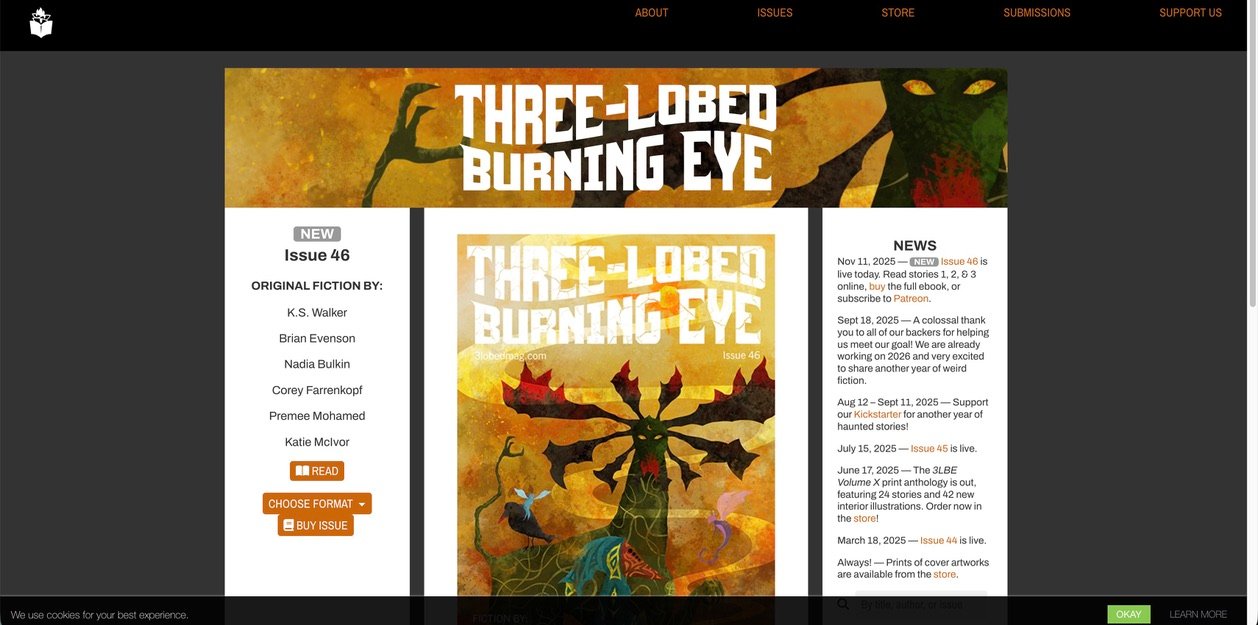
- Issue 46 (current issue on the site).
- Issue 45 (previous issue).
- Issue 44 (another recent issue).
- Store (ebooks, anthology, cover prints, subscriptions).
Your first “research win” is simple: read 2–3 stories on the website and write a short note: What do these stories have in common? That note becomes your personal 3LBE checklist.
| What 3LBE offers | What it means for you | Your action |
|---|---|---|
| Free online issues | You can study style without paying | Read 3 stories + take notes |
| Ebook + audio options (see About) | They care about multiple formats | Write clean, adaptable prose |
| Small number of stories per issue | High selectivity | Submit only your best work |
| Store + Patreon support model | Community matters | Follow updates, support if you can |
Section 2 · Research like a pro
Read like an editor: the fastest way to “learn the magazine”
Beginners often do “random reading.” They read a story, feel inspired, then write something totally different. That’s the slow path.
The fast path is: read with questions. You are not reading only for pleasure. You are reading to extract patterns you can reuse. This is how editors read, and it is also how working writers improve quickly.
Pick one recent issue and read 2–3 stories (with a notebook)
Start here: Issue 46, then optionally: Issue 45 or Issue 44. After each story, write 5 short bullets:
- Hook: what made you keep reading after the first 1–2 paragraphs?
- Core weirdness: what rule of reality was broken?
- Emotion: what did the story make you feel (and how)?
- Structure: scenes? fragments? linear? second-person? epistolary?
- Ending: what changed by the end (knowledge, body, world, meaning)?
This “five-bullet note” is a powerful tool. It trains your brain to see story design, not only story surface.
Create your “3LBE Pattern Sheet” (one page)
Make a single document titled: 3LBE Patterns. Add these headings:
- Openings that work: what do the first paragraphs do?
- Types of weird: cosmic, body, place, dream, folkloric, technology, ghosts, surreal?
- How characters speak: quiet? sharp? lyrical? plain? angry?
- How exposition is handled: explained, implied, withheld, shown by action?
- Endings: closure, ambiguity, punch, beauty, devastation?
After reading 6 stories, you will start seeing repeating patterns. Those patterns are your “secret map” to writing a story that feels at home at 3LBE.
Study the magazine’s structure and formats
3LBE has a site format (read online), and they also offer ebooks and audio readings (see About). That matters because clean writing is easier to convert across formats.
- Keep paragraphs readable (don’t build a wall of text).
- Use punctuation with control (not chaos).
- If you use special formatting (letters, transcripts, messages), keep it consistent.
- If your story uses invented terms, introduce them with context so readers don’t get lost.
Your goal is: “a reader can follow the story and feel the dread/wonder without fighting the text.”
Section 3 · Follow the rules
Submission rules: treat them like law (and don’t guess)
The most common beginner mistake is this: writing first, reading guidelines later. That leads to wasted months.
The correct order is: Guidelines → Fit → Draft → Format → Submit.
Use these official links as your “rulebook”: 3LBE Submissions and the submission portal: Moksha. 3LBE’s guidelines can include: acceptable genres, word-count range, reading periods (open/closed windows), payment, rights, formatting requirements, and whether simultaneous submissions are allowed.
Open the submissions page and copy these items into a note:
- Reading period: exact open months/dates (or “closed” notice).
- Word count: minimum and maximum accepted.
- Pay: rate, when they pay, and how (always verify).
- Rights: what rights they buy (first rights, electronic rights, etc.).
- Format: file type, whether the submission is blind, and cover letter requirements.
- Special notes: do they want content notes, trigger warnings, or anything specific?
If you cannot find one of these items, do not assume. Keep searching the page, site, or updates. When in doubt: your safest move is to follow the official page exactly.
Sometimes magazines close submissions so they can catch up on reading. If that happens, do not panic and do not send stories to random emails. Instead:
- Prepare your best story and keep it ready.
- Follow the magazine’s news page and updates (see About).
- Check the portal and the submissions page regularly for reopening.
- Use the “closed time” to improve your story and write a second backup story.
A closed window is not rejection. It’s simply a timing issue. Smart writers use the time to sharpen their work, not to rush.
Section 4 · Story design
Build a “3LBE-shaped” story idea (a simple framework)
A beginner often starts with a creature: “a ghost,” “a demon,” “a monster.” That can work, but it is not enough.
For 3LBE, you need a story idea that has concept + emotion + consequence. Use this framework to build ideas that feel serious and submission-ready.
Pick a “weird rule” (one sentence)
Write one sentence that describes the strange rule of your story world. Keep it short. Examples (generic, not to copy):
- “Every mirror in town shows a different version of you.”
- “The house rearranges rooms based on your worst memory.”
- “A prayer-book writes replies back in your own handwriting.”
- “A hospital wing treats diseases that come from dreams.”
Your weird rule should not be a gimmick. It should create pressure. Pressure creates story.
Attach a human need (one clear desire)
Now choose what the main character wants. This is what makes the story emotional instead of “cool.” Examples:
- They want forgiveness.
- They want to escape a town, a family, a curse, a job, a grief.
- They want to keep a loved one alive (or bring them back).
- They want to prove they are not insane.
- They want to stop something from happening again.
3LBE-style weirdness often becomes powerful when it touches a real human wound.
Add a cost (the story must hurt)
The strongest stories have a price. Ask: “What does the character lose if they pursue what they want?” Options:
- They lose their body (slow change, body horror, transformation).
- They lose their memory (identity erosion, time distortions).
- They lose their relationships (alienation, obsession).
- They lose reality (truth becomes unstable).
- They lose a moral line (they do something they cannot undo).
You do not need gore. You need consequence. Readers remember consequence.
Design an ending that “clicks” (not just a twist)
For weird horror, a twist is not automatically good. A good ending often does one of these:
- Reveals meaning: the strange rule becomes emotionally true.
- Completes a transformation: the character becomes something new (worse or wiser).
- Locks the theme: the story’s main idea becomes undeniable.
- Gives a final image: one last scene that stays in the reader’s head.
When you finish drafting, your final paragraph should feel inevitable — even if it is surprising.
| Idea part | What to write (1 line) | Common beginner mistake |
|---|---|---|
| Weird rule | What is impossible, and how does it behave? | Rule is vague or doesn’t affect plot |
| Human need | What does the character want (emotionally)? | Character is passive or only “observes” |
| Cost | What do they pay to pursue it? | No consequences; story feels weightless |
| Ending click | What changes, and what final image seals it? | Random twist without meaning |
Section 5 · Drafting (beginner safe)
Drafting workflow: how to finish a strong first draft without getting stuck
Your job in the first draft is not perfection. Your job is to create a complete story you can revise into publishable form. Many beginners never submit because they never finish. This workflow is designed to make finishing easier.
Write 7 short beats before drafting:
- Beat 1: The hook image or disturbance
- Beat 2: The character’s normal (and the wound)
- Beat 3: The weird rule appears clearly
- Beat 4: The character acts (first consequence)
- Beat 5: Things worsen (cost increases)
- Beat 6: The choice / moral line / transformation
- Beat 7: Ending image that clicks
These beats do not restrict you. They help you finish. After you finish, you can reshape the story into a more unusual structure if needed.
Try this 10-day plan:
- Day 1: Read 1 story from Issue 46 and take notes.
- Day 2: Build your 4-line idea (rule/desire/cost/ending).
- Day 3: Create the 7-beat outline.
- Days 4–7: Draft 25% of the story each day (no editing).
- Day 8: Finish the ending even if it feels rough.
- Day 9: Let it rest (no touching).
- Day 10: First revision pass (see next section).
The secret is: finishing builds skill faster than endless tinkering.
Write “scene truth” before “language beauty”
In weird horror, beautiful language can hide weak story movement. First, make sure each scene has: (1) a goal, (2) an obstacle, (3) a change. After that, you polish sentences.
- Goal: what does the character try to do right now?
- Obstacle: what stops them (external or internal)?
- Change: what is different after this scene?
If a scene does not change anything, it is probably a “vibes paragraph.” Keep vibes, but attach them to movement.
Control your explanations (let the reader work a little)
Many great weird stories feel strong because they do not explain everything. They give the reader enough to understand the stakes, but they keep mystery alive. Beginner over-explanation can kill dread.
- Explain the rule only when it affects action.
- Show consequences instead of explaining causes.
- Use sensory detail (texture, smell, sound) to make the weird feel real.
- Trust the reader to connect some dots.
A good test: if you can delete a paragraph and the story still makes sense, that paragraph was probably too explanatory.
Section 6 · Revision (publishable)
Revision workflow: turn a draft into something an editor can say “yes” to
A professional story is not “written once.” It is drafted, then revised in passes. Revision is where most acceptances are made.
Here is a clean pass-based system you can reuse for every story you plan to submit to 3LBE (or any serious speculative magazine).
Structure and clarity pass (big moves)
Ask these questions and fix big problems first:
- What is the story about? If you cannot answer in one sentence, the story is foggy.
- Where does the story truly start? Cut the “warming up” paragraphs if needed.
- Is the weird rule clear enough? Not explained fully, but understood.
- Does the character choose? Stories often need a choice, not only events.
- Does each scene change something? Remove or merge dead scenes.
In this pass, do not worry about beautiful sentences. Fix the story skeleton first.
Emotion pass (make it hurt or shine)
3LBE stories often hit because they feel emotionally true. Use this pass to strengthen the human core:
- Where is the character vulnerable?
- What is the story’s main fear (loss, change, guilt, isolation, hunger, obsession)?
- Where does the character lie to themselves?
- Which image repeats, and what does it mean?
The best weird horror is not weird “for fun.” It is weird because reality is reflecting something broken inside the character.
Language pass (clean, controlled, readable)
Now polish sentences. Your goals: clarity, rhythm, and control. A few practical rules:
- Cut filler words and repeated phrases.
- Replace vague verbs (“was,” “went,” “got”) with stronger actions when it matters.
- Use sensory detail carefully; do not overload every paragraph.
- Keep dialogue natural; avoid “explaining the plot” in dialogue.
- Read the story aloud once. Your ear will catch problems your eyes miss.
If you love lyrical writing, keep it — but make sure the reader can still follow the story.
Consistency pass (tiny mistakes lose trust)
Check the details that often break reader trust:
- Names consistent (spelling, nicknames, titles)
- Timeline consistent (day/night, season, sequence)
- Point of view consistent (no accidental head-hopping)
- Weird rule consistent (no “rule changes” unless intentional)
- Ending consistent with theme (no random final paragraph)
Editors and first readers notice these things quickly. Clean consistency makes you look professional.
Section 7 · Submission package
Format and package your story like a professional contributor
Professional packaging does not mean fancy. It means: correct format, clean document, correct file type, and a clear cover letter.
The exact requirements can differ by magazine and can change over time, so the final authority is always the official submissions page: 3LBE Submissions. But you can safely use this packaging system as a baseline and adjust to the rules you see there.
- Use a readable font (12pt is standard).
- Use clear paragraph breaks. Avoid giant blocks of text.
- Use standard punctuation and quotation marks consistently.
- Include the story title at the top of the document.
- If the guidelines require blind submissions, remove your name from the manuscript file.
- If a specific file type is requested (DOC/DOCX/RTF/PDF), follow that exactly.
Your story should look like it belongs in an editor’s inbox, not like a messy school assignment.
Keep it short. Editors want the story, not your life story. Here is a simple structure:
- Greeting: “Hello 3LBE Editors,”
- Story info: Title + word count + genre note if needed.
- One-line hook: 1–2 sentences describing the story core.
- Bio: 1–3 sentences (relevant publications or background).
- Thanks: “Thank you for your time and consideration.”
Avoid jokes, long explanations, and heavy self-praise. Calm confidence works best.
| Package item | What “good” looks like | What to avoid |
|---|---|---|
| Story file | Correct file type, clean layout, consistent style | Wrong file type, missing title, messy formatting |
| Cover letter | Short, clear, includes word count | Long summary, personal drama, unrelated info |
| Bio | Relevant and brief | Overlong, full CV, irrelevant details |
| Final check | Spelling + punctuation + consistency | Typos, broken formatting, inconsistent POV |
Section 8 · Submitting
Submitting through Moksha: step-by-step (and what to do when it’s closed)
3LBE uses the Moksha Submissions System. This is a standard portal used by many speculative magazines. It helps editors manage submissions and helps you track your status.
On the portal, you may see a notice that the system is temporarily closed. If you see that, it usually means you cannot create new submissions right now, but you can still check on older ones. Do not try to “force” a submission. Use the official instructions and wait for reopening.
How to submit a new story (portal path)
When the portal allows new submissions, your steps are usually:
- Open the portal: threelobedmag.moksha.io
- Choose New Submission (if available).
- Create an account or log in: Login
- Select the publication (3LBE), then follow the submission form.
- Enter your story title, word count, and any required fields.
- Upload the manuscript in the required format.
- Paste your cover letter if they request it in a text box.
- Submit and save the confirmation email/status link.
Always match what the submissions page says: 3LBE Submissions.
What you can still do (smart waiting strategy)
If the portal shows “Temporarily Closed,” do this instead of doing nothing:
- Finalize one best story + one backup story.
- Make a “submission-ready folder” with your files and cover letters.
- Keep a note with the correct word count and format rules from the submissions page.
- Check official updates on: About and Submissions.
- Use the time to read more issues and refine your pattern sheet.
Think like a pro: timing is part of publishing. A closed window is not a “no,” it’s a “not now.”
Use the portal tools for status checks
Moksha usually provides status tools. These links can help you track your work:
Save your status link and keep a small spreadsheet (or notebook) of: story title, date submitted, portal ID, and current status. This is how writers handle multiple submissions without confusion.
Section 9 · Money + career
How you earn money (and more opportunities) from a 3LBE byline
When people say “get paid to write,” they often mean only one thing: a check for one story. But a strong magazine byline can create multiple income paths. Think of 3LBE as both: (1) a place you can be paid for a story, and (2) a credibility engine that helps you earn more elsewhere.
The exact payment and rights are listed on the official submissions page. Always use the current guidelines: Submissions.
- Payment is usually tied to publication acceptance (details vary).
- Rights determine what you can do later (reprints, collections, anthologies).
- Some magazines also do audio readings or anthology collections (3LBE mentions audio and print anthologies on its About page).
Your job is to be a professional: read the rights, understand exclusivity periods, and keep a copy of agreements.
One respected publication credit can help you:
- Pitch other paying magazines and anthologies with stronger credibility.
- Build a portfolio page that converts (clients, editors, agents, collaborators).
- Get invited to reprint anthologies or themed calls (your name becomes “trusted”).
- Grow your audience for Patreon, newsletters, or future books.
- Apply to writing grants, workshops, or mentorships with stronger proof.
A byline is an asset. Treat it like one: save it, showcase it, and use it in future pitches.
| Opportunity | How 3LBE helps | Your next action |
|---|---|---|
| More magazine acceptances | Shows you can meet a high bar | Create a “clips” page with 3LBE link |
| Anthologies / reprints | Story becomes eligible for reprint later (depending on rights) | Track rights dates and reprint markets |
| Book / collection | Publication credits increase trust | Save your best stories and plan a collection |
| Community income | Readers discover you through the magazine | Add a simple author website + newsletter signup |
Keep a “rights + submissions” tracker (simple but powerful)
Make a tracker with these columns:
- Story title
- Word count
- Date submitted
- Where submitted (3LBE)
- Status link (Moksha)
- Decision date
- Rights summary + exclusivity date
- Publication date (if accepted)
This habit prevents mistakes and makes you look professional when you later manage multiple markets.
Turn your acceptance into a portfolio page in 30 minutes
If you get accepted, create a simple page on your own site:
- Story title + short logline
- Link to the published story on 3LBE
- 2–3 sentences: what the story explores (theme)
- Short author bio + contact
- Link to your other stories
When you pitch future work, you can send that page as your “proof.” It helps editors trust you faster.
Section 10 · FAQ + resources
FAQ for beginners + a big link library (official first)
- 3LBE Homepage (3lobedmag.com)
- About 3LBE (history, news, current issue)
- Submissions (rules, windows, pay, rights — always verify here)
- Issue 46 (current issue)
- Issue 45
- Issue 44
- Store (ebooks, anthology, cover prints, subscriptions)
- Support 3LBE (ways to support the magazine and authors)
- Advertising (official advertising options)
- Patreon (support and subscriptions)
- Editor: Andrew S. Fuller (official site)
1) Read 3 stories from Issue 46 and make a Pattern Sheet.
2) Build a 4-line idea (rule/desire/cost/ending image).
3) Draft fast (finish first), then revise in 4 passes (structure/emotion/language/consistency).
4) Open Submissions and match every rule (word count, format, window, pay, rights).
5) Submit through Moksha when open. Track your status links.
6) If accepted, build a portfolio page and pitch more markets using your 3LBE clip.