


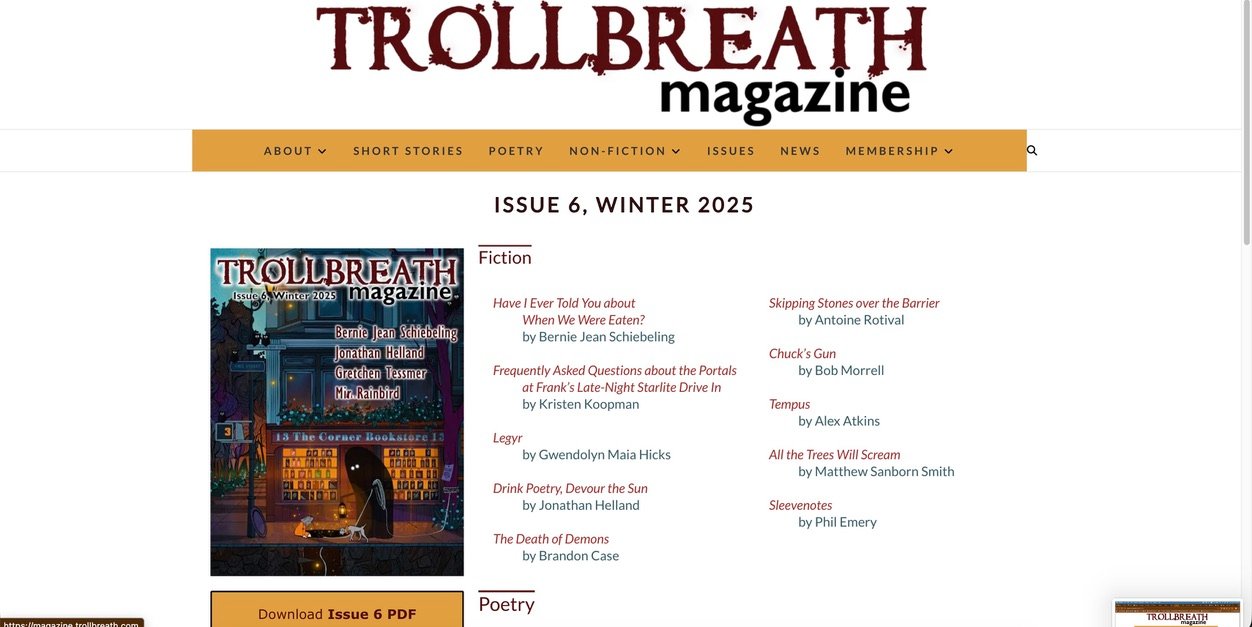
Practical guide — How to submit and get published in Trollbreath Magazine
This step-by-step guide explains how Trollbreath Magazine works, how to shape a submission, format your manuscript, use their submission form, and — crucially — how to make your submission editor-friendly so you stand a real chance of being published and paid.
Everything below is written for beginners who are ready to write short stories, poems, or non-fiction for a small speculative journal. Links are included to official pages and helpful external tools so you can act immediately.
Section 1 · What Trollbreath actually publishes
Overview: scope, voice, and audience
Trollbreath Magazine is a quarterly online journal that focuses on speculative fiction (science fiction, fantasy, slipstream), poetry, and non-fiction (essays, reviews, interviews and creative nonfiction) with an editorial stance that is explicitly antifascist and feminist and often leans into weird, surreal, or boundary-pushing work.
What this means for you: editors look for strong voice, bold ideas, and pieces that fit the magazine’s sensibility — whether that sensibility is a dark, uncanny short story, an emotionally precise poem, or a craft-focused non-fiction essay about art or storytelling.
- Short stories (speculative, slipstream, dark fantasy, hopepunk, surrealism)
- Poetry with strong craft and imagistic immediacy
- Non-fiction: essays, artist interviews, reviews, and creative commentary
- Artwork and artist features in certain issues
If your piece fits one of these categories and has a clear, polished shape, it stands a chance — especially if it has a clear editorial angle and strong opening.
The readers are fans of small-press speculative work: other writers, editors, publishers, and readers who enjoy inventive fiction and new voices. That means good exposure for early-career authors and a community that notices bold, memorable pieces.
Section 2 · Submission windows & current status
When they accept work and the current openings
Trollbreath operates on submission windows and also announces open-for-submissions posts (quarterly). Always check the official Submission Guidelines page and their “Open for Submissions” or news posts to confirm whether they are currently accepting short fiction, poetry, or non-fiction.
Important current note (do this first): their official Submission Guidelines page includes notices about closed categories and queue status — for example, at the time this guide was researched the site showed specific queued/closed notes for fiction and poetry in certain periods. Always read the top of the Submission Guidelines before preparing a file.
Section 3 · Shape your piece
Genre, ideal lengths, and editorial taste
Length guidance (general): submission directories and community reports list typical short-story lengths for Trollbreath in the 1,500–7,500 word range. For non-fiction and poetry, follow the magazine’s specific prompts or the submission form guidance. When in doubt, aim for tight, fully-realized short stories in the 2k–5k range unless the guidelines ask otherwise.
Voice and angle: Trollbreath likes pieces that take a clear creative risk, have an original image or emotional core, and fit the magazine’s editorial tone. Avoid work that reads like a pastiche of well-known authors; instead, focus on your distinct perspective, strong openings, and active scenes.
- Does the piece feel “speculative” (not strictly realism)?
- Does the first paragraph/scene pull the reader into an emotional or conceptual puzzle?
- Is the prose tidy (no unnecessary exposition) and is the pacing appropriate for the length?
- Can you summarize the story in one sentence? (If yes, that’s usually a good sign)
Section 4 · Manuscript formatting: Shunn & practical steps
How to format a short story or poem so editors can read it comfortably
Most small-press editors prefer a clean, predictable manuscript format. William Shunn’s “Proper Manuscript Format” is the de facto industry standard for short fiction and is widely recommended for small magazines. Follow it unless Trollbreath’s guidelines say otherwise.
- 12-point Times New Roman (or similar serif), double-spaced
- One-inch margins all around
- Indent first line of each paragraph (½ inch), no extra spaces between paragraphs
- Header on each page with your name / story title / page number
- Front page: your contact info (upper-left), approximate word count (upper-right), centered title and byline
- Save as .docx or .doc unless the guidelines request PDF
These simple rules make your manuscript easy to read and show professional courtesy to the editor.
- Use standard punctuation; avoid fancy typography (no smart quotes only if they cause issues).
- Number scenes or parts if your story uses clear divisions, but many editors prefer plain paragraph breaks.
- For poetry, keep line breaks intact and include a header with the poem title; save single Poem-per-file if requested.
- For non-fiction, include links in your cover letter, and attach the draft in the requested file format.
If Trollbreath’s submission page asks for a specific format — use that. Otherwise, default to Shunn.
Section 5 · How to use the Trollbreath submission form
Step-by-step: what to prepare, what to write, and what to attach
Trollbreath provides a submission form. The form asks for: title, preferred author name, email, submission type (Short Story / Poetry / Non-fiction / Artwork), a short cover letter / bio, and the file upload (or pitch for non-fiction). Fill every field cleanly and attach the correctly formatted file.
Exact step-by-step
- Read the top of the Submission Guidelines page — note open/closed categories and any special requests (e.g., “we are currently closed for fiction until X”).
- Confirm the submission window via the “Open for Submissions” posts or the news archive — Trollbreath announces windows and changes there.
- Prepare one file per submission and name the file clearly (e.g., “Lastname_Title.docx”).
- Fill the form fields exactly: short bio/cover letter should be concise (1–3 sentences), and include links to published clips if you have them.
- Attach the file and click submit — wait for the confirmation message or email; they may send a verification or queue update.
Section 6 · Rights, AI policy, exclusivity, and pay
What to expect about rights, AI, and money
Rights and exclusivity: small magazines vary. Trollbreath’s submissions and editorial communications will specify whether they require first electronic serial rights, a short exclusivity period, or non-exclusive rights — read any acceptance email carefully and keep a copy of the contract. If the guidelines mention an exclusive window (or an embargo) that will be in the acceptance correspondence. Always confirm in writing.
AI and content policy: community listings and market directories indicate Trollbreath prohibits AI-generated stories and asks for original human-authored work. Check the guidelines for explicit statements and don’t submit AI-generated drafts as your own.
Pay: pay rates for small-press magazines are small and vary. Market entries for Trollbreath list a pay scale (for example, a 4¢/word rate for original short fiction was listed on market aggregators at the time of research, and different summary sites list a broad $25–$150 range depending on type). Treat pay as modest; focus first on publication, rights retained, and building a portfolio. Always confirm pay in the acceptance email or contract.
Section 7 · Sample materials: cover letter, bio & pitch
Templates you can copy and adapt
Short cover letter (for story/poem)
Hello Trollbreath editors,

Please find attached my short story/poem "TITLE" for consideration in Trollbreath Magazine (submission type: Short Story / Poetry). The piece is approximately X,XXX words and explores [one-line high-level description of theme/angle]. I am attaching the manuscript in .docx per the guidelines.

A short bio: [One sentence — e.g., "Jane Doe is a speculative fiction writer from Maine. Her work appears in Magazine A and Journal B (links)."]

Thank you for your time and consideration.

Best,
Your Name
Email | Optional website or social handle
Non-fiction pitch (short)
Pitch title: "How [topic] taught me [lesson]" (roughly 1,200–2,000 words)

Why it fits Trollbreath: [one line linking the idea to the magazine's sensibility]

Outline:
1. Hook / anecdote (100–200 words)
2. Background / context (200–400 words)
3. Main argument or craft point (400–800 words)
4. Closing: takeaway and resources (100–200 words)

Previous clips: [link to a published essay or blog]
Bio: [one short sentence]

Attached: pitch document or draft.
- Keep the cover letter factual and short. Editors often read hundreds of submissions — brevity is kindness.
- For poetry, include a short bio and the full poem. Some editors prefer multiple poems in one submission if allowed — check the form.
- For non-fiction, include links to any reporting sources and be transparent about your experience and perspective.
Section 8 · After you submit
What happens next — timelines, follow-ups, and reuse
Response time: community-reported estimates and market directories put Trollbreath’s response time around 30–60 days for many small literary markets; the Submission Guidelines and market listings will give the most up-to-date expectations. Always assume it may take several weeks.
Follow-ups: if the guidelines mention a follow-up policy, follow that. If not, a polite follow-up after 8–10 weeks is acceptable in most small-press contexts — but only if the submission window is closed and they promised a decision timeline. Be short and professional in your follow-up.
- Save the rejection (polite, brief) and note the date.
- Revise based on any editor notes (if provided) and consider resubmitting elsewhere.
- Keep a submissions tracker (market, date, file sent, response). Use tools like The Submission Grinder or Duotrope to log markets.
Section 9 · Checklist & quick resources
Everything to do before you hit submit
- Trollbreath — Submission Guidelines.
- Trollbreath — Submission Form.
- Trollbreath Magazine — Home / Issues.
- William Shunn — Proper Manuscript Format (short stories & classic/modern options).
- The Submission Grinder — Trollbreath market entry (market stats, pay, and user-reported response times).
- Duotrope — Trollbreath listing (market description and subscription info).
- CreativeWritingNews — summary & pay notes.
- Trollbreath (author site & related resources).