


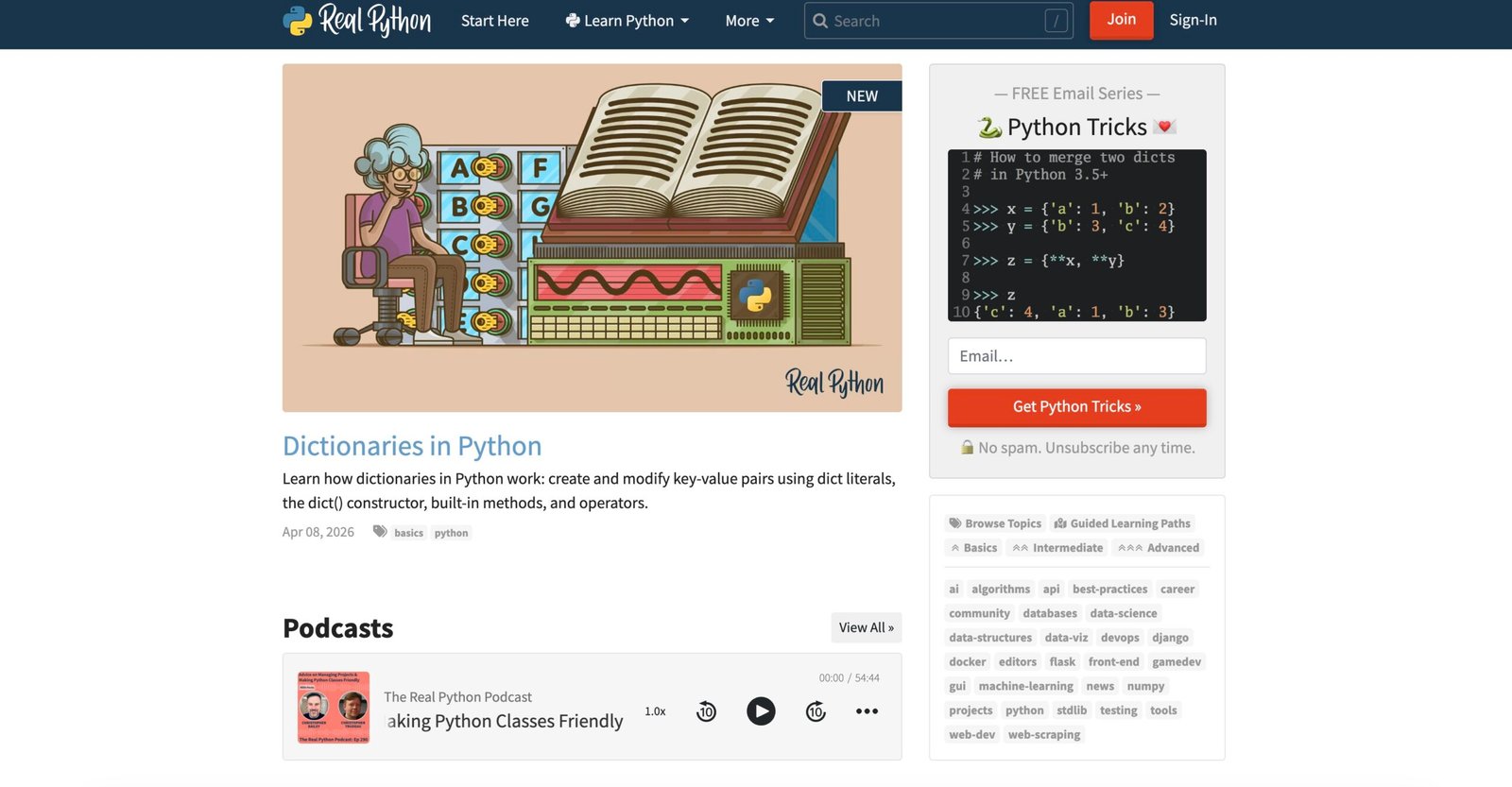
How to write paid tutorials for Real Python — a complete, beginner-friendly guide
This guide walks you through everything: understanding Real Python’s audience and style, choosing an idea, preparing a demo and writing samples, the editorial process, pitching and applying, and how to turn a tutorial into real earnings and career momentum.
It’s written to match Real Python’s tone: clear, example-first, and practical — so you can follow the steps and create a tutorial people actually learn from.
Why Real Python is worth aiming for (and what it gives you)
Real Python is a focused, high-quality learning platform: tutorials, video courses, interactive exercises, and a large developer audience. Publishing a well-made tutorial on Real Python gives you paid work, editorial polish, and a strong portfolio piece that’s visible to thousands of Python developers.
Audience & reach
Real Python readers are developers who want to build real projects: beginners who want grounding, and intermediate developers who want to learn idiomatic Python and modern tooling. Articles focus on practical code and clear examples.
Why write for them?
Aside from pay, Real Python offers editorial feedback, exposure, and the chance to build a repeatable writing relationship (many contributors write multiple tutorials over time). Their editorial standards mean work published here is often re-used in teaching, hiring, and portfolios.
Know the Real Python reader (so you target the right problem)
Before you write, imagine a specific reader. The more concrete you can be, the better your article will land. Pick a single reader persona (for example, “a junior backend dev who’s learning Django and needs to add background tasks”) and keep that person in mind when you shape the tutorial.
Common reader types
- Absolute beginner aiming to ship a tiny project (install, run, basic features).
- New professional building real tooling (APIs, automation, testing).
- Intermediate dev exploring new libs & patterns (async, type hints, data tools).
What they expect
Clear setup instructions, runnable code, small reproducible examples, explanation of the “why”, and actionable next steps. Avoid long untested code blocks — prefer short functions with commentary and links to a complete repo or gist.
How to shape Real-Python-shaped ideas (three checks)
Many ideas are possible. Use these three rapid checks to decide if an idea is a Real-Python fit.
Check 1 — Solves a job
If a reader can finish a task after reading your piece, it’s worth writing. Example: “Process CSV uploads reliably in FastAPI and save to PostgreSQL” — that’s a concrete job.
Check 2 — Specific angle
Avoid broad “Intro to X” topics unless you have a unique, practical angle. Compare: “Intro to Pandas” (too broad) vs “Transform messy CSVs to normalized tables with pandas’ melt and pivot” (specific and teachable).
Check 3 — Can you prove it?
Have a small demo, a repo, or real experience. If not, build the minimal working example first. Real Python editors expect code that runs and can be tested — this isn’t a purely theoretical essay.
Prepare: samples, a repo, and writing practice
Before you apply, publish 2–4 solid writing samples in public places (your blog, Dev.to, Medium, or GitHub README tutorials). These samples act as your portfolio and prove you can finish a full tutorial. Real Python’s application process asks for writing samples and evidence of tested code.
What each sample should include
- Headline & short intro (what the reader will build and why).
- Setup & prerequisites (exact versions, OS notes if relevant).
- Step-by-step code, small runnable examples, and a final result link (repo/CodeSandbox/GitHub).
- Short summary & next steps (how to extend the work).
Where to host demos
Host code on GitHub; for front-end or notebook demos use CodePen, Repl.it, Binder, or GitHub Pages. A one-click link to run the project increases trust.
Sample article outline (copy & paste)
Tutorial structure, tone, and style — matching Real Python
Real Python emphasizes clarity, tested examples, and educational progression. Their editorial guidance notes that tutorials are typically long-form, often averaging multiple thousands of words to fully cover a topic — they aim for deep, accurate learning experiences rather than short listicles. When aiming to write for them, design a tutorial that can stand alone as a complete learning unit.
Recommended structure
- Intro & goal — what will be built and why it matters.
- Prerequisites & setup — versions, packages, starter repo link.
- Step-by-step implementation — short code blocks, tested snippets.
- Testing & verification — how to run and confirm the result.
- Performance & pitfalls — gotchas, alternatives.
- Next steps & resources — how to extend learning.
Style & voice
Use active voice, short paragraphs, and inline code styling (`backticks`). Explain the “why” for non-trivial choices, and include links to documentation or the standard library. Keep language simple, but precise — readers want both correctness and approachability.
Code presentation rules
- Prefer small, explained functions over a huge blob of code.
- Include a final, fully working example in the repo and point to it.
- Label commands clearly (e.g., `pip install …`, `uvicorn main:app –reload`).
- Make tests optional but suggested (unit or smoke tests help).
The Real Python editorial process (what to expect)
Real Python hires tutorial writers and course instructors and runs a robust editorial workflow: initial pitch → outline → draft → review → final edits → publication. The team polishes examples, tests code, and may ask for refactors or clarifications during editing. Be prepared to iterate.
What editors commonly improve
- Clarity and ordering of steps.
- Error handling and platform compatibility notes.
- Grammar, flow, and concise explanations.
- Code formatting and consistency with PEP 8.
How to make editing easier
Provide a tested repo, add comments in code for tricky parts, and include notes about any known platform-specific steps (Windows vs macOS vs Linux). Editors appreciate safety nets: small test commands, expected outputs, and reproducible examples.
How to apply — step-by-step (practical)
Real Python posts openings for Tutorial Writers and other contributor roles; their jobs page and application form explain the role and ask for writing samples, experience, and a short pitch or outline. Read the job listing carefully and prepare the materials requested.
Before you click Apply
- Have 2–4 public writing samples (links).
- A short bio highlighting Python experience and teaching or dev background.
- One sample outline (200–400 words) for a Real-Python tutorial idea.
- Links to any repos, demos, or test artifacts.
Application template — paste & customize
Full name:
Email:
GitHub / portfolio:
Years of Python experience:
Short bio (2–3 lines):
Writing samples (links):
Idea #1 (title + 3-line summary + 6–8 bullet outline):
Idea #2 (optional):
Availability (how many tutorials / month):
Any past teaching, mentoring, or public speaking?
Example pitch (copy & paste)
Title: Build a small ETL pipeline with pandas and SQLite for local analytics

Summary:
Many product teams need a simple, reproducible ETL pipeline for small datasets. This tutorial shows a beginner-friendly pipeline using pandas to extract CSVs, transform data with explicit cleaning steps, and load results into a local SQLite file for queries and charts.

Outline:
- Intro: goal & what reader will have
- Setup: Python 3.11, pandas, sqlite3 (link to starter repo)
- Step 1: Read and validate CSVs (examples)
- Step 2: Normalize columns, types, and dates
- Step 3: Write to SQLite and query
- Step 4: Quick plotting and basic analysis
- Wrap-up: Next steps and performance notes

Why me:
I run data workflows for a small analytics team, built this exact pipeline in production, and have published two similar tutorials (links).
Money, benefits, and republishing (practical realities)
Pay varies by assignment and project. Public reports and community posts often cite Real Python paying contributors up to a few hundred dollars per tutorial, though exact fees depend on length, complexity, and arrangement. Use public job postings and community experiences as rough guides, but confirm payment during the hiring process.
What contributors often receive
- Per-article/project payment (one-time fee).
- Editorial support, testing, and copy editing.
- Promotion to Real Python’s audience (site, newsletter, social).
- Potential follow-up opportunities (more tutorials or courses).
Republishing & rights
Terms vary. Some outlets allow reposting after an exclusive period; get the agreement in writing and ask the editor about repost rights if you plan to mirror content on your blog. Always confirm reuse policy in the contract.
Publish & promote — make the tutorial work for you
Publication is one step; promotion makes it pay off. Use these tactics after publication:
Promotion checklist
- Share the official link on LinkedIn and relevant dev communities (r/Python, Hacker News when appropriate).
- Create a 1-minute demo video or GIF and pin it to social posts.
- Repurpose the tutorial into a short slide deck or a webinar.
- Link the tutorial in your portfolio and CV (clients love evidence of teaching).
Evergreen upgrades
Maintain the repo, update dependencies annually, and respond to comments or issues. Editors value authors who keep tutorials current; being responsive can lead to more assignments.
Pre-pitch checklist (copyable)
FAQ & curated resources
FAQ — quick answers
Q: Can beginners write for Real Python?
A: Yes — if they can ship a complete tutorial with tested code and clear explanations. Real Python values real, testable examples over credentials alone.
Q: How long should a tutorial be?
A: Real Python often publishes long, in-depth tutorials. Their editorial notes mention tutorials averaging several thousand words to fully cover topics. Plan for depth, not a short listicle.
Useful Real Python pages (open & bookmark)
| Resource | Why it helps |
|---|---|
| Real Python — Home | See current tutorials, topics, and site tone. Useful to read recent posts before pitching. |
| Tutorial Writer — Job posting | Role details, expectations, and how they describe the position. Read this first. |
| Start here — Real Python guide | Great primer on the site’s approach and mission; helpful for tone and audience. |
| Editorial guidelines | Explains expectations for depth, testing, and subject matter expertise. Read thoroughly. |
| Apply page (example) | Example application form fields and sample questions — useful to prepare exact inputs. |
Further reading (outside Real Python)
- PEP 8 — Style Guide for Python Code — follow it for consistent code style.
- GitHub — host your demo and include clear README + quickstart.
- Dev.to — a friendly place to publish early drafts and samples.