


Guide: How to Submit to Salamander Magazine — step-by-step for beginners
This guide walks you through Salamander Magazine’s submission process, how to prepare publishable work, how to use the submission manager, practical pitch templates, contest entry tips, and ways to turn a publication into real income or career momentum.
Wherever possible you’ll find direct links to Salamander’s own pages and helpful external resources so you can follow along in your browser. If a page changes, always trust the live Salamander site for the final word.
Section 1 · What they publish
Genres, tone, and the magazine’s identity
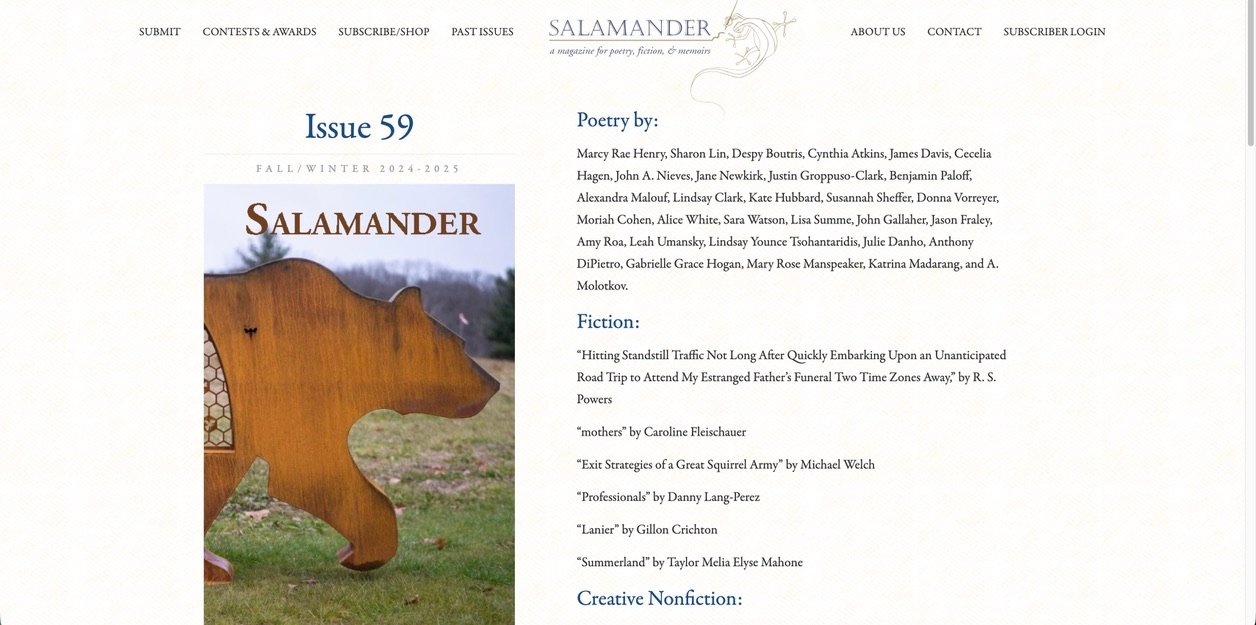
Salamander Magazine is a literary magazine that publishes poetry, fiction, and creative nonfiction. It has print issues and an online presence exhibiting contemporary literary work from emerging and established authors.
The magazine often features short fiction, lyric and narrative poems, and personal essays or memoir pieces that show craft, voice, and attention to language. Read recent issues to sense the tone and the types of poems and stories editors tend to select: Past Issues.
- Confident voice and clear line-level craft (poetry and prose).
- Original, precise images and sharp storytelling arcs (even in flash).
- For nonfiction: a strong point of view and honest, vivid detail.
- Work that benefits from careful editing — polished submissions are favoured.
Readers of Salamander are literary readers: they expect craft, revision, and an authorial voice. Editors look for pieces that will stand up in print and benefit from good copyediting.
Section 2 · How submissions work (core rules)
Submission manager, genre limits, simultaneous submissions
Salamander uses an online Submission Manager for all incoming work. Do not e-mail full submissions unless the site explicitly allows it for a special contest: follow the Submission Manager link to upload your files and track your entry. Links to the manager and help pages make it quick to start: Submission Manager.
A few practical, repeatedly-noted rules you’ll see on the official guidelines:
- Send only one submission at a time (or follow the one-submission-per-reading-period rule that applies to some genres).
- Poetry: usually up to five poems in a single submission (follow the page’s specifics).
- Fiction/nonfiction: generally one story or memoir per submission; flash categories often allow multiple short pieces.
- Simultaneous submissions: Salamander often permits simultaneous submissions — but if your piece is accepted elsewhere, you must withdraw it promptly via the submission manager or by email to the editors.
Section 3 · Preparing your work
Formatting, file types, and polishing before you submit
Editors are busy. The cleaner and easier your submission is to read, the better your chances. Below are practical formatting and drafting tips that seasoned submitters use.
- Read aloud — sentences that sound awkward will often read awkwardly to an editor.
- Cut to the specific image or scene — avoid long expository paragraphs at the top.
- Respect word/line limits for the chosen category (flash vs standard fiction).
- Proof for spelling, punctuation, consistent tense, and paragraph breaks.
- Use standard file types unless the form asks otherwise — typically .docx, .pdf, or plain text for prose; single .docx or .pdf preferred for multiple poems.
- Name files clearly: lastname_title_genre.docx (e.g. “Nguyen_the-lake-fiction.docx”).
- If submitting poems, include a title on each poem and a single file with the batch.
Extra step: create a one-page version of your submission that shows the first 300–400 words or first two poems. Editors sometimes preview the top of a piece — make sure it hooks.
Section 4 · Using the Submission Manager
Step-by-step: create an account, upload, track, and withdraw
Salamander uses a web-based Submission Manager (the same family of systems used by many literary journals). If you have submitted before, you likely already have an account; otherwise registration is quick. The manager allows you to track status and withdraw if accepted elsewhere. See the manager’s help page for login/reset instructions.
- Open the manager: Submission Manager.
- Create account/login: Use the email you prefer for submission replies. If you forget a password, use the reset link on the manager help page.
- Choose genre: Select Poetry, Fiction, Nonfiction, or Contests as appropriate.
- Upload & metadata: Title(s), author name, author bio (short), and the file(s).
- Pay fees if needed: Some contests require a reading fee; general submissions usually are free unless contest pages specify otherwise.
- Confirm & submit: Save your submission ID or confirmation message — you’ll need it for future correspondence.
- If accepted elsewhere: Withdraw immediately through the manager or email the editor address listed on the site.
Section 5 · Contests & prizes
How contests change the strategy and what to expect
Salamander runs contests from time to time (fiction contests, for example) with specific entry windows and fees. Contests are judged separately and sometimes include a reading or entry fee — consult the Contests page for the latest deadlines and rules.
- Read the full contest rules — word limits and anonymity requirements matter.
- Format for blind reading: remove bylines where the contest asks for anonymous submission.
- Don’t send multiple contest entries that violate the rule; buy separate entries if allowed.
- Keep a copy of your entry confirmation and payment receipt.
Section 6 · Pitch templates & cover notes
Short cover note templates you can reuse
Most submissions to Salamander do not require a long pitch; the manager will ask for a short bio and any notes. Still, a brief and professional cover note (1–3 lines) is useful for editors. Below are templates you can paste into the “cover letter” or “bio” fields.
For a single short story
Hello — Please consider my short story “Title” (approx. 2,400 words) for Salamander. I am [your short bio line — 1 sentence about publications or work]. Thank you for reading.
For a batch of poems
Hello — I’m submitting five poems titled [list titles] for consideration. I live in [city/country], and my recent work appears at [if relevant: journal name]. Thanks for your time.
For a personal essay or memoir
Hello — Please consider my essay “Title” (approx. 2,000 words). I have previously published at [optional publication names]. I appreciate your consideration.
Polite follow-up after 8–12 weeks
Hello — I’m checking on the status of my submission titled “Title” submitted on [date]. I look forward to hearing whether it remains under consideration. Thank you for your time.
Section 7 · How publication can earn you money
Direct and indirect income paths from literary publication
Many literary journals pay little or nothing for single poems and stories — but publication creates value. Here’s how to turn a “yes” into earnings:
- Contests & prizes: enter paid contests where winnings are real cash (check contests pages for prize amounts).
- Book & grant applications: an accepted story or poem strengthens CVs for grants, residencies, and book publishers.
- Paid readings and events: magazines sometimes invite contributors to paid readings, panels, or workshops.
- Freelance and client work: a byline in a respected magazine makes it easier to land paid commissions (essays, journalism, editing).
- Teaching & workshops: publication credits help you advertise paid workshops or craft classes.
Many journals allow authors to repost work after an exclusive period or request permission to reprint. Always check the specific agreement editors send with acceptance. Keep a record of rights and dates.
Section 8 · Final checklist & follow-ups
Pre-submit checklist and sample follow-up sequences
Use this checklist each time you send a submission to reduce mistakes and increase professionalism.